Spotlight On: Juan Tagle, Director, Palm Beach Capital
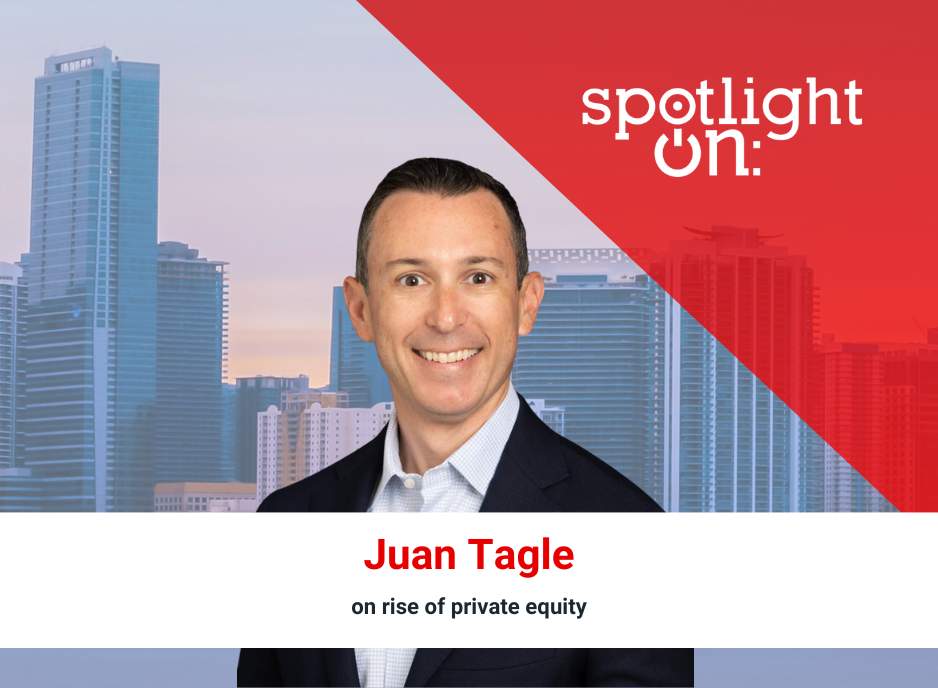 July 2025 — The Palm Beach market continues to build its reputation as the Wall Street of the South. What was once a nascent market has transformed into the place to be in the post-COVID era. In an interview with Invest:, Juan Tagle, Director of Palm Beach Capital, highlighted the growth of the private equity space and how it has evolved in recent times. “The bigger the industry grows, the greater the benefits for the county as a whole,” Tagle said.
What trends are shaping the private equity space in the Palm Beach market?
We have been around for more than 25 years and we have continued to grow the size of the firm and the assets under management. Much of this is driven by our historical track record of investments and keeping our investors happy. The growth of the firm has been as a result of our focus on investments in founder-led businesses, where we have deep industry expertise. We continue to see private equity build a presence in the county. We continue to see firms that have offices in New York City, Boston, and Chicago, for example, continue to expand their presence in the Palm Beach market. Some of this was accelerated during the COVID era and has continued to grow in the last few years. What seemed to be temporary because of COVID has become more permanent. With this growth, it is benefiting the community as a whole. Many of the firms have global investors that are flying into our airport to conduct business. As a feeder effect, they are staying in our hotels and eating in our restaurants. The bigger the industry grows, the greater the benefits for the county as a whole.
What sectors or industries are driving growth in the industry?
Our investment strategy mirrors the economy. We are predominantly service-oriented investors. When you think about Florida, it is really a services-oriented economy. There is very little manufacturing although it is getting better. It is just not an industrial type of environment. We do a lot around business services, more specifically in engineering services, such as civil, environmental, and geo-technical engineering. All of these areas are very active. We have done a lot in the transportation and logistics space. When you think about Palm Beach, there is also a port economy. Florida is a big distribution point to other parts of the world. We also focus on the healthcare sector. Florida has always been busy in the healthcare space. What you are seeing now is a rise in the growth of healthcare given the population growth and demographic trends. There are a lot of healthcare investments coming into our community.
What role does private equity play in supporting local businesses?
We are big advocates of supporting local businesses. Ultimately, we are partnering with and investing in small businesses to ensure our capital acts as a catalyst for growth. This could be investing in and growing the size of a company, or assisting with hiring, or helping businesses expand into new markets or new product lines. All of our capital helps facilitate this. We help businesses grow through acquisitions and expanding inorganically. All of this is core to what we do.
The other tangential benefit is that we are always here to be a business resource to business owners. We believe that even if we do not invest, we can have a conversation with a business owner and be a resource from an intellectual capital perspective.
What market challenges is the industry facing?
Tariffs have been a big headline this year. Tariffs have a ripple effect across businesses that have direct exposure as well as tipping the economy into a more recessionary environment. This impacts everyone, not just private equity. The ripple effect within private equity is that there could be the potential of a slowdown in fundraising cycles as a result of a slowdown in the exit activity within a portfolio. We are already seeing the M&A market slowdown somewhat. Banks are starting to pull back. I believe all of this creates an environment that is less than ideal for both the private equity space and the small business owner.
How has the definition of financial freedom evolved over the years?
The challenge within South Florida is that the cost of living and housing affordability continues to rise. The biggest challenge is understanding the requisite compensation for the job or career a person wants to have, what does that mean in terms of making a desired salary, and what does that allow me to do. Financial freedom means something different to everyone, but I think what is important is understanding the career path that someone wants to take, how they will pay for an education toward that career, and what their salary expectations are for that career path.
In what other ways has the private equity space changed?
Private equity as an asset class has continued to grow near historic levels year after year. Part of the reason is that the asset class has continued to perform well. Investors have been rewarded for being in the asset class when you compare it to other asset classes. There is this dynamic that the sector continues to grow and support other aspects of the private markets industry. Now, private credit has become a large asset class adjacent to private equity. There are other flavors of private markets, whether that is venture or growth, that continue to mature in the country and in South Florida. There is still a lot of what we call “dry powder,” meaning that funds have been committed and have to be deployed to continue to execute on their strategy. Barring any dramatic hits, I believe the asset class will continue to perform well.
How do you see the private equity space evolving in the near term?
When you consider the significant commercial and residential real estate development going on in West Palm, there is this long-term view that the market will mirror Palo Alto-Silicon Valley, where there is a large presence from the financial community across every asset class and it becomes a top-notch think tank and hub for financial services broadly. I believe we have the right footprint to make this happen. We are starting to see a bigger attraction from the higher education space. There are talks of Vanderbilt coming to the market. I believe in five to ten years, we will see more financial services firms in our market with a bigger presence, and the ripple effects of this will influence nonprofits, employment rates, and wages, for example.
For more information, please visit: