
Why companies and talent are choosing Atlanta — and the Beltline
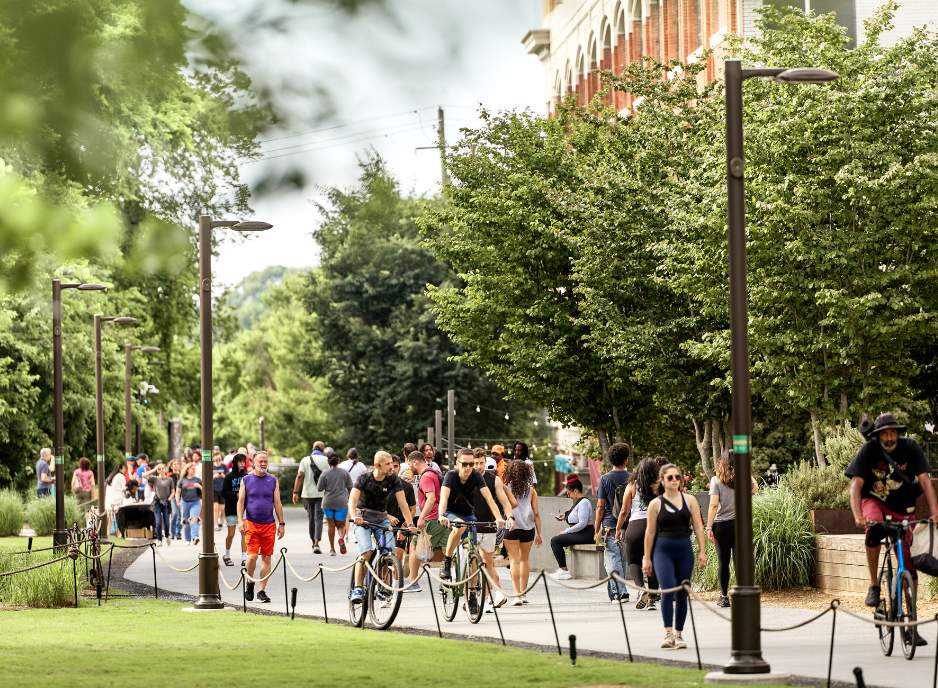
July 2025 — As global firms seek out office space for top workers, Atlanta is staying competitive with its expanding urban trail. The Atlanta Beltline has helped attract talent, real estate investment, and major employers, creating a corridor where lifestyle and commerce merge.
“If you’re a company like BlackRock and you need to hire a thousand people, put an office on the Beltline somewhere. It’s going to be a lot easier to attract the type of workforce you’re looking for because you have a location where people want to be,” said Clyde Higgs, president and CEO of Atlanta Beltline, to Focus:.
Last week, electric vehicle maker Rivian announced its new East Coast headquarters will open along the Beltline’s Eastside Trail, bringing up to 500 workers to the space once completed. According to the organization, around 6,000 businesses are located within a half mile of Atlanta’s major urban trail network.
In June, the team behind the urban redevelopment program approved a nearly $242 million budget for FY2026. The plan prioritizes trail completion, affordable housing, and transit access, with close to $99 million allocated to mainline trail construction and around $40 million to support housing and commercial space development. The goal is to deliver 18 miles of continuous paved trail by early 2026 and remain on track for full completion of the 22-mile loop by 2023.
This milestone reflects the momentum behind a long-term strategy to build an inclusive and connected city. A key piece of that strategy is the Special Service District (SSD) established in 2021. Through a modest tax on commercial and multifamily property owners within the Beltline Planning area, the SSD has generated $100 million. Alongside support from the Woodruff Foundation, Cox Enterprises, and other philanthropic partners, total funding for the Beltline has reached roughly $400 million over the past four years.

“We’ve started to see the real output from that financing,” said Higgs. “Today, we have over 10 construction projects actively underway. It’s something that, having been with the Beltline for nearly a decade, I would have once considered unimaginable.”
Spotlight On: Clyde Higgs, President & CEO, Atlanta Beltline
The impact extends beyond physical infrastructure. The Beltline has helped drive a new vision for where people want to live, how they want to commute, and what they expect from their neighborhoods and workspaces. In 2024, the Beltline saw more than 2.4 million visits.
“From a real estate investment perspective, the Beltline is one of the most important places in the city of Atlanta right now,” Higgs said.
Atlanta’s office market is still in recovery, with Colliers reporting an overall vacancy rate of 24.2% in 1Q25. However, demand is growing for locations that offer more than just square footage as tenants prioritize walkability, transit access, and amenities that support a balanced and flexible lifestyle.
The appeal of the city is no accident. In an interview with Focus:, Kristi Brigman, chief economic development officer of the Metro Atlanta Chamber, emphasized the region’s strength in talent development, quality of life, and economic diversity. “One of my favorite things about a company that is already here is knowing they could go anywhere else in the world — it’s a strong endorsement from them to continue that growth in Greater Atlanta,” Brigman said. “It is a compelling story when you think about a company that might have to relocate employees. They want to ensure they are asking their employees to relocate to a place where they’ll be happy and feel comfortable bringing their families.”
Images via Erin Sintos/Beltline
For more information, please visit: