Regional Review: Can Boston’s tech sector capitalize on major changes?
 Regional Review is a year-end series from caa that looks at key developments in a focused industry throughout the year and sets the stage for what’s to come in the near term.
December 2025 — Tech was the key player for the Massachusetts economy in 2025, despite a turbulent start to the year, followed by mass layoffs across the sector. Now America’s oldest city intends to capitalize on tech and innovation for future growth.
Join us at caa’s upcoming leadership summits! These premier events bring together hundreds of public and private sector leaders to discuss the challenges and opportunities for businesses and investors. Find the next summit in a city near you!
“Over the next four years, we will continue…to make our city a hub for every thinker whose business is making our world a better place for all,” said Mayor Michelle Wu following her re-election in November.
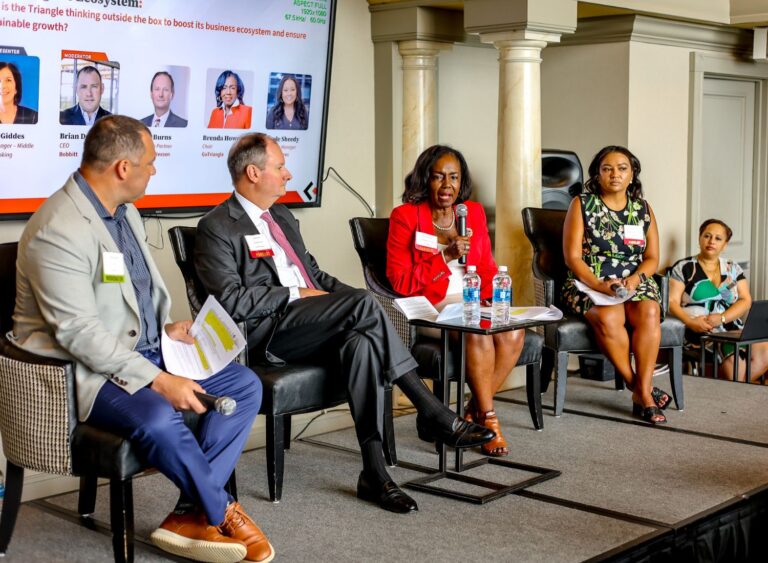
Yet, Massachusetts’ tech industry remains at the crossroads of talent, technology, and purpose, according to industry leaders who spoke at Boston Globe’s Tech Innovation Summit in June 2025.
“The first half of the year reflected genuine uncertainty about whether the fundamentals of our industry were still intact,” according to Kendalle O’Connell, CEO and president of MassBio, a leading network of innovative Massachusetts-based companies and life sciences industry leaders, as cited in a press release.
Boston’s tech sector faced consistent employment challenges and dips in funding, signaling trouble for the road ahead. According to the Boston Business Journal, in 2024, Massachusetts lost over 8,200 tech jobs — the second-largest decline in tech jobs among all U.S. states, which contributed to a weak start to the year.
Meanwhile, in the first half of 2025, venture capital investment in Boston-based tech companies fell 17% compared to the same period in 2024, representing a new low since 2017, according to Stat10.
However, 2025 was a turning point for the industry. M&A activity surged in the last quarter, while interest rates stabilized. According to finviz, U.S. biotech stocks rallied to new 52-week high after years of sluggish growth.
O’Connell noted that the preconditions for recovery are now in place for the year ahead, despite major pain points for the industry still at play.
“The critical question for 2026 is whether improving late-stage sentiment translates into renewed and sustained early-stage activity, including hiring, more venture capital rounds, and increased seed investments,” added O’Connell.
Tech talent
It was a mixed year for tech workers and graduates in 2025, especially in the face of talent shortages, layoffs, and higher education challenges — including multiple college shutdowns, the looming enrollment cliff, and the Trump administration’s new immigration policies barring international students from the United States.
Still, Massachusetts remained one of the strongest tech labor markets, with a total of 270,000 jobs in the sector, according to Nasdaq. The state also led the nation in AI job demand for specific sectors, according to a report by the Massachusetts High Technology Council and BCG.
Despite strong fundamentals, this year was not without its fair share of employment challenges, keeping in line with the previous year. The United States as a whole faced tech talent shortages, which trickled down to Boston. Between February and September 2025, job postings in Boston’s Professional, Scientific, and Technical Services industry dropped 4% to 28,446, per the city’s official report. According to Hiring Lab, Boston’s tech job openings saw an even bigger gap (as of early 2025) — reflecting a 51% dip compared to pre-pandemic levels. Additionally, Massachusetts retained less than half of its AI-trained graduates, well below the levels of most peer states, as per the Massachusetts High Technology Council.
Yet, there are growing signs of optimism for the tech workforce in 2026, underscored by the strong demand for specialized roles related to AI, data science, cybersecurity, and cloud computing, which are among Boston’s core strengths.
Capital needs
Boston’s startup landscape remained dynamic, despite limited access to capital and distribution. While Boston faced a notable scarcity of capital for its growth-stage ventures, according to Startup Boston, seed-stage investments have remained robust this year, particularly in high-tech areas like AI and automation, which experienced vibrant deal activity.
According to Masslive, some Mass-based companies that raised significant investment this year include fusion reactor startup Commonwealth Fusion Systems ($863 million), obesity drug developer Kailera Therapeutics ($600 million), and the AI-driven science lab Lila Sciences ($550 million). Additionally, AI music creation startup Suno raised $250 million, according to TechCrunch.
Still, valuations remain below 2021 levels, which were inflated post-Covid. Investors are now increasingly prioritizing stronger fundamentals — including sustainable profit margins, achievable growth rates, and clear visibility into cash flows — which is expected to lead to a more cautious and measured approach to funding rounds in 2026, particularly for Series B and C rounds.
At the same time, money raised by venture capital firms this year fell well below market expectations as a result of macroeconomic headwinds. According to MassLive, Boston’s VC companies are expected to raise just $2.6 billion by the end of 2025, which would be the lowest level seen in a decade.
A weak venture capital market bodes poorly for local investment, making it more difficult to retain local talent and grow industries, according to Startup Boston. This would hamper Mayor Wu’s growth ambitions in tech and profoundly set back the sector.
However, with economic pressures such as interest rates and tariffs easing in the fourth quarter, the financing landscape is shifting to cautious optimism, which could offer new opportunities for funding and help retain talent in the region.
Tech exodus
Beyond the challenges of hiring, venture capital, and investment, Boston’s tech sector is at risk of a major exodus. According to Lily Lyman, a general partner at the Mass-based Underscore VC, Boston is struggling to hold onto its talented tech graduates and entrepreneurs, given the level of investment being poured into bigger tech markets like San Francisco.
“I think you can feel it, just the pace of change, the volume of talent, and density of talent, the amount of capital getting thrown around (in the Bay Area),” said Lyman as cited by MassLive. “It’s definitely having a center-of-gravity moment that’s very palpable.”
Massachusetts just recently lost one of its major tech manufacturers, SencorpWhite, to Ohio. According to Local 12 news, the manufacturing firm announced plans to relocate its Cape Cod headquarters to a new facility in the Cincinnati region.
SencorpWhite officials said they considered several different states for its new facility, including Kansas, Florida, and Massachusetts. However, ultimately, the choice came down to the incentives offered by JobsOhio, REDI Cincinnati, and the city of Hamilton.
Without major public incentives, renewed appetite for funding and investment, and focus on talent retention, Beantown risks losing its foothold as a major tech and innovation hub. But recovery is possible in the road ahead to 2026, according to O’Connell, especially if Boston leans on its strong tech fundamentals and continues to support hiring, funding, and investment in the sector.
Want more? Read the Invest: Boston report.
Subscribe to Our Newsletters