Spotlight On: Kyle Clayton, Chief Strategy Officer, Nashville Predators
Key points:
- The Nashville Predators are investing $700 million to modernize 30-year-old Bridgestone Arena, positioning it to remain a premier venue and catalyst for downtown Nashville’s growth for decades to come.
- Rather than relocating or building elsewhere, the organization is committed to its prime Broadway location, calling it an irreplaceable “corner of Main and Main” in the heart of downtown.
- The transformation combines a full arena renovation, new street-level retail and restaurant space that opens the building to Broadway, and a potential hotel development, creating three projects in one.
 March 2026 — Invest: spoke with Kyle Clayton, chief strategy officer of the Nashville Predators, about the vision behind the $700 million transformation of Bridgestone Arena and its role in downtown Nashville. Clayton reflected on the arena’s origins as a revitalizing development and why the organization is committed to remaining in its prime Broadway location. “You could not pick a better location for a downtown sports venue than where we are,” said Clayton.
How would you describe the overall vision for this upcoming arena renovation, and what it means for Bridgestone Arena’s future?
First, you kind of flash back to the original construction of the building. If you go back in time to the mid-90s, downtown Nashville was not what it is today. It was not a place you’d come for entertainment.
Thinking back to Mayor Bredesen’s vision at the time of building a catalyst to spark investment in downtown – that’s what the arena was. It was probably not the greatest plan, but it worked, and it worked tenfold. The building opened in 1996, the team came in 1998 and look at what Broadway has become. We have always thought of ourselves as the catalyst for Broadway’s expansion and development.
Now you flash forward 30 years later, and you can’t pick a better spot for an arena in Nashville.
Join us at Invest: Nashville’s upcoming leadership summit! This premier event bring together hundreds of public and private sector leaders to discuss the challenges and opportunities for businesses and investors. Buy your ticket now!
As we look at the future of our organization, we asked: What do we need to do? Where do we need to be? We just need to renovate this building. You could give us whatever amount of money, you could give us a new building and all that, but if it’s not in this location, we’re going to pass on it. We’ve decided this is what we want to do and this is where we want to be.
About 10 years ago, we really started thinking about the future of the venue — what we can do to renovate and be here for another 30 years, and to continue to be that catalyst for downtown. The original investment helped spark downtown, and now that activity is helping fund us, with everyone coming to our events and the arena serving as a destination. Tourism tied to those events has gone through the roof. Now it’s our turn again to reinvest in the building.
Explore more from our Nashville coverage:
Invest: Nashville leadership summit spotlights real estate, regional partnerships
Regional Review: How Nashville’s new infrastructure is powering global investment
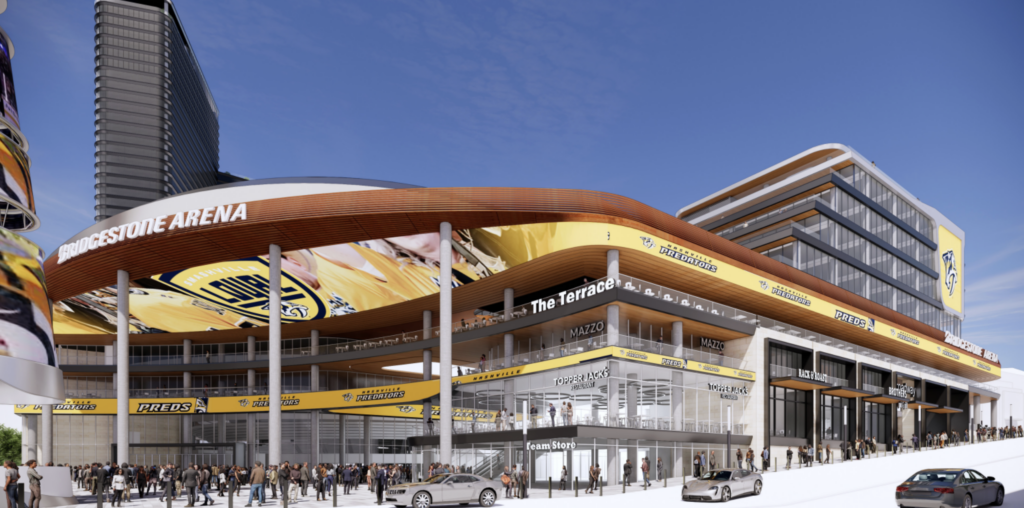
The arena as originally built was all concrete walls and barriers — it feels like a fortress. It’s a very introverted-style building, and we want to flip that by adding glass and more open opportunities. When it was built, it was all concrete walls. There was a police station and a register of deeds office — things that make you think, “Wow, that’s on Broadway?”
Now we’re going to tear down those walls and create four stories of retail and restaurant opportunities, mirroring the Fifth + Broadway development across the street, which has been so successful. You can tell downtown is benefitting from a lot of traffic going over there, so we’ll bring that to our side of the street as well.
It’s also an arena project. This building is 30 years old. At the end of the day, what are new buildings doing? What are renovated buildings doing? You’re looking at premium spaces, partnership activation spaces, seating capacity, and the press box. There are things we weren’t designed for in the 1990s, but now, being one of the busiest concert venues in the U.S. and having a successful hockey team, we have to ask what we’re missing and how we continue to evolve as a building.
The third piece is potentially a hotel. We put out a vision of building a hotel on the corner of Demonbreun and Fifth Avenue. At first it was, “If we could do it, that would be great.” Now, as we get into it, there seems to be strong demand in the market, which is exciting, especially considering how many hotels have been built in the last five to 10 years. That project is gaining more momentum as we move forward.
So, it’s really an arena project first — a 30-year-old building where we want to take care of our fans, partners, performers, players and staff, and make it the best, most up-to-date modern building we can, given our incredible location. Then there’s the Broadway redevelopment, and potentially a hotel on the backside. It’s really three projects rolled into one.
How do you see sports venues driving traffic, and how has that played out in Nashville?
A lot of teams are looking at a real estate play. They’ll build where they can develop around it. The Battery in Atlanta is a great example — they moved outside the downtown core and developed parcels around it. Even Nissan Stadium here in town is building a new facility on the East Bank and will develop around it.
Here, the development already exists. The folks are already there, and there’s a ton of traffic. It’s a great balance — we drive a lot of traffic, but we also get to take advantage of that traffic. We call ourselves the corner of Main and Main. You could not pick a better location for a downtown sports venue than where we are.
What do you think fans will notice first when they experience the newly renovated arena?
We’re going to take a phased approach. That’s been our mantra for years. We’ve invested roughly $10 million a year on average for the last seven to eight years. We pride ourselves on almost always being in some form of renovation. Every season, when a fan comes into the building for the first time, we want them to notice something different and have a new experience, without negatively impacting their visit. We try to do most of that work in the summer, though sometimes it spills into pre- and post-season.
With this larger transformation, we’ll be balancing a lot, especially with construction along Broadway and on the backside of the building. Our goal is to have minimal impact on the fan journey. We want frictionless entrance, easy access to seats, concessions and the team store, and no negative impact on that experience.
Inside the bowl, we already have one of the best game presentation experiences in the NHL. Our team does an incredible job. As we renovate the exterior, we’re also investing inside — projection systems, lighting systems and other enhancements to elevate the game experience.
Fans will certainly notice the construction, but hopefully they’ll also see the journey toward where we are headed. When fans are in their seats enjoying the game, they’ll continue to have the great fan experience they’ve always had here in Smashville, and hopefully the players on the ice can feed off that as well.
What do you see as the potential for Nashville as a sports town?
The last several years have been an incredible ride for sports in Nashville. Ten years ago, First Horizon Park was built for the Sounds. GEODIS Park opened not long after for Nashville SC. And now, Nissan Stadium is being replaced with a new, state-of-the-art $2 billion football stadium with development around it, and Bridgestone Arena is undergoing a $700 million transformation in the downtown core.
From a sports perspective, the growth in just a decade is incredible. We are collectively transforming the sports landscape in this town. At the same time, you have hotels, development, bars and restaurants expanding across Broadway, SoBro, the Gulch, East Nashville and West End. There’s so much going on.
I’m originally from Middle Tennessee, just south of Nashville, so I’ve been here the whole time and seen it firsthand. I’ve been with the Predators for almost 18 years. Living through all of this has been awesome. There are so many people moving here from California, New York and elsewhere, bringing new energy, ideas and investment.
Nashville is in an incredible position right here, right now in 2026. It’s growing at an amazing rate, and to be in the middle of it as part of the community’s premier sports team is so much fun. After almost 18 years, I’ve never been more excited to come to work. It’s a great time to be downtown and part of this organization.