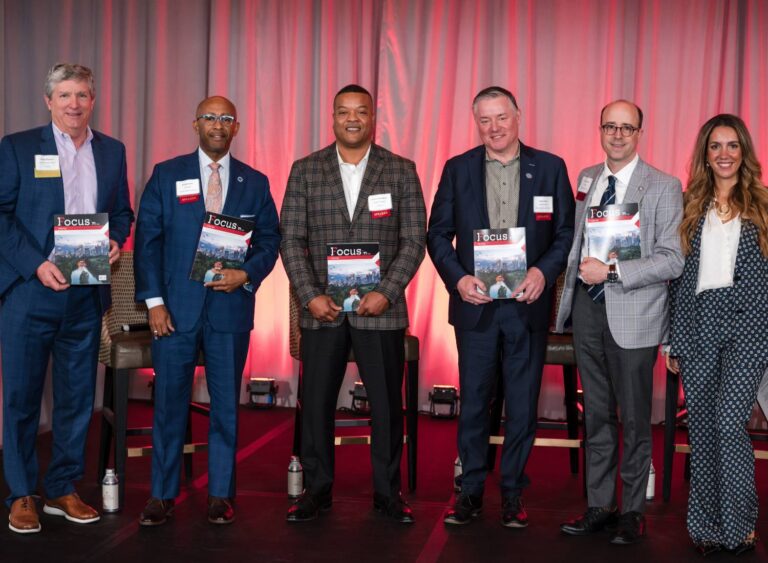







Andrew Kassner, Chair Emeritus, Faegre Drinker Biddle & Reath LLP
 Five years after a successful merger, the continued focus on a diverse offering of business, litigation, and regulatory practice areas and superior client service resulted in a successful year for Faegre Drinker Biddle & Reath LLP, according to Chairman Emeritus Andrew Kassner. “Last year, we passed the $1 billion mark in revenue for the first time. We had a very successful year,” Kassner told Invest.
What were some of the firm’s most impactful achievements in the last year?
Our firm is now five years from one of the five largest domestic law firm combinations in the United States, a merger of two similarly sized law firms. I’m pleased to report that we are now truly one firm in all respects. No one is referring to legacy firm this or legacy firm that. We are now Faegre Drinker Biddle & Reath LLP. It’s been a very exciting time, and the firm is thriving.
In 2024, we had a successful year and passed the $1 billion mark in revenue for the first time. More importantly, we remain focused as a firm on supporting our clients by maintaining a balanced focus on 50% litigation and 50% business and regulatory practices across our 20-plus offices.
We implemented a five-year strategic plan at the time of the launch of the new firm in 2020 and executed that plan over the past five years. In 2023, we engaged in a successful leadership succession to the next generation. Over the past year, the new leadership team spearheaded and completed a new strategic plan for the firm. Having a sound strategy is always important, but strategic planning today is more important than ever as firms address massive changes confronting our clients and the legal sector both globally and domestically.
Faegre has been named a “Most Recommended Law Firm.” How are clients feeling about the firm and what do such recognitions mean?
Overall, we are very pleased that we are viewed by our clients as a leading firm and trusted adviser for companies that require interdisciplinary legal advice across the country and beyond. That is very important for us. Having a strong culture based on a set of values emphasizing trust, integrity, excellence, and teamwork was critical as we went through the pandemic and a lot of interesting times over the past several years. That culture is serving us very well. Our clients see that culture and those values in everything we do. We don’t want to just be a hotel for lawyers, where lawyers just come and go and don’t feel connected.
You’re only as good as your team. Our lawyers are being recognized for quality, service, and collaborative teamwork by our clients, the bar, and other attorneys. For example, Philadelphia is a significant litigation destination in the United States. A lot of complex litigation in the areas of mass tort and class actions are venued in Philadelphia. It has a very sophisticated trial bar, with top litigators. When judges see our lawyers appear before them in their courts, they know that they’re seeing lawyers who are prepared, really at the top of their game, and work as a team. That’s very important to us, our clients, and to our reputation.
In the end, when our lawyers get awards and recognitions, it’s really a recognition of the entire supporting team. Our lawyers celebrate these acknowledgments as a team.
What major trends do you see across the legal industry?
The movement continues toward clients looking for their law firms to be able to address and fulfill clients’ business objectives with a coordinated cross-disciplinary array of legal services in an increasingly complex legal environment. For example, they appreciate that they can go to one firm that can handle sophisticated business transactions and at the same time also address tariff, sanction, and international trade issues, as well as executive compensation and regulatory matters.
Consequently, the trend of consolidation continues across the legal industry, and the challenge is to grow but not just for scale itself. Another trend is talent is more mobile, so talent retention, management, and recruitment on a bigger scale is another trend. People who are interested in joining a firm like the fact that we have many different areas that can support our clients. It helps attract and retain talent.
Another trend is managing talent in an age of generational diversity. We have four generations of people in our law firm. They all communicate differently. My generation was not the social media generation. The Gen Z generation is all social media. They communicate in text. Baby boomers communicated by picking up the phone. Gen X did it by email. Everyone has a different, preferred way of communicating. How do you do that now in a collaborative way that maximizes our expertise for clients? Our clients are facing the same issue.
Finally, a fourth issue is managing the incredible socio-geopolitical disruption that is going on, not only in the United States, but around the globe. How do you manage that as an institution? This is all the more challenging, and more complex, because law firms today are being asked to take public positions as firms on socio-political issues, both internally and externally. In the past, law firms were not pressured to take positions on so many issues publicly. We were just here to serve our clients. If individual lawyers wanted to take positions, that was fine. But most law firms didn’t. Now, law firms are being asked to take sides, and it’s a real leadership challenge.
How do you think AI is going to change the legal sector?
It’s a main focus now for clients and their firms, and it’s very exciting. Some people are frightened by it because it’s an unknown, but it’s coming, and everyone agrees it will change the way lawyers practice law and serve clients. It’s going to change how our clients operate, so it will affect us as well.
A lot of law firms are saying that they are creating their own AI. Well, let’s be honest with ourselves here. There are tech companies out there investing hundreds of millions of dollars in developing AI products. Law firms don’t invest hundreds of millions of dollars in technology. We need to invest in recruiting, training, and retaining our talent. We spend on technology, but in the end, the real advances in AI are going to be provided to us in the form of products developed by the tech sector. That’s their business. Our challenge will be adapting those emerging technologies to our practices. That’s where our investment is going to have to be. Training and adapting the technology in a way that interfaces with our clients appropriately.
For example, our firm has its own internal chat platform, Atlas AI, powered by GenAI40. It functions similarly to ChatGPT but within Faegre Drinker’s secure cloud environment. To support the platform, our office of general counsel provides ethics sessions and an online learning platform, SkillBurst, teaches us all how to effectively prompt and work with GenAI. Another example is at the request and consent of specific clients, we are including a GenAI – assisted patent drafting platform, a content redlining platform, and a due diligence platform, among other technologies.
What is your outlook for Philadelphia?
I am very pro-Philly and I believe it’s a very optimistic and opportunistic time for Philadelphia as a city. We have a mayor who has hit the ground running with the right programs, including having a safe and clean city, and a city that is thinking about development and talent. I believe the current administration has had a very positive impact on the city.
In terms of housing and cost of living generally, Philadelphia is favorable compared to the other big Northeast cities of Washington, Boston, and New York. I believe there are reports that many people, especially young adults from higher cost cities like New York, are relocating to Philly. For example, there has been a good amount of development along the Delaware and Schuylkill rivers, and in neighborhoods like Fishtown.
Today, people are hearing good things about the city, and that creates some buzz and momentum. Philadelphia has a lot of positives in terms of its reputation for its education and medical sectors as well as its cultural arts and restaurants. Like any other city, it has its challenges, but it’s well-positioned to thrive going forward if it can deal with those challenges and have a city government that partners with its communities and businesses.