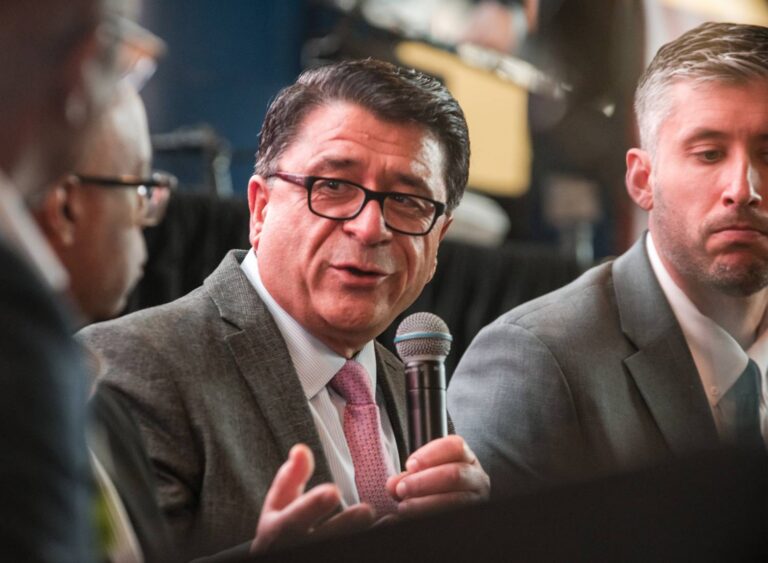







Bartow Morgan, CEO, Georgia Banking Company
 In an interview with Focus:, Bartow Morgan, CEO of Georgia Banking Company, discussed the institution’s offering for businesses in Atlanta during this uncertain time, emphasizing personalized attention and advanced technological solutions for clients. “We’re making sure that we offer the products they need,” Morgan said.
What indicators are shaping your expectations for the banking sector in the near term?
“Tariff” is the big word out there. It seems to have become a negotiating tool that everybody’s talking about, and it creates uncertainties in relation to people’s future. Whether as a homeowner deciding to redo a house, a multifamily developer building a project, or a manufacturer in need of raw materials, nobody knows what the cost will be, or when it will be that cost. This slows down the decision-making process, and we’re seeing some customers being more methodical. When we see purchasing slowing down, we start to see the chances of recession, or at least the declining of GDP. And with recessionary concerns, the Federal Reserve will start considering if we are in a downward interest rate environment. That said, some businesses do better in a lower interest rate environment.
What strategies does your organization have to help small and midsize clients navigate uncertainties?
First of all, continue to do business. This isn’t the time to stop transacting. It is time to act more cautiously. If you were thinking about big purchases or expansion, you might want to rethink that. It would be wise to pause and figure out what the outcome would be. More than likely, interest rates will come down over the coming months. If you believe in this macroeconomic view, you can fare better by shaping your business accordingly. A client, whose major competitors were Chinese companies, actually received a lot of orders because the tariffs were not applicable to their company. So, not all the effects were negative, and we need to prepare companies for what the world might look like in the future.
What role do regional and community banks play in addressing national concerns, such as financial inclusion?
There has been mass consolidation in the banking industry, with three players controlling 65% of the industry. Therein lies the opportunity. Big banks are stable, and it could be a good thing for a business to go with the big banks because they may have the services some businesses need — and businesses need to find the institution that fits them. We are $2.5 billion in size, which is on the larger side of the community bank scale. But as a community bank, we can do things that larger banks can’t. We can offer a level of customer service that they might not have, and with less of the bureaucratic processes. Banks that are smaller than us may not be able to invest in the technology and people that the bigger banks can. We are in this space intentionally, so we can offer a high-touch service to our customers, who are typically small businesses in the real estate or manufacturing business. We’re making sure that we offer the products they need, including the more sophisticated treasury products.
How do you leverage digital tools in enhancing relationship-based banking?
I don’t believe we can fight technology. If technology has figured out the solution, the solution is simply better. And most people are going to choose that solution. So, we work with technology. We start with the customer, figuring out what the customer needs, and make sure we have qualified people who understand both the technology and the customer. Then, we can deliver the products with the technology, and deliver the services with higher-touch than some of the larger banks are able to offer. We’re balancing that every day.
Where do you see the biggest opportunities for growth among industries across the state?
We’re seeing a migration around the country now, from the Northeast to the Southeast. With Atlanta being one of the biggest cities in the region, developers were seeing a lot of real estate transactions here in the past cycle, causing an oversupply of single-family residential housing. In the current cycle, there is an undersupply. Multifamily development has been tough because of the rising cost. But with the increase in housing demand, we’re seeing a lot of mortgages, even with the rates ticking up. Warehouse business also increased dramatically in the first quarter, and it will continue throughout the year.
In the technology sector, multiple companies need data centers within the Southeast. Industrial locations, which would have been for distribution and storage, have now turned into data centers, which provide the technology for back office operations. And the power companies are trying to figure out how to deal with this drastic increase in power usage. The commercial and industrial world is highly competitive, and everybody wants these customers.
What is the key differentiator that sets Georgia Banking Company apart from its competitors?
Seven years ago in Atlanta, there would have been five banks the size of Georgia Banking Company. Today, there’s just one. Those banks were rolled up into regional banks, and there isn’t another large community bank sitting in Atlanta doing what we’re doing right now. Most of the banks here are either much smaller than we are, or much larger. So, we’re being very deliberate in offering small businesses a better solution: a high-touch, advanced technological solution catering to the Atlanta market.
How does the company support economic development across Georgia while being involved with community engagement?
We try to gamify everything. From kindergartners to adults, people like to play games. And we make sure that it doesn’t only involve the production of deposits or loans. It has a community responsibility component, where being the top donor of time in the community gets rewarded equally with being top in sales production. Some people who might not have a sales-focused job inside the institution would then see the impact of their participation on our service and sales trips. It’s all about the employees participating in the community. I don’t dictate how. All I want is to have a group of employees who care about the community, participate how they want to, and then be recognized for the contributions that reflect their values. We are a reflection of our community, and our employees need to participate in ways that they feel best serves this community.
How might the recent regulatory environment impact the banking industry?
We’re in a transitional but positive regulatory environment, and our two main regulators have been good partners to us. In the last four years, throughout the process of buying, recapitalizing and raising debt on a bank, we have had healthy discussions with them. We were able to complete the merger and acquisition, all while growing organically. I believe we are focusing on the same goals.
What are your top priorities over the next few years?
We want to keep our organic growth rates up, with the team in place to support raising deposits. Being an acquisitive organization, we have raised the capital to complete our recent transaction, and hope to find another partner wanting to be a part of our story. That said, as a growing community bank, we need to raise capital, whether through investors or debt, so we need to watch all the growth opportunities.