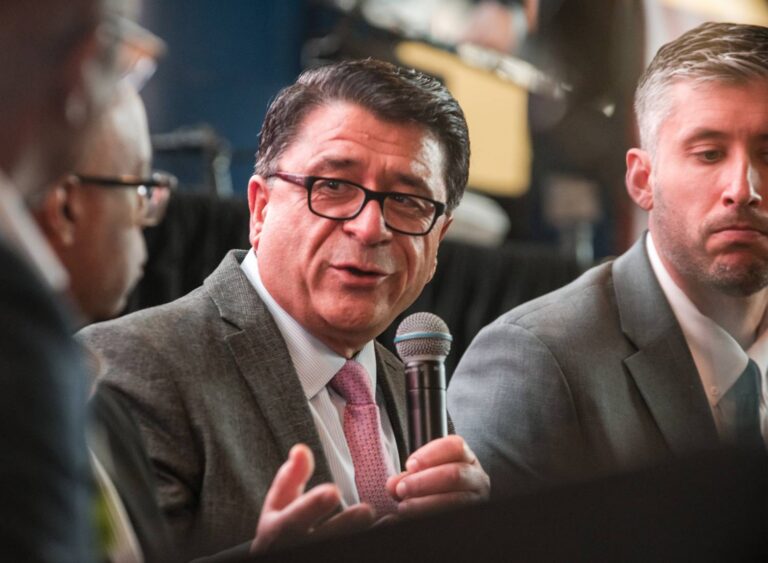






Brandon Hembree, Mayor, City of Sugar Hill
 In an interview with Focus:, Brandon Hembree, Sugar Hill mayor, discussed how the city is balancing suburban charm with urban amenities. Hembree highlighted investments in parks, walkability, and performing arts to enhance livability while addressing challenges like affordable housing and commercial development. “All of this is about making Sugar Hill a place where people want to live, work, and raise their families for years to come,” Hembree said.
What changes over the past year have most impacted Sugar Hill and in what ways?
It has been a good year, so far, for Sugar Hill. We were just named the 15th fastest-growing city in the United States. I attribute that to the fact that we have a community where people want to live, as well as the investments we have made in our community. We have extended the Sugar Hill Greenway to a total of seven miles, connecting more neighborhoods and giving families new ways to walk, bike, and enjoy the outdoors. We have also added two new parks, Gold Mine Park and Ridge Lake Park. Seeing kids and parents fishing at Ridge Lake has been so rewarding. On top of that, we have also updated our zoning policies to make sure development happens the right way, keeping that balance between growth and the small-town feel people love. And we are not stopping there as we also plan on using new tools, like AI for road assessments, to keep improving the city in smart ways. All of this is about making Sugar Hill a place where people want to live, work, and raise their families for years to come.
Over the past year, what have been the most significant developments in Sugar Hill and how do they reflect the region’s evolving landscape?
We are a community that offers a mixture of both suburban and urban attributes, and that attracts people. We are served by an excellent school system, with two school clusters, the North Gwinnett cluster and the Lanier cluster, which are among the very best in the Gwinnett County public school system. That is a significant draw for young families looking to relocate. Additionally, our geographic location is advantageous within metro Atlanta. We are not too far from downtown Atlanta, yet we are close enough to job opportunities in the region. We have also invested heavily in outdoor amenities, with plans for more. These features make our community very attractive to families.
We are also making efforts to be less car-dependent. The United States has spent 75 years building car-dependent communities, and shifting away from that takes time. We are doing our best to improve walkability, though we still have progress to make.
How do you envision expanding the use of AI and similar technologies in other city departments or infrastructure projects?
Many cities in Georgia are discussing AI and its applications, but there are also concerns about its long-term effects on jobs and other areas. We continue to use our pavement assessment tool, which involves attaching a camera to city vehicles. As employees drive through the community, the camera captures pavement conditions, allowing us to rank roads based on their needs and allocate repaving budgets more effectively.
We also use Placer AI, a tool adopted from Tybee Island. It helps estimate crowd sizes during events like our fall festival or Fourth of July fireworks, aiding in traffic and public safety planning. It has been particularly useful in our downtown area, where we can demonstrate foot traffic to prospective businesses.
What role has the Suite Spot business incubator played in fostering entrepreneurship in Sugar Hill?
We are a city of mostly small, home-based businesses. That is because we do not have enough office space in our community. That is a future initiative we are working on. We need more office space so that we can grow and keep businesses here in Sugar Hill.
We have a great example of a local veterinarian who started in the Suite Spot. They recently purchased their own building and property, expanding into their own location. We are really excited about that. It is an example of what we are trying to accomplish. We are still growing from a commercial standpoint. I do not know the exact percentage of residential versus commercial in our community, but it has improved significantly over the last several years.
What kinds of community education or public-private partnerships could help shift perceptions and open pathways for inclusive housing solutions in Sugar Hill?
We have not made a lot of progress as a community, unfortunately. I think that is the case with most communities in metro Atlanta. Gwinnett County, where we are located, has initiated a program providing grants for affordable housing initiatives. We are the recipient of one of the grants.
Like every other city, we recognize that housing affordability is a top issue that needs to be addressed. It is just a difficult issue to tackle for a variety of reasons. For example, there is still political concern from certain groups about what affordable housing means. It has been a real challenge to overcome that stigma within the community, but it is something we are working through. Furthermore, the real estate market is quite unpredictable right now as there has been a shift from a buyer’s market to a seller’s market, so timing is very important.
As Sugar Hill evolves its entertainment districts, how are you positioning the city to stand out in the region’s cultural economy?
Sugar Hill has a unique identity compared to other cities. We work diligently to differentiate ourselves. Our neighboring city, Suwanee, has a great reputation for visual arts. If you visit their downtown and parks, you will see sculptures and community-focused art installations.
In Sugar Hill, we have chosen to emphasize performing arts. We have two great venues in our downtown area: an outdoor concert venue called The Bowl and a performing arts theater called the Eagle Theater. We program both venues in different ways. We host a summer concert series at The Bowl and a year-round concert series at the Eagle Theater.
We also partner with local schools, providing them access to the venues. We collaborate with a local players guild, a big band called the Broad Street Concert Band, and a children’s theater group called On the Stage Children’s Theater. We are working hard to create that identity for our community.
One statistic that stands out for us relates to our local middle school, Lanier Middle School, which has a growing reputation for performing arts. Over 80% of the students there are involved in one or more fine arts programs offered by the city. We are working together as a team to build that identity for Sugar Hill.
Over the next two to three years, what are your key goals for Sugar Hill and how do these align with regional economic priorities?
For me, it is all about community engagement. We have grown a lot as a city, and now it is time to bring all the different parts of the community together. That will be my focus over my next term as mayor.
We are working diligently to expand our commercial office space because we recognize that is a critical need for our local businesses. We want to keep businesses here in Sugar Hill and attract new ones, which aligns with Gwinnett County’s broader economic priorities.
Affordable housing remains a top issue we are addressing through partnerships with the county and grant opportunities. We understand this is a regional challenge that requires regional solutions. And as already mentioned, we are also continuing to build our identity in the performing arts through venues like The Bowl and the Eagle Theater as this not only enhances quality of life but also supports metro Atlanta’s cultural economy.
Finally, infrastructure improvements, including roads and green spaces, will be important as we grow. We want to ensure Sugar Hill develops in a way that maintains what makes our community special while keeping pace with the region.