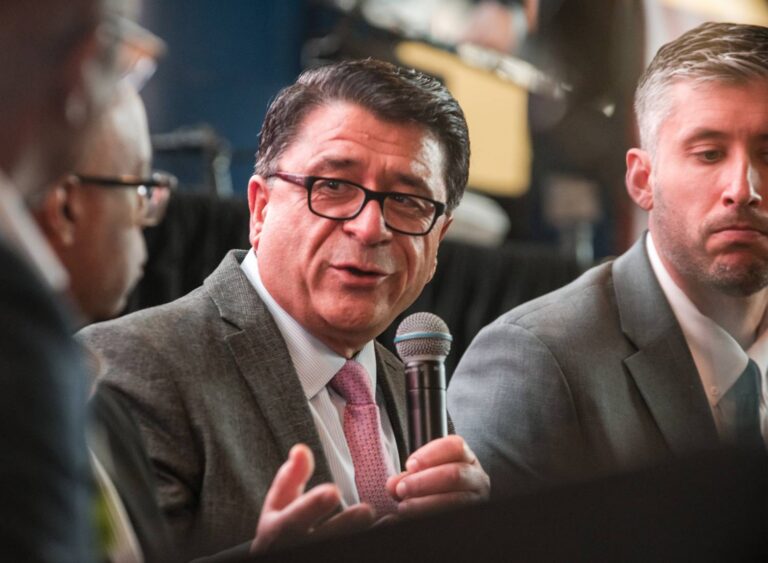







Charles Stembler, President, Cardinal Newman High School
 Charles Stembler, president of Cardinal Newman High School, sat down with Invest: to discuss new renovations that are underway, challenges the education industry is facing and how the school is leveraging technology, innovation, and AI tools to prepare students for jobs that do not exist yet. “Analysis, creative thinking, and collaboration will be important for students moving forward. The world is different now and we need to be training students for this,” Stembler said.
What changes over the past year have had the biggest impact on Cardinal Newman High School, and in what ways?
The opening of the new Rocco A. Marcello Family Academic Building last September has been transformative for our campus. It’s a state-of-the-art facility featuring cutting-edge science and robotics labs that give students hands-on, real-world learning opportunities. Every detail of the new classrooms—from their open layout to the modern, movable furniture—was designed to encourage collaboration, allowing students to easily form small learning groups and work together on projects.
To further enhance student growth both academically and spiritually, we have expanded our faculty, adding additional teachers, another college counselor to provide more personalized guidance throughout the increasingly complex college admissions process, and an additional faith minister to walk alongside students on their spiritual journey, whether they are Catholic or of another faith. We have added a new Learning Specialist to assist students with learning differences. We have also restructured our honors program for gifted students. The program includes monthly field experiences, peer discussions, and a junior/senior-year Capstone research project, creating new opportunities for enrichment both inside and outside the classroom.
What is your overview of the education landscape in Palm Beach and South Florida and the related trends that are emerging?
Population growth in South Florida has been tremendous, and with it, the demand for private education has grown significantly. At Cardinal Newman, we’ve experienced an incredible increase in interest from families across the community, resulting in long waitlists for every grade level.
As a faith-based institution, how do you instill Catholic values among your students and how does that prepare students to become well-rounded individuals and adults?
Seventy percent of our students are Catholic and the other thirty percent are not. We lead with the fact we are a Catholic school. But, regardless of faith background, we focus on supporting each student’s spiritual journey. We begin and end each day with prayer, students participate in monthly all-school masses, and we offer a robust campus ministry program that includes retreats, prayer services, and numerous community service opportunities.
Faith is at the heart of our community, uniting students and faculty in a shared sense of purpose and belonging that is truly special. These experiences nurture a deeper faith life, encourage personal growth, and inspire students to live out values that will guide them for a lifetime. People see the value in a faith-based education and that we are developing students to be better citizens.
What should be the value proposition of a high school education in modern times, and how is Cardinal Newman encouraging its students to pursue continuing education?
In today’s world, it is about striking the right balance between knowledge, skills, and character. Yes, students need a strong foundation in core subjects, but they also need to understand the “why” behind what they learn—such as the lessons of history or the logic of mathematics.
At Cardinal Newman, we are preparing students for jobs that may not even exist yet. We focus on critical thinking, analysis, collaboration, and adaptability—skills that will serve them for life.
How is the school leveraging technology and innovation, and more specifically AI tools, in preparing students for the future academic environment and workforce?
AI is still in its infancy, and, like all schools, we’re determining how to integrate it in ways that truly benefit learning. The key is finding a balanced approach—acknowledging that AI can be a powerful tool, but not treating it as a replacement for critical thinking and problem-solving. Telling students they cannot use it is like telling students they can’t bring computers to school. But, it is also not the be all and end all.
At Cardinal Newman, we’ve begun exploring ways to incorporate AI into classroom projects and discussions, helping students understand both its capabilities and its limitations. Teachers are engaging in professional development to learn how AI can be used responsibly, whether that’s streamlining research, sparking creative ideas, or enhancing data analysis. Our goal is to prepare students to use emerging technologies effectively, ethically, and with discernment as they move into higher education and the workforce.
How is Cardinal Newman leveraging the combination of academics, athletics, and arts to teach transferable skills that will prepare students for the future?
Academics are the foundation of every school, and at Cardinal Newman, it is our first priority. We are committed to preparing our students with the knowledge and skills they need for the future. We believe it is how athletics and the arts complement that academic core, working together to create well-rounded, engaged young people.
We want to create well-rounded students. I encourage young people to try things that they have never done because that is how they grow. This opens students up to a whole other world. As an educated, well-rounded person, you need to have a multitude of experiences. These extracurriculars complement the academic experience.
Students here don’t have to choose just one path—they can thrive in multiple areas. Our band has more than 100 members who compete, perform at sporting events, and march at Disney World. The chorus program is equally strong, Our drama program gives students opportunities not only to act and sing, but also to contribute behind the scenes by building sets, designing costumes, and running lighting. Meanwhile, our visual arts program continues to expand, with ceramics and pottery now part of the curriculum.
Athletics at Newman are just as vibrant. Our track team won the state championship, our football team has been undefeated in Palm Beach County for four years, our lacrosse team advanced to regionals, our girls volleyball program is thriving, and we’ve recently added opportunities like girls flag football and wrestling. Athletics build leadership, discipline, and resilience—skills that mirror the collaborative and creative growth students experience in the arts.
At the end of the day, Newman encourages students to step outside their comfort zones, get involved, and embrace the full range of opportunities—academics, athletics, and the arts. Together, these experiences teach teamwork, leadership, time management, and creativity, while giving students a deep sense of belonging. It’s this balanced approach that ensures our graduates are prepared – not just for college and careers, but for life.
As you look at the changing needs and expectations of your students, how are you constructing and updating your curriculum to align with those demands?
We are constantly reviewing and refining our curriculum to ensure it meets the evolving needs of our students. There’s no way to teach everything, so we focus on what will have the most lasting impact—both in content and in skills. Twenty years ago, students memorized every battle of the Civil War. Now, you can look everything up on Google. However, we still want students to have a core knowledge. Students should know the causes of World War II and the lessons of the Holocaust. But, you don’t need to memorize every battle of the Civil War. A strong knowledge base is essential, we also prioritize skills like analysis, creative thinking, collaboration, and adaptability.
In recent years, we’ve expanded our STEM offerings, incorporated more project-based learning, and created opportunities for cross-disciplinary projects that mirror real-world problem-solving. We’ve also updated our honors program to give gifted students more avenues for enrichment both inside and outside the classroom. The world is changing quickly, and our responsibility is to prepare students not only for college, but for a future where the ability to learn, adapt, and work well with others are the most valuable skills of all.
How is the school working to strengthen student engagement while at the same time helping students to manage stress?
Supporting students’ mental, emotional, and spiritual well-being is a priority at Cardinal Newman. Our faith-based environment offers a foundation of hope and strength—students know they are not alone and that God loves them. This sense of purpose and belonging is reinforced daily by caring teachers, counselors, and staff who take the time to know and support each student. For our faculty and staff, this is not just a job. We are here because we care about young people. When you create that environment, it is much easier to increase student engagement and help students through their daily struggles.
We also encourage students to get involved in athletics, clubs, and activities, knowing that connection to others and balanced engagement outside the classroom helps reduce stress and build resilience. Our school counselors provide specialized support for those dealing with stress, anxiety, or other challenges.
What are the primary challenges facing the education industry, and how is Cardinal Newman working to address these?
Like many schools, we face challenges in recruiting the best teachers, especially given the rising cost of living in South Florida. At Cardinal Newman, we’ve addressed this by providing significant raises over the past couple of years and fostering a strong family atmosphere where faculty feel valued and supported. This sense of community is one of our greatest strengths.
We also continue to adapt to the changing needs of students, ensuring our programs, facilities, and teaching methods prepare them for the world they’re entering. By supporting our teachers and keeping our focus on the student experience, we’re able to navigate industry challenges while continuing to deliver an exceptional education.