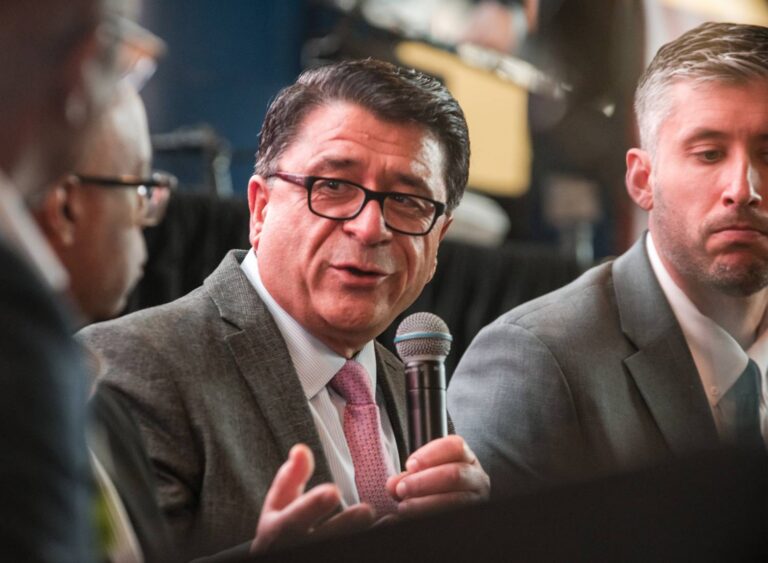







Chris Di Lorenzo, Business Development Manager, Turner Construction Company
 In an interview with Invest:, Chris DiLorenzo, Manager of Business Development at Turner Construction Company, said that adaptability, innovation, and community engagement are driving the company’s efforts in a rapidly evolving construction landscape. “Our goal is to deliver in a way that helps Pittsburgh become the city we all believe it can be.”
Over the last 12 months, what major developments have impacted Turner’s operations in Pittsburgh, and in what ways?
From a Pittsburgh standpoint, we’ve had a longstanding presence in the city — over 100 years. Year over year, Pittsburgh’s construction landscape has been largely driven by a few key sectors, mainly healthcare and higher education, what we often refer to as “eds and meds.” Over the last year, we’ve been navigating the effects of the current economic climate and funding conditions. It’s about determining which projects have the financial legs to move forward and which may be stalled due to broader economic or governmental factors outside of the city’s control.
A big part of our work has been trying to stay ahead of these macroeconomic shifts. That’s not always easy to forecast, but it’s necessary. We’re also seeing a noticeable increase in the focus on technology — AI and robotics — largely driven by partnerships within higher education institutions here in Pittsburgh. They’re teaming up with outside groups, and we’re actively monitoring those developments to stay competitive.
One area generating a lot of excitement is the data center space. There’s a real buzz around that sector, and while it hasn’t fully taken off in Pittsburgh yet, we believe it will soon. We’re preparing by building our expertise both locally and globally to be ready when that market expands here. Data centers have grown to 40% of our work , and once that momentum hits Western PA, we’ll be ready to lead.
Given your 100-year legacy and involvement in shaping Pittsburgh’s skyline, can you highlight some of your recent or ongoing projects in the region?
Over our century-long history, we’ve played a major role in constructing many of Pittsburgh’s most iconic buildings. A lot of us on the Turner Pittsburgh team are locally born and raised here, so there’s a real sense of pride in the legacy we’re continuing.
One of the most prominent recent projects is our work at the Pittsburgh International Airport. But perhaps the most cutting-edge is the cell and gene therapy facility we’re delivering in partnership with Tishman Speyer and the University of Pittsburgh at Hazelwood Green. That project is currently underway and is a major life sciences development for the city.
We’ve also recently formed new partnerships, including a project with Saint Vincent College, about an hour and a half outside Pittsburgh, where we’re building a new athletic facility. Another exciting development is the upcoming headquarters for K&L Gates, which will take up approximately 150,000 square feet. Our team is currently working with them during the preconstruction phase.
In addition to those larger projects, we’ve had steady success in commercial tenant improvement work. While the office market isn’t as robust as it once was, we’ve still managed to deliver high-quality spaces for clients like Federal Home Loan Bank, CBRE, and PricewaterhouseCoopers (PwC) over the past few years. We are also currently delivering new office space in the city for Deloitte and New York Life. We are optimistic that this trend towards rebuilding the commercial market will continue.
We’ve also had longstanding relationships with major institutions like the University of Pittsburgh and UPMC, as well as Allegheny Health Network. All of these organizations have been great partners, and we’ve completed several impactful healthcare and higher education projects for them in recent years. Those relationships are extremely valuable to us.
How is Turner making the business case for smart, sustainable buildings?
From an ESG standpoint, Turner has always been ahead of the curve. We’ve taken a proactive approach to sustainability across the board. We have ESG professionals embedded throughout the company, and our regional sustainability manager, Kayla Reddington, is actively involved in every project we do here.
What’s unique is that we don’t wait for clients to request sustainable practices — we embed them into our processes. We treat it as a core part of how we operate. That philosophy really resonates with our team because they know they’re contributing to a greater environmental impact.
And just when we think we’ve mastered it, we continue to raise the bar. Our operations and ESG teams are tightly aligned, and we’re always looking for ways to innovate and push sustainability forward. That’s what keeps us sharp and at the forefront of ESG in construction.
How is Turner attracting and training talent in Pittsburgh?
That’s a huge focus for us. We have a dedicated Community and Citizenship (C&C) team, and here in Pittsburgh, we’re fortunate to have two full-time professionals — Patriece and Nia — who concentrate solely on this area. One of our core goals is raising awareness around careers in the skilled trades, particularly in communities that may not be aware of the opportunities available to have a rewarding career in construction.
We work closely with local unions and align our training programs with upcoming projects. The idea is to connect individuals with union training, then place them on real job sites where they can build long-term careers.
These efforts also align with our clients’ goals, as many of them share the same concerns about labor shortages. The results are starting to show. It’s not happening as quickly as we’d like, but progress is there, and we know we need to keep pushing because if we don’t address the labor gap now, it will only grow into a bigger issue down the line. Turner, both locally and globally, is committed to getting ahead of that.
What other challenges are top-of-mind for Turner in Pittsburgh?
One of the biggest issues right now is the uncertainty around construction costs. That’s not unique to Pittsburgh, but it’s definitely being felt here. Clients are wary about where prices are heading.
As the largest company in the construction services industry in North America, Turner’s reach gives us an edge in managing global issues such as tariffs and supply chain disruptions. Through our partner company, SourceBlue, we’re able to track and manage lead times across materials and equipment more effectively. That helps our clients get a clearer picture of what to expect and how to plan accordingly.
Another advantage we have is our ability to benchmark. Almost every project we take on in Pittsburgh has a parallel somewhere else in the company. That gives us real-time data on costs and best practices, which allows us to give clients realistic, informed projections from the start.
How is the Pittsburgh office giving back to the community?
Our community work is ongoing. Our C&C team drives much of it year-round, but they partner closely with our project managers and field teams to integrate community support into our job sites. For example, if we’re working in Hazelwood, we prioritize supporting local businesses, whether it’s ordering catering or sourcing supplies locally.
We’ve taken the same approach in Latrobe, at Saint Vincent College. Wherever we go, we want to be more than a builder. We want to be a community partner and leave a positive impact.
What are Turner’s key priorities in Pittsburgh over the next two to three years?
Our goal is to deliver in a way that helps Pittsburgh become the city we all believe it can be. This region has evolved from its industrial past into a center for healthcare, education, and now innovation. While cities like Boston and San Francisco often get the spotlight as tech hubs, Pittsburgh has all the right ingredients to be in that conversation, especially with its growing focus on AI, robotics, and data centers.
But it’s not something anyone can do alone. It requires collaboration with city leaders, developers, universities, and other partners. We need to support an environment where development is encouraged, so businesses see Pittsburgh as a destination, not just a possibility.
As we do that, we’ll continue to attract companies and talent and create a ripple effect that benefits everyone. I’d love to see what Pittsburgh looks like 10 or 15 years from now because the potential here is real, and I believe we’re on the brink of something transformational.