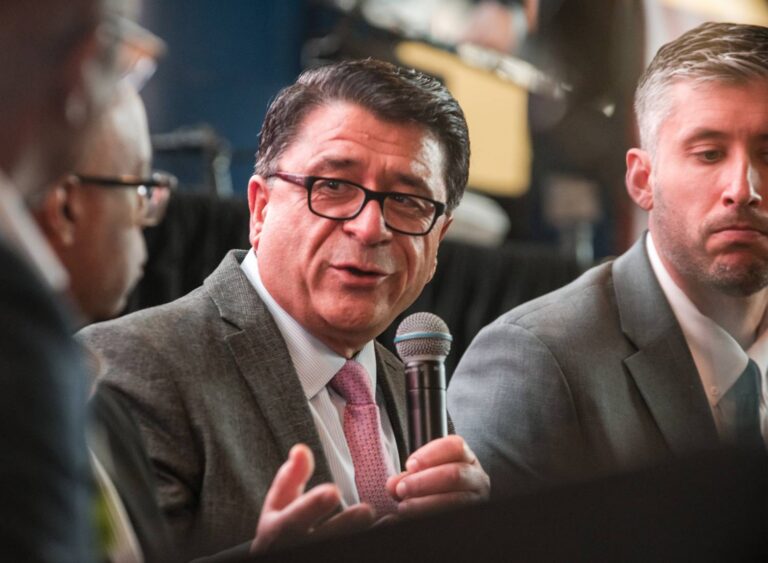







Fahd Riaz, Managing Partner, Philadelphia office/Chair, Philadelphia Corporate practice, DLA Piper
 The financial environment for the biotech and life sciences sectors has become increasingly challenging, with companies across the Philadelphia region struggling to secure necessary funding and maintain their product pipelines, according to Fahd Riaz, managing partner at DLA Piper. “Philadelphia is well-poised for success. It just needs more capital,” Riaz told Invest:.
What recent changes have impacted your clients the most, and how have those changes shaped DLA Piper’s priorities and operations in the region?
A lot of my clients are biotech life sciences companies, and the last few years, especially the last two to three years, have been hard in terms of fundraising. Everyone thought that with the new administration, in January of this year, things were going to change in the biotech pharmaceutical space. That has not happened. Conversely, it has become even harder for companies to raise money, whether they’re established companies, public, or private.
Additionally, many of these companies that are on life support are not further developing their pipeline of products because they’re in survival mode. It is just a very hard time right now in terms of the economics associated with raising money for a lot of these companies, and the same is true for companies developing new drugs. Overall, the economic landscape has reduced the number of companies starting up. That isn’t the case everywhere in the country, but that is what I’m seeing here in Philly.
What changes have you seen in the M&A and private equity landscape over the past 12 to 18 months?
Post-2020, when people saw that the economy was actually better than anticipated during COVID, there was a frenzy on the private equity side. We were doing deals left and right, and valuations were crazy. Right now, on the private equity (PE) side, the valuations are more realistic, or actually significantly lower. It takes a lot to manage companies’ expectations regarding the liquidity event that they hoped for with PE. At the very least, the first liquidity event is just not there at the numbers that they were expecting.
We also see the economics change after the letter of intent or term sheet is out, when the quality of earnings and the analysis are being done by the PE shops. It’s just the reality. We’re advising clients acquired by PE to be prepared for that. For PE clients, my advice to them has always been that if you’re going to have the companies continue to be operators, you should let them know that. It’s all contingent on the numbers coming in the way the companies claimed they would. Oftentimes, one’s viewpoint of their numbers isn’t the reality.
Do you think, as a result, you’re seeing increased caution or more creativity in deal-making?
It’s taking longer to do deals, but on the PE side, for revenue-generating companies, deals are happening. I wouldn’t say there’s caution. It just takes a while.
What are the key differentiators that set your firm apart from other players in the market?
DLA Piper is a very diversified firm in terms of practices. We have Fortune 500 clients for which we do the gamut of work, from deals, to M&A, and capital markets transactions, along with litigation work, which includes multiclass action litigation, white collar, and antitrust work. You name it, we do it.
What are your strategies to recruit and retain top talent?
We have decided to really recruit early. In our summer program, people come and fill an associate position with us, and quite frankly, we see it makes a difference. We are very much trying to invest in talent early on so we can develop them.
Also, the firm is regimented in our training. We have training academies throughout the year at every stage of our associates’ development. We are very focused on making sure our talent is well developed. We also train them for the possibility of becoming a partner to ensure they have the tools they will need on day one in the role.
How do you see technology and new innovations changing the practice of law over the next few years?
Technology has already changed the legal field a lot. DLA Piper has its own data scientists and a tech-building team. We’ve developed a lot of specialized technologies ourselves internally in certain practices to streamline common projects, making us very cost-efficient by not requiring as many man-hours.
AI is definitely going to make things even more efficient and help us deliver even better results for our clients.
What role do you think Philadelphia will continue to play in the broader national conversation around innovation and corporate investment?
Philadelphia has as much talent as New York, Boston, and other business hubs. We have major institutions here, including the University of Pennsylvania, Drexel, and Temple, among many other high-caliber universities. We have a lot of talent in various sectors, whether it’s life sciences or the technology side. I think we’re poised to be successful.
The question fundamentally is whether the capital is here or not. I’ve seen shifts where the capital is here or is coming, and then, as a result of the economic landscape, it shifts backward. Philadelphia is well-poised for success. It just needs more capital.