






Five reasons businesses are investing in Greater Boston today
Writer: Mirella Franzese
 February 2025 — Boston’s robust STEM and innovation-based economy draws in billions of dollars in funding from investors each year. But 2025 is expected to create even bigger opportunities for Massachusetts-based businesses as the state leverages its talent pipeline and innovation culture to build on emerging AI technologies and real estate supply-demand gaps. Here are five reasons why businesses should invest in Greater Boston today.
Startup Culture and Innovation Mentality
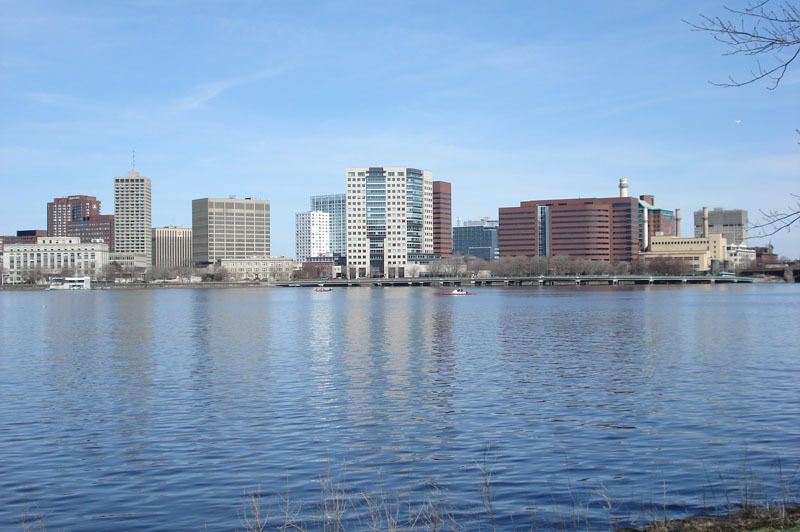
Boston consistently ranks among the Top 5 Global Cities for startups, according to Startup Blink, due to the strength of the region’s STEM-focused economy and culture of innovation. Cambridge’s Kendall Square, considered “the most innovative square mile on the planet”, is home to over 2,000 businesses and 600 startups where 60% of employees work towards the “creation of ideas.” Startups in Kendall Square benefit from proximity to leading academic institutions and a steady supply of young and entrepreneurial professionals, which is critical for early-stage ventures. “The timescale of decisions for a start-up can be really short,” said former MIT professor Martin Schmidt to Hassell Studio. “You’ve got a small organization that needs to react quickly.”
Access to Talent
Boston’s reputation as a higher education leader continues to attract talent from across the globe seeking to attend the region’s top schools and universities, namely Harvard University and MIT. With more than half a million undergraduate and graduate students earning their diplomas every year — of which, about 75% are expected to stay and work in the region over the next five years — Mass-based companies often enjoy unparalleled advantages when it comes to access to a skilled and diverse talent pool. Among some of the region’s top employers are Moderna, Vertex Pharmaceuticals, and Amazon.
AI and Tech Economy
In December, Governor Maura Healey announced a partnership to provide $100 million in funding for the establishment of Massachusetts AI Hub, a new facility at the Massachusetts Technology Collaborative (MassTech) meant to transform the state into the global leader in Applied AI Innovation. “Through the AI Hub, we will set the standard for AI development by supporting trailblazing research, attracting and retaining unparalleled AI talent, and transforming our state into the global leader in applied AI innovation, solving the greatest challenges facing our society today,” said Gov. Healy in a recent press release.
The AI Hub will enable businesses to develop AI projects at scale, expanding access to the necessary components and computing processors required for operating artificial intelligence technology. Through partnerships with leading academic institutions and research organizations, the Massachusetts AI Hub expects to promote the creation of accelerator programs for AI-focused startups, encourage AI adoption among SMEs, and attract foremost global AI experts.
Access to Venture Capital Investment
Massachusetts remains the national leader in venture capital investment with a long-standing history of funding research in innovation and technology. While VC activity decreased slightly over the past year due to a transitional election year, the outlook for 2025 is strong as startups in the artificial intelligence space, such as Liquid AI in Cambridge and Ascend Elements in Westborough, continue to attract significant funding from investors. Another example is the Sommerville-based power player, Form Energy, which successfully raised $405 million from its October Series F round, further highlighting capital-raising opportunities in the Greater Boston Metro.
Real Estate Appreciation
Greater Boston’s residential real estate market remains a solid investment opportunity as population growth continues to fuel demand — which, coupled with low inventory and limited availability of land — drives up home values. As a result, new properties in the single-family and condo space are expected to retain or increase value over time. The median sales price of a home in Boston grew by 5.4% to $843,000 in December of 2024, compared to the previous year, indicating consistent appreciation over time. Conversely, the number of active listings on the market decreased by 6% to a total of 2,500 properties from the last year.
Similarly, Boston’s commercial real estate market is uniquely positioned for growth in 2025 due to sustained demand for “beds, meds, and sheds” in the multifamily, healthcare, and life sciences sectors. Boston’s life science cluster currently enjoys approximately $20 billion in annual funding from the National Institutes of Health (NIH), leading to strong demand for class A lab space. Because high construction costs and interest rates remains a challenge for developers in the urban core, Boston’s submarkets — namely Medford, Everett, and Revere — have emerged as new hotspots for the development of logistics and storage facilities, and other industrial warehouse projects. Redevelopment of aging properties in Kendall Square and the Seaport District are also becoming increasingly popular as a result of land challenges. One such example is the renewal of the 601 Congress St. building by BioMed Realty, which was repurposed into Seaport Science Center, a state-of-the-art laboratory space.