







Houston’s population growth demands transportation solutions
Writer: Pablo Marquez
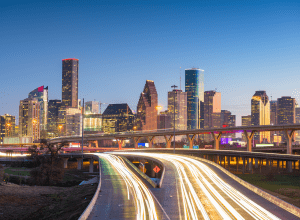 June 2024 — As Houston’s population growth shows no sign of slowing, a set of dynamic transportation infrastructure projects may be key to meeting future mobility needs.
“Houston is vast, diverse, and not slowing in growth, so convenient access to transit is a legitimate challenge,” said Elizabeth Gonzalez Brock, chair of the Metropolitan Transit Authority (METRO), in a recent interview with Invest: Houston.
“Houston’s growth is palpable, and METRO must evolve alongside our city. We need to improve infrastructure like sidewalks and bus shelters to enhance customer experiences. Furthermore, METRO is committed to responsibly maintaining the infrastructure that all citizens utilize, such as repairing roads that have fallen into disrepair and strategically placing shared-use lanes to best serve commuters and pedestrians alike,” she added.
The 2025-2028 Transportation Improvement Plan (TIP), released by the Houston-Galveston Area Council (H-GAC) earlier in the year, is one step toward overall improvement. The plan directs federal and state funding to transportation projects in the eight-county Houston-Galveston metropolitan planning area. The four-year transportation plan allocates $405.46 million in funds to the city of Houston. Improvements include reducing traffic congestion, public transit accessibility, and greater mobility on congested highways across the Houston region. (View an interactive map of projects here.) Houston’s population is expected to grow by 10% by 2028, making greater mobility and connectivity critical for sustainable growth.
In addition to the TIP, there are a number of road and highway construction projects in progress whose goal is to relieve congestion and traffic on Houston’s busiest highways. After nearly two decades of work, the North Houston Highway Improvement Project (NHHIP) designed by the Texas Department of Transportation (TxDOT) has almost finished the planned reconstruction of I-45N, an expansion project between Houston’s downtown area and the North Sam Houston Tollway. According to the NHHIP, this project will improve I-45 from Beltway 8 to I-10, and reroute I-45 through the downtown area along I-10 and US 59/I-69. At the same time, the I-69 Southwest and the 610 West Loop Interchange Lane construction projects are nearly finished after six years of work. Finally, the span of the Houston Ship Channel bridge has resumed from its pause in 2020, meaning that the southbound bridge is set to be completed by 2025 and the northbound bridge will be finished by 2028.
“I’m here to let everyone know this is a new beginning. We’re not going to tolerate broken infrastructure, whether it’s our roads and streets or our drainage. We’re going to fix Houston,” said Mayor John Whitmire during a ceremony speech that celebrated the Westheimer Improvement Project.
As far as railway operations go, the Amtrak Houston-Dallas project is a bullet train proposal that aims to connect the two largest cities in Texas. The Houston-to-Dallas initiative seems to be gaining momentum, as the construction of a Japanese bullet train cruising through a high-speed railway would shorten commuting and transportation times between both cities. As Amtrak continues to explore this long-standing idea, successful completion of the project would mean an improvement both for commercial as well as business transit opportunities for the city of Houston and the state of Texas as a whole.
Houston’s public transit ridership numbers have been struggling since the post-pandemic period. According to data from the American Public Transportation Association (APTA), ridership in the Houston metro area is still at 86% of pre-pandemic levels, down from 7.5 million trips in September 2019 to 6.4 million trips in September 2023. This is important because public transit via buses and light rail generally reflects on a city’s quality and overall standard of living by liberating car traffic congestion, removing parking lot spaces, and creating greener and cleaner spaces. Houston needs to improve ridership and public transit if it wants to become a more vibrant and healthier city.
“I look forward to working collaboratively with the mayor, the METRO Board, and all levels of government to transform METRO into a best-in-class model of transit, accountability and transparency. We will empower a strong management team that will drive measurable results and work directly with customers to understand their real needs to make public transit a safe, clean, and viable option for everyone,” said Brock in a press release published by the city of Houston Mayor’s Office of Communications.
For more information, please visit: