






How Houston is becoming a top global hub for business growth

Writer: Andrea Teran
May 2025 — As global supply chains shift and business ecosystems evolve, Houston is leveraging its industrial legacy, strategic infrastructure, and regional collaboration to solidify its standing as a top-tier destination for business investment. From clean energy and tech manufacturing to global trade and infrastructure planning, Greater Houston’s interconnected economic engines are driving forward.
1. Advanced Manufacturing Is Back — and Houston Is Leading It
Global tech leaders like Apple and Nvidia are reinvesting in American production — and choosing Houston. New AI-powered manufacturing facilities in Harris County mark a resurgence of high-tech industrial growth, reflecting a broader trend of reshoring.
“If businesses are successful here, then Brazoria County is successful,” Patti Worfe Mills, president and CEO of the Economic Development Alliance for Brazoria County, told Invest:. “We help companies find the right site, ensure utility access, and support workforce needs from day one.”
Houston’s large, diverse labor force — supported by local colleges offering tailored training — gives it a clear edge in attracting high-tech and clean energy manufacturers.
2. Global Trade Keeps Houston Competitive
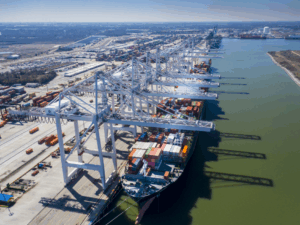
Houston leads the United States in exports, shipping $180.9 billion in goods in 2024 — more than New York and Los Angeles combined. The region has held the top spot in 12 of the past 13 years, according to the Greater Houston Partnership. Port Houston set new records in 2024, with 3.4 million containers processed, reinforcing the region’s status as a global logistics hub.
The Houston/Galveston Customs District also set a record, handling 432.6 million metric tons of cargo last year. Exports made up two-thirds of all trade value, well above national averages. Key exports include energy, chemicals, electronics, and machinery.
With nearly 1,000 foreign-owned firms operating locally and deep ties across 111 countries, Houston remains a key node in the global economy.
3. Infrastructure Is Expanding to Match Demand
Houston’s physical infrastructure is catching up with its economic ambitions. The $1 billion Houston Ship Channel expansion (Project 11) will accommodate larger vessels, while new container wharves at Bayport are increasing capacity.
The Texas Department of Transportation (TxDOT) is also investing heavily in freight mobility. Projects include elevating I-10 at White Oak Bayou to prevent flooding and reconstructing the Houston Avenue bridge to run beneath I-10, mitigating frequent collisions with over-height vehicles.
“Councils of Government like H-GAC are designed for this purpose — planning for the future while contending with infrastructure, transportation, workforce, and connectivity challenges,” said Rick Guerrero of the Houston-Galveston Area Council in an interview with Invest:.
4. A Skilled Workforce Built for Global Industry
Houston’s ability to attract global investment is not just about infrastructure — it’s about talent. The region’s community colleges and workforce universities are aligning training with industry needs, helping companies to quickly scale.
Three years after Texas House Bill 8 took effect, funding for community colleges is now tied to measurable student outcomes, like degrees earned, dual credit courses, and job placement, rather than enrollment. This shift has accelerated the expansion of programs in high-wage, high-demand fields such as AI, advanced manufacturing, robotics, and logistics.
Institutions like Houston Community College, Lone Star College, and San Jacinto College are responding by partnering directly with industry to design and deliver workforce-ready training in robotics, automation, supply chain management, and clean energy systems. Programs like Upskill Houston further strengthen middle-skill pipelines, ensuring employers can access job-ready talent across key sectors.
5. Fiscal Responsibility Builds Confidence
Houston’s $7 billion FY 2026 city budget closes a major deficit without raising taxes. Operational efficiencies, departmental consolidations, and voluntary retirements generated $134 million in savings across all funds.
The plan also includes $184 million in street and drainage improvements — vital for both residents and industries dependent on a resilient urban infrastructure.
“The mayor has made good on his commitment to address waste and duplication,” said Steve Kean, president and CEO of the Greater Houston Partnership, as cited by the Partnership.
For more information, please visit: