





How strategic investments are shaping North Texas’ economic future
Writer: Andrea Teran
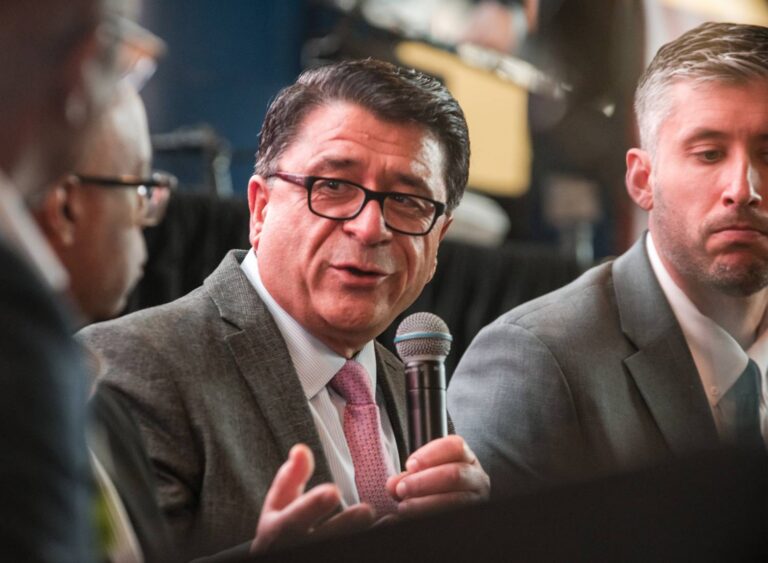
 March 2025 — The Invest: Dallas-Fort Worth 3rd Edition Launch Conference brought together regional leaders to discuss the future of economic growth and development in North Texas. During the first panel discussion, “Shaping Tomorrow: How Strategic Development Drives Prosperity in North Texas Communities,” leaders explored the evolving landscape of public-private partnerships (P3s), infrastructure investment, and sustainable expansion.
Moderated by Mike Koch, regional president at Happy State Bank, the panel featured economic development executives representing four of North Texas’ fastest-growing cities.
Gloria Salinas, vice president of Frisco Economic Development Corporation (EDC) highlighted Frisco’s success with P3s, pointing to how walkable, amenitized districts enhance both business opportunities and quality of life. “We are really well known for public-private partnerships,” she said. “It’s important that we focus on green space, walkability, and speed to market as we shape our developments.” She pointed to The Star, the PGA of America headquarters, and Toyota’s satellite facility as key examples of this approach.
Frisco is also welcoming The Mix, a $3 billion, 112-acre mixed-use project that broke ground in January, transforming the long-abandoned Wade Park site. The development will feature a luxury hotel, an 8-acre central park, high-end retail, millions of square feet of office and residential space, and is set to complete its first phase by late 2026. Backed by a $10 million infrastructure grant from the Frisco EDC and $103.4 million in tax grants from city entities, The Mix underscores Frisco’s commitment to leveraging public investment to attract private capital.
Additionally, the city has approved a $182 million renovation of Toyota Stadium, home to FC Dallas, as part of its strategy to enhance sports tourism and local economic impact. With funding contributions from both the city and the Hunt family, owners of FC Dallas, construction is expected to begin in early 2025, with completion targeted for 2028.
Salinas added that Frisco is integrating smart-city technologies, including autonomous delivery systems, AI-driven traffic management, and logistics innovations, to support rapid expansion and minimize congestion. “We are leaning into a lot of new technology — people-mover systems, logistics, and e-commerce solutions — that will help sustain long-term growth,” she said.
Beth Bowman, president and CEO of the Irving Economic Development Partnership, reinforced the importance of regional collaboration and infrastructure investment in maintaining North Texas’ economic momentum. She highlighted Irving’s pro-business environment, where 70% of the city’s tax base comes from commercial sources, enabling long-term investment in infrastructure and workforce development. Projects like the Toyota Music Factory and Wells Fargo Workplace Center showcase how Irving collaborates with the private sector to foster economic expansion.
Bowman explained that factors such as transportation, utilities, and broadband access often determine whether companies choose to establish or expand operations in North Texas. “It’s a daily investment, a 5-, 10-, 20-year conversation,” she said. “If we say, ‘it’s coming,’ that can create a significant pause and put us at a competitive disadvantage.” Bowman also pointed to the role of existing businesses in promoting regional economic vitality, noting that companies already operating in Irving are some of the city’s strongest advocates. “Your residents and your customers are your best spokespeople to amplify every great quality that each of our communities have to offer,” she said, reinforcing how a well-planned city not only attracts businesses but also fosters an engaged and supportive community.
Further reinforcing the region’s strength as a corporate hub, Goldman Sachs’ 800,000-square-foot campus in Dallas is set to become one of the largest financial investments in the metroplex. The development, expected to open in the coming years, will house over 5,000 employees, expanding the firm’s North Texas workforce beyond its current 4,000. Designed to function more like a corporate campus than a traditional office tower, the development will feature rooftop gardens, a 1.5-acre park, bike parking, childcare services, and a central landscaped Paseo walkway connecting the site to the surrounding neighborhood. The expansion also aligns with the firm’s broader cost-cutting strategy, shifting employees from high-cost cities like New York and London to more affordable business hubs like Dallas and Salt Lake City.
Read more: ‘Y’all Street’: 6 factors reshaping finance in North Texas
Marty Wieder, executive director of the Arlington Economic Development Corporation, emphasized long-term infrastructure planning in Arlington, noting that strategic investments have positioned the city as a hub for large-scale development and global events. Arlington, which secured nine FIFA World Cup events for 2026, continues to leverage public-private investment to fuel its economic growth. The city is also undergoing a major expansion of its Entertainment District, a multi-million-dollar project that includes Loews Arlington Hotel and Convention Center. Additionally, One Rangers Way, the district’s first luxury residential development, is nearly fully leased ahead of Rangers’ Opening Day, while the forthcoming National Medal of Honor Museum, opening on March 25, 2025, will further elevate Arlington’s profile as a world-class destination.
Wieder noted that the city’s sales tax revenue is being reinvested in property acquisitions and infrastructure upgrades, ensuring that aging properties are modernized to fit current business needs. “We want our growth to be sustainable,” he said. “Part of that is ensuring we’re investing in redeveloping sites that can support modern economic activity.”
Jason Moore, executive director of Mansfield Economic Development Corporation, reinforced the importance of infrastructure alignment with private sector momentum, highlighting Mansfield’s focus on ensuring land availability and infrastructure readiness to attract investment. “Deals go where deals flow, and deals flow where infrastructure grows,” he said.
As the discussion wrapped up, the panelists reinforced the importance of long-term planning, regional cooperation, and data-driven strategies in ensuring North Texas remains a thriving economic hub. Moore put it best: “Forty years from now, when we look back, we’ll ask: ‘Did we do it right?’ I think we’ll say ‘yes’ more often than ‘no’ — because of the public-private partnerships we have in place today.”
To read the brand-new Invest: Dallas-Fort Worth 3rd edition, click here. (Subscription required.)
Watch Panel 1 of the Invest Dallas Fort-Worth 2025 Launch Conference here:
About caa & Invest: Dallas-Fort Worth 3rd Edition
An integrated media platform, caa produces in-depth business intelligence through its annual print and digital economic reviews, high-impact conferences and events and top-level interviews via its video platform, Invest:Insights.
The Invest: Dallas-Fort Worth report provides an in-depth look at what makes the region’s economy tick and the challenges that remain from the perspective of over 200 local leaders and elected officials.
Invest: Dallas-Fort Worth looks at the metro area’s key industries, including healthcare, energy, financial services, real estate, technology, tourism and infrastructure, that drive the local economy. The area has enjoyed continuous growth and economic expansion in recent years, fueled by business friendly policies and a number of business relocations and expansions during and after the pandemic. Based on this solid foundation, the region is poised to continue its robust growth in the years to come.
For more information, contact:
Jerrica DuBois
Senior Editor
305-523-9708 Ext 261