





Invest: Pittsburgh leadership summit highlights talent needs, partnerships

Key points:
- • The Invest: Pittsburgh Summit focused on workforce readiness and regional collaboration.
- • Leaders stressed stronger employer-education alignment and experiential learning to close skills gaps.
- • Mentorship and adaptable leadership pipelines were highlighted as key to long-term competitiveness.
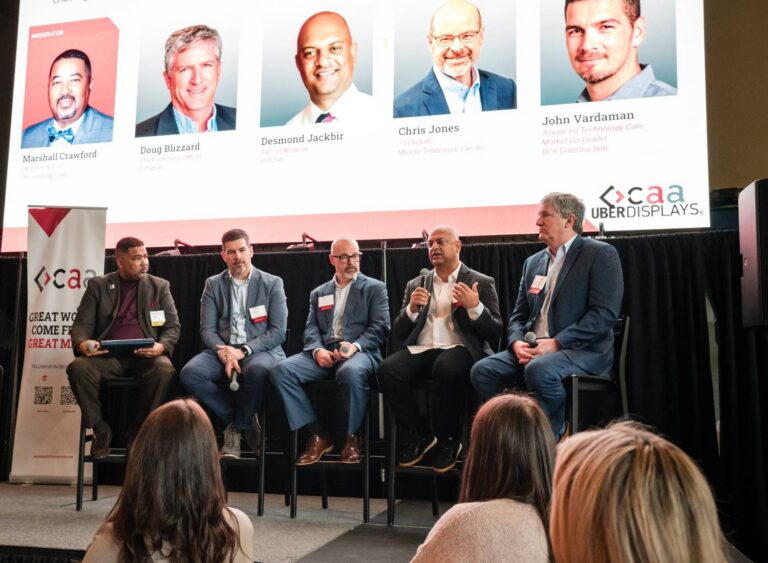
 February 2026 — Business and civic leaders from across Southwestern Pennsylvania gathered for the Invest: Pittsburgh Leadership Summit, where discussions centered on workforce readiness, leadership development, and the partnerships shaping the region’s economic future.
Join us at caa’s upcoming leadership summits! These premier events bring together hundreds of public and private sector leaders to discuss the challenges and opportunities for businesses and investors. Find the next summit in a city near you!
Abby Lindenberg, founder and CEO of caa, opened the program by reflecting on Pittsburgh’s identity — a city defined less by flash than by durability.
“There’s a toughness here. Not flashy. Not loud. Just steady,” Lindenberg said. “You’re a city that went from steel mills to robotics labs. From industrial backbone to innovation hub. You don’t just reinvent — you rebuild. And you do it together.”
The program began with a fireside chat between Corey O’Connor, mayor of the city of Pittsburgh, and Lindenberg, focused on civic leadership, regional competitiveness, and community engagement.
“It’s being active… but also making sure everyone gets a voice,” O’Connor said.
Become a member today to access the latest edition of Invest: Pittsburgh.
Innovation at Work
The opening panel, “Innovation at Work: Which sectors are reshaping the skills landscape, and how are employers and educators collaborating to close skills gaps?”, explored how shifting industry needs are influencing Pittsburgh’s workforce and skills ecosystem.
The session was presented by David Adair, senior vice president of health system business development at CarepathRX and UPMC Chartwell, and moderated by Martin Kimmel, president of Kimmel Architecture. Panelists included Guy Amatangelo, president of Mariani & Richards Inc; Christina Clark, president of La Roche University; Prasad Vemala, dean of the Haverlack College of Business at Slippery Rock University; and Sally Schufreider, market leader and general manager at Cigna Healthcare.
Panelists pointed to rapid technological change, demographic shifts, and evolving workplace expectations as forces reshaping hiring and training strategies. Employers and educators, they said, are working more closely to align curriculum with real-time industry needs, expand experiential learning, and support continuous upskilling.
“The reality is there are five generations in the workforce today that work very differently,” said Schufreider.
Speakers emphasized that sustained collaboration between business and academia remains one of Pittsburgh’s competitive advantages.
Next-gen leaders
The second panel, “Next-Gen Leaders: How will the ‘leaders of the future’ differ from today’s leaders, and what can employers do now to train the next-gen pipeline?”, turned to succession planning and leadership development.
Presented by Regis Etzel, president of Etzel Engineer and Build, Inc., and moderated by Karen Wolk Feinstein, president and CEO of the Jewish Healthcare Foundation, the panel featured Bethany Bryant, regional director at Glenmede; Joseph Thompson, senior vice president and branch manager at Baird Pittsburgh Riverfront & Wexford; Ken Scaggs, market president at AON Pittsburgh; and Stephen Girard, vice president, C&I Sales – East Region at NRG.
Speakers argued that future leaders must be comfortable navigating ambiguity, leading hybrid teams, and fostering cultures that prioritize both performance and purpose. Mentorship, structured development programs, and clearer leadership pipelines were cited as essential tools for retention and resilience.
“When people come into the office… I think leadership has to make sure they are available and willing to see people,” Girard said. “They should understand why they are there and what they are doing. I think that’s what makes the difference and can bridge the gap in this hybrid world that we’re living in.”
Panelists agreed that partnerships can accelerate leadership readiness and reinforce the region’s long-term competitiveness.
From campus to company
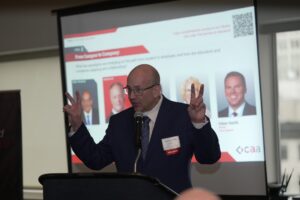
The final panel, “From Campus to Company: What new paradigms are emerging on the path from student to employee, and how are educators and companies adapting and collaborating?”, focused on the evolving transition from higher education to the workforce.
Moderated by David Ballard, vice president at One Mind at Work, and presented by Douglas Chew, commissioner of Westmoreland County, the discussion included Elizabeth MacLeod Walls, president of Washington & Jefferson College; Roger Davis, president of Community College of Beaver County; and Adam Smith, partner at Forvis Mazars.
Discussion centered on experiential learning, employer-embedded curricula, internships, and other models designed to shorten the distance between classroom and career.
“We cultivate skilled, adaptive minds… What I’ve been hearing all morning from the employers in the room is that technical skills are really important but we also need those next-level leaders to step into our organization to be able to adapt and problem solve,” MacLeod Walls said.
Panelists concluded that modernizing education-to-employment pathways is critical to attracting talent, strengthening workforce alignment, and sustaining long-term economic growth across the Pittsburgh region.
To watch the panel discussions from our Invest: Pittsburgh Leadership Summit, stay tuned to our Youtube Channel.
About caa & Invest: Pittsburgh
caa is an integrated media platform that produces in-depth business intelligence through its annual print and digital economic reviews, high-impact conferences and events, and top-level interviews via its video platform, Invest:Insights.
Invest: Pittsburgh is an in-depth economic review of the key issues facing the Southwestern Pennsylvania economy, featuring the exclusive insights of prominent regional leaders. Invest: Pittsburgh is produced with two goals in mind: 1) to provide comprehensive investment knowledge on the region for local, national, and international investors, and 2) to promote the region as a place to invest and do business.
The report conducts a deep dive into the top economic sectors in the region, including technology, real estate and construction, infrastructure, banking and finance, healthcare, education, and tourism. The publication is compiled from insights collected from more than 200 economic leaders, sector insiders, political leaders, and heads of important institutions. It analyzes the leading challenges facing the market and uncovers emerging opportunities for investors, entrepreneurs, and innovators.
For more information, please contact:
Danielle Karlinsky
Executive Director
(305) 340-2730








Become a member today to access the latest edition of Invest: Pittsburgh.