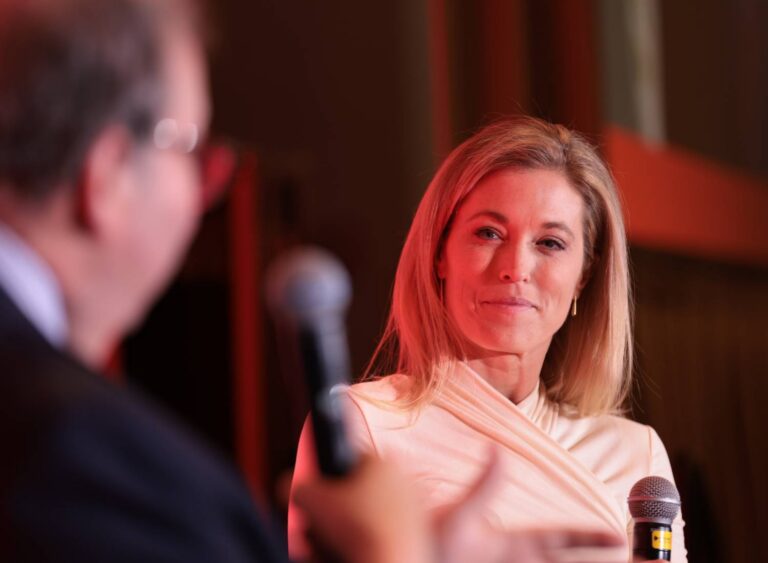







Ivy Cadle, Managing Shareholder, Baker Donelson
 In an interview with Focus:, Ivy Cadle, managing shareholder at Baker Donelson, discussed growth, talent, community impact, and the evolving Southeast market. “Atlanta is the hub of economic growth, attracting investment, talent, and innovation across all sectors,” Cadle said.
What changes over the past year have most impacted the firm, and in what ways?
The last year has been dynamic in many respects. It has been strong for our firm and our offices. We’ve seen sustained demand across multiple practice areas, particularly in litigation, healthcare, and real estate. That mirrors broader trends in the legal industry, where clients increasingly look for sophisticated counsel to help them manage economic uncertainty, regulatory complexity, and technological change.
At the same time, the competitive landscape has intensified. Clients expect more value, efficiency, and responsiveness from their legal partners. So, we’ve worked to integrate systems and processes that make those expectations possible. For us, that has translated into continued investment in talent, technology, and client service initiatives so we can remain agile and responsive.
What trends are you seeing in the Southeast business climate, especially for clients navigating real estate and infrastructure investments?
The market remains robust, but partners are more focused on value and cost. Across my practice, there’s a lot of attention on questions like: If certain steps are taken, what is the return on investment going to be? How can that return be maximized? How can clients ensure they are getting what they pay for?
There is also a focus on structuring deals so that fees make sense in light of current conditions. It’s consistent with what we’ve been seeing, but it feels more palpable now because of the economic uncertainty, regulatory issues, and technological change that continue to shape the landscape.
Do you feel business leaders today are fully prepared for emerging risks and opportunities?
Business leaders are paying close attention, especially given the headlines and the current geopolitical situation. It’s difficult to say they’re underestimating risks. Rather, different industries and companies focus on what feels most relevant to their sectors. That can mean some things get missed, but it tends to be sector by sector.
In the legal industry, there is a strong focus on AI and how it will change the practice of law. I served as president of the State Bar of Georgia last bar year, and we have a committee looking at the rules of professional conduct to ensure they address AI appropriately.
Our firm has adopted AI tools but remains focused on our core responsibilities. For other industries, the integration of AI looks different. An engineering business, for example, may rely on entirely different tools. So, the highlights vary by industry, but my sense is that leaders are doing a good job of paying attention to what’s relevant to them.
In Georgia, how do you see population growth and urbanization shaping land use and development?
Georgia remains a destination for people to live and do business. We continue to see robust population growth, which, from a land use perspective, means a greater need for infrastructure. That includes more cell towers, improved vehicle infrastructure, and more governmental takings for condemnation to widen roads. The Georgia Department of Transportation is actively involved in infrastructure improvement, and MARTA is expanding routes and increasing ridership, like the recent Clayton County bus terminal project.
Growth means land is being used more intensely. AI is starting to affect that as well. I recently had the opportunity to ride in a Waymo, and it was fascinating to think about how autonomous vehicles could change commutes. Atlanta is known for its long commutes, but with automated cars, people could spend that time working or catching up on news instead of focusing on the road.
It will be interesting to see how road expansion evolves if more people use automated vehicles. Traffic patterns could become more orderly, or less so, and people may be less concerned about travel times if they’re not the ones driving. All of this ties back to how population growth and technological change will continue to shape development in the South.
What are some of the more complicated legal dynamics involved in public-private partnerships?
Anytime there is a public sector and private sector partnership, there will be different interests that need to be aligned. Coming to a place where those interests are shared, and then documenting that in a way that conforms to the rules governing public entities, is always a key challenge. Governmental entities must avoid favoritism and cannot accept kickbacks, so compliance with those rules is critical.
Those complexities continue to be a focus in these partnerships. Georgia, for example, is benefiting from what appears to be a remarkable private partnership with the Hyundai plant, the battery plant, and the Metaplant going into Bryan County (a battery and mass-produced EV plant). That area is experiencing growth that’s really unrivaled in the state. It will be interesting to see how that development impacts what has traditionally been a rural area.
There is a lot of opportunity here, and Georgia remains one of the best states to do business. I expect our government will continue to look for ways to help the economy grow through these types of partnerships.
How would you describe the firm’s role when it comes to helping clients navigate complex legal challenges?
Exceptional client service and our internal culture are major factors in Baker Donelson’s success. We continue to hear from colleagues and clients that our culture is one of the main contributors to that success.
Recently, a national company called needing help with a dispute in Memphis. Within two emails, without even having to pick up the phone, we were able to connect them with the right resource.
That level of collaboration and responsiveness allows us to deliver quickly for clients. As our growth trajectory continues to rise, we look forward to using those internal relationships to maintain our strong reputation.
What strategies help the firm recruit and retain top talent?
Collaboration and transparency are at the core of our approach to recruiting and retaining talent. We share a significant amount of information internally at Baker Donelson, whether that’s about performance or compensation relative to peers, which helps build trust and clarity.
In the Atlanta office over the past six months, we’ve spent time figuring out what motivates our people to come in. If employees need to get home to pick up their kids, planning a late happy hour isn’t going to work. So, sometimes a lunch or breakfast event makes more sense. Those may sound like simple things, but the intentionality behind understanding what our people want is what matters.
It’s about building relationships because collaboration is ultimately built on trust. Team members need to know they can rely on the person down the hall to get something done, whether it’s a brief or a filing that keeps the client on track. That trust is fundamental, and I think we have that in spades.
How does the firm approach community engagement?
We have a strong partnership with the City of Refuge and have participated in Habitat for Humanity builds. We are always looking for community partners and ways to stay involved.
We also host a speaker series, bringing in people from the community to share insights. Recently, we had someone from Rowen Development, a large development near the Briscoe Field airport on the border of Gwinnett County, come speak. They’re working on thousands of acres for sophisticated, technology-oriented businesses, so hearing directly from their CEO was valuable.
In addition, our team members serve on a wide range of boards, from animal welfare organizations to the Atlanta Metro Chamber. We stay engaged on many levels and encourage our attorneys and employees to be active in the community as part of their growth plan.
What are your top priorities for the office over the next few years?
We remain committed to growth. Our office is in growth mode, and we’ve added some lateral shareholders and of counsel who have been great additions. We recently added Davis Butler, a corporate lawyer, and expanded into New Jersey, bringing on nearly 30 attorneys.
We’re focused on finding talent that fits, people who make sense for us, and for whom we make sense as well. We’ve grown our capacity in real estate, ERISA law, and tort defense, and we expect that to continue.
That growth is both a blessing and a challenge. Finding the right people in a highly competitive market requires us to stay focused and strategic. But we remain optimistic. Atlanta is the hub of economic growth, attracting investment, talent, and innovation across all sectors. We look forward to serving clients who are engaged in that dynamic economy.