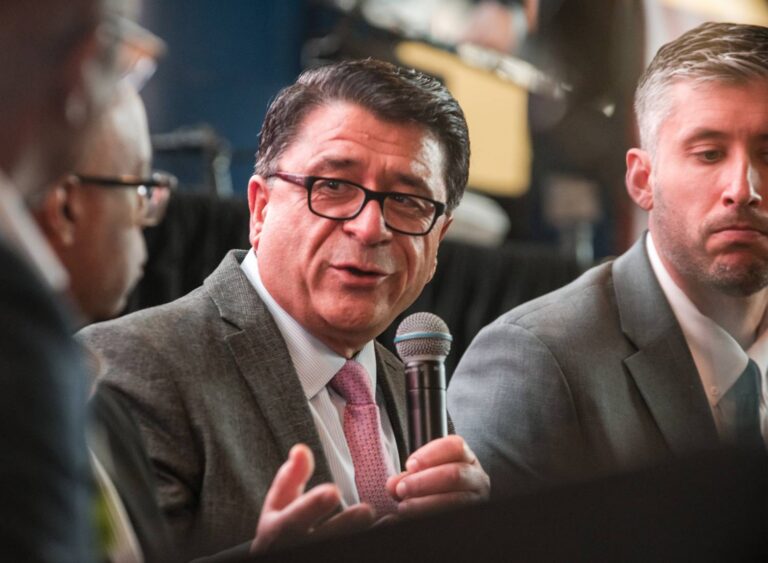







Jeff Hornstein, Executive Director, Economy League of Greater Philadelphia
 In an interview with Invest:, Jeff Hornstein, executive director of the Economy League of Greater Philadelphia, discussed building an inclusive economy, expanding local impact, and leveraging institutional purchasing power for community growth. “We’ve made clear bets on building an economy that reflects the city.”
What changes over the past year have most impacted the organization?
The Economy League is 115 years old, but I treat it like a startup. We’re in a constant state of change, always adjusting what we do and how we do it. Externally, the changing fiscal climate in Washington has added uncertainty. Leading a small nonprofit now means slower payments and more unpredictability. For example, we were working closely with Deloitte on publishing a guide for local, diverse businesses to navigate the complexities of institutional supply chains, the main thrust of our PAGE (Philadelphia Anchors for Growth and Equity) initiative. PAGE is a collaboration between the Economy League and the major eds and meds like Penn, Drexel, CHOP, Jefferson, and Temple. We were ready to send the procurement guide to the printer, but a week before release, the Trump administration issued executive orders threatening consequences for institutions that didn’t distance themselves from diversity, equity, and inclusion programs, and, as a result, many stakeholders, probably wisely, pulled back from the language in the guide. That was a direct hit.
We’ve made clear bets on building an economy that reflects the city. Philadelphia is about 65% nonwhite, yet business ownership is still skewed toward people who look like me. That is not sustainable. Regardless of what people think about race, the reality is that the local economy already does not look like me. If the city and country do not bring in people who do not look like me, there will not be much of an economy left in 25 years. What happens in D.C. affects more than money. Major institutions doing lifesaving research now risk losing funding for using the “wrong” words to describe work that makes the economy fairer.
What role does your work play in addressing systemic challenges in the local economy?
Connecting research to action was a major step. Since 1909, the Economy League has always produced strong research, often for government, but now we apply research to tackle problems and develop ideas others can scale. One example is our work around property devaluation, Know Your Price, Philly. Philadelphia has a high homeownership rate, but many homeowners, particularly those in majority non-white neighborhoods, have seen their houses actually lose value in real terms. That goes against the long-standing American promise that hard work and homeownership build wealth.
Meanwhile, those of us who bought property in Center City 20 years ago have seen our household wealth grow sharply. The gap between value accumulation in nonwhite versus white-majority neighborhoods is truly staggering. The reasons are clear: neighborhood investment or lack thereof, credit access, and structural racism. So, armed with the data, through our Impact Labs program, we launched the Fair City Challenge to crowdsource and invest in promising community-driven solutions to revaluing properties and neighborhoods. We know we cannot fix it alone, but we can spark ideas for others to grow.
I am hoping that our next social impact challenge will address the severe economic opportunity costs of criminal records. Philadelphia has over 200,000 adults saddled with records, despite having supposedly ‘done their time,’ and this is a huge drag on the economy. People serve their time but stay locked out of good jobs, costing billions as they remain stuck in low-wage work. States like Maryland and Illinois have done mass pardons for cannabis offenses, which should be a model for removing barriers.
This is not about ideology but about building an economy that works. Demographics will not change. In 25 years, this will not be a majority-white country. If the business community does not reflect that, the economy will suffer. No administration can stop that. We want an economy that is ready for that reality.
What lessons have you learned about expanding local economic impact?
We keep learning. My deputy director, Kenyatta James, shaped our modern PAGE initiative. One lesson is that institutional supply chains are more complex than we thought. We started with universities and hospitals because they are anchors that buy large volumes and are mission-driven, meaning their actions should positively impact the community.
When I was a Penn grad student in 1990, I worked as a bouncer and walked students home because the area was considered unsafe. Penn invested billions in local retail and real estate, which improved the neighborhood but did not erase poverty. Penn saw the need for “buy, hire, and invest locally” early on, but like so many things in Philadelphia, their great work remained relatively siloed.
Today, Penn, Drexel, CHOP, Jefferson, and Temple employ over 150,000 people, about a fifth of the labor market, and have thousands of open jobs. A real bright spot is the University City District’s Skills Initiative, which works with churches and community groups to identify underemployed Philadelphians and train them for jobs at Penn and other institutions, which can change lives because not only are they good-paying, family-sustaining jobs, but they have great benefits like tuition assistance for employees and their families.
PAGE does something similar to the Skills Initiative for business development. Instead of “train and pray,” we align skills and contracts with real demand. We have data-sharing agreements and work with Stimulus, a Black woman-owned tech firm, to analyze supply chains and find opportunities in sectors like construction and real estate.
We work with the city government to ensure spending helps neighborhoods. We leverage our relationships with the City Council to hold institutions accountable. We help procurement teams find local businesses that can do the work.
One of our most significant initiatives is called the PAGE 100, a portfolio of ‘contract-ready’ local businesses. They may not have big sales teams, but they can deliver. A grant from JPMorgan is helping us create shared back office capacity so small firms can compete or partner with larger ones.
One path to scale is structuring contracts so smaller firms get steady, challenging work. Another is creating joint ventures that build capacity. A $5 million minority-owned construction firm may not qualify for bonding on a $100 million project, but we bring them together with larger firms and build agreements that help them grow. Banks see that performance and raise bonding limits, opening doors.
We also push institutions to share long-term project plans. One big PAGE win was EMSCO Scientific, a Black-owned lab supply company that was stuck at about $10 million in annual revenues and was finding it challenging to break into the eds-and-meds sector. We worked with Penn, the largest purchaser of lab supplies, to restructure its $25 million lab supply contract and helped create a value-add partnership between ThermoFisher and EMSCO. Penn Labs got what they needed, while EMSCO nearly quadrupled in size, built its own building, and now employs 100 people. They are now a regional player importing dollars to pay for jobs in Philadelphia.
We are always looking for the next EMSCO, the next local business ready to grow, create jobs, and build real wealth.
How does research and relationship-building shape your work?
I have a research director who was a management consultant in India for 10 years before coming to Penn to pursue a master’s degree in data science. I happen to teach in her program, and I was so impressed by her, I hired her to rebuild our research department. Now we have an in-house team that produces high-quality research and distributes it as ‘actionable intelligence’ as we call it, through our biweekly Leading Indicators newsletter. The research team also does internal work, like landscape analyses of construction projects and firms, as well as program evaluation.
We spend a lot of time gathering data and analyzing it. Big institutions say they want to do better, but follow-through can lag. I met with a university president recently who asked how engaged his institution had been with PAGE. When I told him that they hadn’t responded to our annual requests for procurement data in almost 5 years, he became visibly annoyed and said that would change, which matters because we cannot manage what we cannot measure. I am at the point in my career where I do not want to just accept a check from an institution that is not aligned with the mission. Unfortunately, there are some institutions that simply write checks rather than do the hard work of changing systems and processes to make them more inclusive. But overall, we have a great ecosystem here, and it always works better to treat them as partners, not adversaries.
How have you approached building financial sustainability for PAGE?
One good thing is that we are far less dependent on institutional contributions than before, as philanthropy has stepped up in a big way, especially since the murder of George Floyd. That brings challenges but helps stabilize us.
One of the biggest moves we’ve made in recent years is tapping into state tax credit programs. The Commonwealth of Pennsylvania gives generous tax credits, up to 95%, to private firms that donate to nonprofits. In sum, a company that was going to donate $10,000 to us can donate $100,000, and after the tax credit, it costs them the same. That’s allowed us to build a cohort of ‘super-donors’ like TD Bank, Comcast, and Independence Blue Cross.
We believe that PAGE can create an engine for growth at the state level. The Commonwealth, under Gov. Josh Shapiro and earlier administrations, has supported nonprofits and understands why we exist: to solve market failures, and so it makes sense to incentivize corporations to contribute. That is exactly what PAGE does. We serve as a ‘concierge’ of sorts between small, diverse-owned businesses and the huge pot of demand, helping firms navigate complex supply chains so they can grow and really build wealth.