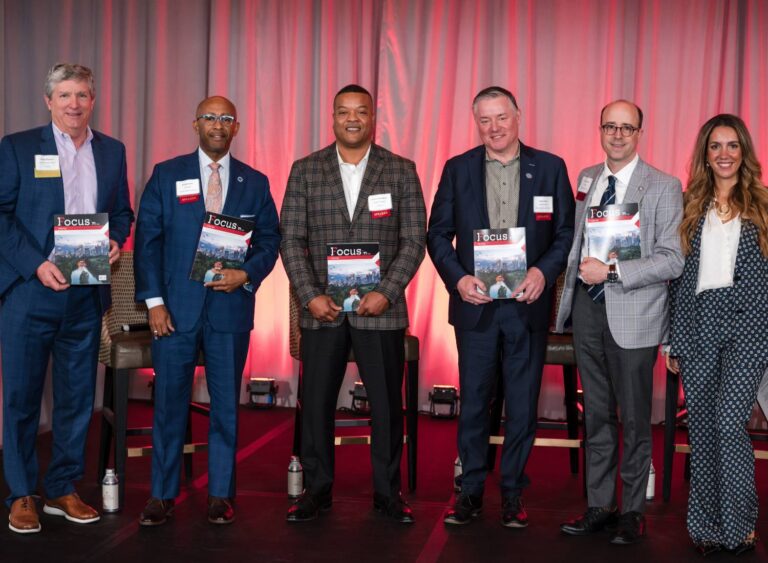






John McNichol, President & CEO, Pennsylvania Convention Center Authority
 Moving past the recovery phase post-pandemic, the Pennsylvania Convention Center remains a key economic driver for Philadelphia and the region. Invest: caught up with CEO John McNichol to hear about the biggest changes in the meetings and events industry over the past year. He also shared how vital the industry is for the regional workforce, and the growing partnership with the Commonwealth to deliver “the most technologically advanced and smart digital offering of any convention center in the country.”
What changes over the past year have most impacted the Pennsylvania Convention Center?
One thing we’ve seen in terms of change is a very positive progression in the return of the meetings and events industry. For a while, we were talking about the pandemic as a recovery phase, but we’re well beyond that now.
We’ve put the pandemic in the rear-view mirror. 2024 into 2025 marks the full recovery of the meetings and conventions industry, as we’ve now returned to pre-2019 levels.
We hesitate to talk much about what we experienced during that time, because it’s in the past and we’ve moved forward, not just at the Pennsylvania Convention Center but industry-wide.
There was a lot of transition and turnover across the industry. Many meeting planners retired or moved on to other roles, and that brought in a new, younger class of professionals. Some have come in with fresh, bright, and innovative ideas; others bring a certain naivete and are still learning the logistics involved in producing large-scale shows at major venues.
Our team continues to be challenged by that evolution in the professional ranks of meeting planners. But it’s not a bad thing, in fact, it’s refreshing. So in a broad sense, that has been the most noteworthy evolution in the industry over the past year.
What types of events or industries have been the strongest drivers of growth recently?
For Philadelphia, because of who we are, where we are, and the types of businesses based here, our strongest concentration has always been in the life sciences category.
As that industry ebbs and flows, you can almost directly track its movement to the business we see coming through the Convention Center. One area where we’ve grown beyond our core in life sciences is corporate business.
We found, particularly during the pandemic, that corporate meetings operate on a much shorter booking window. Whereas a major healthcare trade association might book five, seven, nine, or even 12 years out, a corporate event might book within a year for that same year.
Between 2020 and 2024, we were able to attract and grow our corporate business. That was very important to us, as it represented essentially new business.
Historically, our book of business has included a strong life sciences presence, a couple of large gate shows, and commercial or retail expos. But being able to bring in high-production-value corporate events, meetings, and large-scale conferences has been a strong area of growth for us.
How does the Convention Center support the broader Philadelphia economy?
We’re an important driver of the regional economy, and employ a lot of people. When you talk about the economic impact of a large facility such as ours that brings business to the Greater Philadelphia region, we have around 80,000 people who work in and around the hospitality industry in just the City of Philadelphia.
But beyond that, the business and event attendees that we attract to the region help support the approximately 195,000 jobs in the hospitality sector in the Greater Philadelphia area.
That’s one way that we’re helping put food on people’s tables. We’re giving people great, family-sustaining jobs and wages with benefits. It also gives people a great point of entry, where they might not have much more than a GED or a high school degree, but they can get into the workforce in the hospitality sector or in some of the peripheral sectors. There are opportunities for upward mobility, even without college or advanced degrees.
What sets Philadelphia apart from other cities?
We try to make Philadelphia as competitive as possible so that when someone is looking at a calendar of events, maybe planning the next three conference years from overseas, it’s City A, City B, and Philadelphia. We want Philadelphia to be the most attractive choice on that list.
We recognize that international and national issues can creep into the consumer’s mindset. That consumer might be a neurosurgeon from Europe deciding whether to attend a U.S.-based conference this year, next year, or the year after. Our goal is to make Philadelphia so appealing that it makes sense for her to come this year.
That’s one way we’re approaching the market a little differently. It’s a real value proposition we offer in Philadelphia. Even though our hotels are performing exceptionally well and room rates have grown to be very competitive, we’re still priced below many major metropolitan centers.
We’re more reasonably priced than New York, more affordable than D.C., better than Boston, and yet we offer everything you’d expect from any of those peer cities.
What new features, amenities, or services do you think will be most important for convention centers in the next few years?
We have a couple of exciting things happening from a capital perspective, and some very exciting programs underway. It’s worth mentioning our partnership with the Commonwealth of Pennsylvania, which is also our landlord. They understand and appreciate the value of the hospitality industry and the direct and incremental revenue that comes from a vibrant and successful convention center.
They’ve been incredibly supportive of our capital needs on an annual basis. One of the biggest projects we’ve undertaken in recent years is a full digitalization of our signage package inside the building. We’re aiming to be the most technologically advanced with the most extensive smart digital offering of any convention center in the country.
This aligns with how people consume information today. They’re on their phones and constantly engaging with digital screens. Static signage in convention centers is virtually invisible now, and it’s also expensive to produce, install, and remove.
All of this ultimately lowers costs for our customers. Heading into 2026, we’ll have exciting digital assets available throughout the building. These won’t just be for wayfinding, but also to support customer signage that in the past was printed and hung throughout the venue at a greater expense. It’s going to be very exciting. We’re really focused on it, and I imagine it will generate a lot of attention.
What are your top priorities for the Convention Center over the next couple of years?
I hate to be too cliché about it, but if it’s not broken, you don’t fix it — you reimagine it. So, it’s about doing the same things we’re already doing, but doing them even better. At the Pennsylvania Convention Center, we pride ourselves on being empathetic, putting ourselves in the customer’s shoes and really understanding what they’re looking for when they come to a venue.
I can say that uniquely because my position isn’t driven by profit. I’m not looking to make money off our customers. That happens downstream. What I want is for our customers to be wildly successful in producing their piece of business here at the Pennsylvania Convention Center. The benefit comes to us on the back end, through hotel tax revenue and the incremental revenues generated by the presence of those individuals.