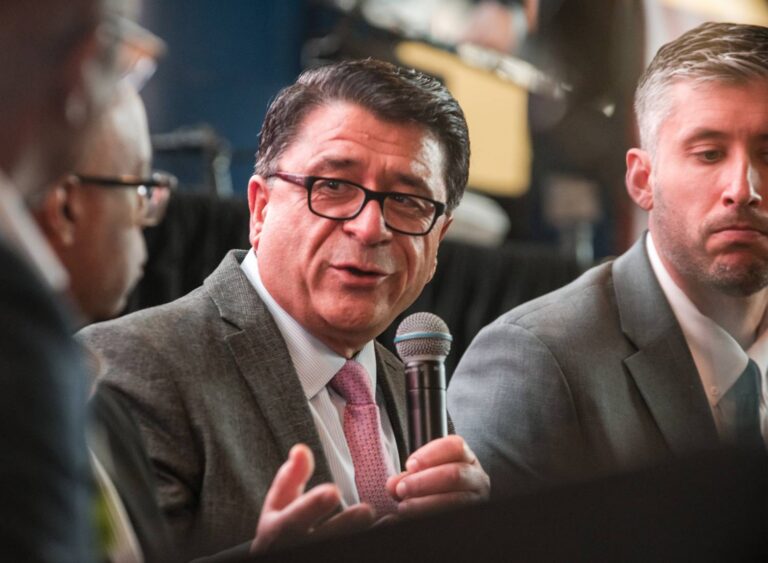






Prema Katari Gupta, President & CEO, Center City District
 In an interview with Invest:, Prema Katari Gupta, president and CEO of Center City District, discussed walkability, collaboration, commerce, and building a vibrant downtown ecosystem. “We want to remind potential residents, visitors, investors, and commuters how vibrant, safe, and inviting Center City truly is,” Gupta said.
What changes over the past year have most impacted the organization, and in what ways?
I became CEO last January, succeeding our legendary founder, Paul Levy, after his 33-year run. A lot tends to happen after a founder transition, and much of our time has been spent on understanding our stakeholders’ priorities as well as assessing organizational culture and systems, while ensuring mission continuity. We worked together as a senior staff to define our mission, vision, and values. Much of the new work we’ve taken on has come from marrying stakeholder conversations with internal reflection and identifying what we see as strategic opportunities.
Our mission is to steward and advocate for a clean, safe, and thriving Center City Philadelphia. Our vision is that Center City is Philadelphia’s heart of commerce, culture, and connection, generating opportunity and prosperity for the city and region.
At our core, we are an operational organization. We clean sidewalks three times a day, provide homeless outreach, and deploy public safety and hospitality ambassadors, whom we call community service representatives. That will always be our foundational work. However, the organization has also created space and resources to take on strategic initiatives.
What strategic opportunities are you focused on right now?
One of Philadelphia’s advantages, and a competitive one, is walkability, especially downtown. We were just named, for the third year in a row, the most walkable city in America. William Penn and Thomas Holmes laid the foundation with a logical street layout with regular blocks that makes navigation intuitive. Our dense, mixed-use downtown concentrates residential high-rises, office towers, restaurants, shops, cultural venues, and services with a small footprint, so that most daily needs can be met within walking distance. Transit brings commuting workers and visitors into the walkable core. Active street life comes from ground-floor retail, restaurants, and businesses that keep sidewalks populated and interesting. Of course, Center City District’s on-street teams work hard to provide supplemental cleaning, public safety, homeless outreach, and hospitality services with the goal of making the sidewalks comfortable and inviting for all.
Our team has focused on leveraging that walkability. We’ve been experimenting with Walnut Street, our main retail corridor, closing it to automobiles on select Sundays through Open Streets Walnut. We just ran the same car-free experiment in Midtown Village. The thesis is that people walking are more likely to spend money at restaurants and retailers than people driving through. We want to treat the street as an extension of public space and create more room for interaction.
These experiments have been successful. Retailers and restaurants have seen significant increases in sales volumes. It’s an exciting initiative that reinforces the idea that downtown should offer experiences where people are surrounded by strangers, all enjoying the city together.
I often think about how Americans love visiting walkable cities in Latin America and Europe, yet few American cities offer that experience daily. It’s worth questioning why those vibrant environments are valued abroad but not always prioritized at home.
To be clear, I’m not anti-car; I usually take the train to work, but today I drove to work and parked in a garage. But parking is essentially a fixed resource, and cars only bring so many people downtown. Walking, biking, and transit unlock much more density and activity, which are essential for a thriving downtown.
How do cities and downtown areas play a role in bringing people together?
In many ways, we are up against the pandemic default setting of staying atomized, spending the day on phones or Zoom. It’s understandable, especially with people working across time zones, but it can make society feel fragmented. That fragmentation has had political consequences, with people remaining in bubbles of others who think and look like them.
The point of a downtown is to bring people together. It’s not enough to gather only in offices or on Zoom. People need physical spaces to interact, and that’s a key focus of our work — supporting residents, employers, visitors, and workers alike. What makes cities magnetic is that they gather people. That is something we need to celebrate and foster.
Center City Philadelphia has remained stronger than many other downtowns because of the growth of its residential population. Over the past 30 years, we’ve built a strong downtown residential base. During the long COVID-19 shutdowns, many of these residents stayed downtown. They continued shopping, ordering takeout, and walking in parks, maintaining their connection to downtown, unlike cities with more commuter-driven populations.
Downtown Philadelphia’s residential population has grown by 27% over the last 15 years, and much of the city’s multifamily construction is happening downtown. This is a place where people want to live, and that, combined with strong retail, great restaurants, and life on the streets, draws people to work here too.
No one wants to sit in traffic for 45 minutes, sit at a desk for eight hours, then drive home another 45 minutes. People want a community at work, things to do before and after work, and choices in how they get there.
These different downtown populations, residents, workers, and visitors, reinforce each other. That mix is what makes a great city.
What makes a downtown area vibrant and successful today?
Modern portfolio theory applies to downtowns; the hearts of cities perform best when they are diversified. A successful downtown needs different groups using it at different times of day. One of my favorite illustrations in a recent report shows how residents, workers, and visitors each have different daily patterns of using the city. For a downtown to feel vibrant, sidewalks must stay populated throughout much of the day, and that diversity of use is critical.
No city feels lively at 3:00 a.m., but achieving an 18-hour city is desirable. We focus on making all these groups feel welcome and comfortable because that diversity is what creates a truly great urban environment.
How are partnerships and collaboration helping fulfill Center City District’s mission?
There have been a lot of positives with a growing residential population, year-over-year return to office increases, and strong retail performance, but challenges remain. One of the major ones is a nationwide homelessness crisis that has affected Philadelphia. It’s a humanitarian issue. While we have a homeless outreach team trained to connect individuals with services, it’s not something we can solve alone. Partnerships are crucial. We work closely with the city government and organizations like Project HOME. Collaboration is the only way to address massive, systemic issues meaningfully.
Another key area is maintaining a clean and green city, which aligns with one of the new mayor’s top priorities. It’s exciting to see renewed focus and energy around these initiatives. One of the unsung heroes of this administration is Sanitation Commissioner Crystal Jacobs Shipman, who brings a creative approach to rethinking long-standing challenges like trash collection and street cleaning.
While we are a sizable organization with resources, scaling our impact requires collaboration. Through partnerships, we can tackle bigger problems and deliver better results.
What is your long-term vision for Center City District, and what are your top priorities?
There are several priorities. First, I want to double down on making Center City the most walkable downtown in America. That means making the streets more welcoming and improving the pedestrian experience.
We’ve been thinking carefully about wayfinding. I recently visited Granada on a family vacation, which has beautiful and intuitive wayfinding, that made the city feel welcoming and legible. There are many models elsewhere that we are studying.
The Open Streets initiative exceeded expectations. We anticipated strong interest, but the response was overwhelming. Now there’s demand to expand it, and we are working to bring it back on a larger scale. Walkability is central to this vision.
However, a city isn’t truly walkable if the sidewalks aren’t clean or if people don’t feel safe. We are working to close the gap between perceptions and reality. Our goal is for everyone, especially women and young people, to feel comfortable walking around downtown.
Operationally, we are always seeking ways to use our resources more effectively and deliver better service. Reliability and consistency are at the core of our work.
At the same time, we must stay strategic and responsive. That means addressing perceptions of downtown, because perception is reality. We want to demonstrate how vibrant, safe, and inviting Center City truly is.
We are also pursuing innovative solutions and partnerships around homeless outreach. And we are fortunate to have a strong, enthusiastic mayor who is taking bold, admirable positions on key issues. It’s an exciting time, and we are committed to helping Center City continue to thrive.