



Raleigh-Durham leaders focus on sustainable growth strategies amid rising construction costs and transit needs

Writer: Eleana Teran
 August 2024 — Raleigh-Durham business leaders are tackling rising construction costs and infrastructure challenges through collaboration and innovation.
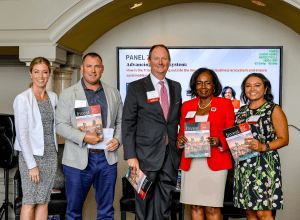
At the Invest: Raleigh-Durham 2024-2025 Launch Conference, leaders across sectors came together to explore strategies for enhancing the Triangle’s business ecosystem. The panel, titled “Advancing the Ecosystem: How is the Triangle thinking outside the box to boost its business ecosystem and ensure sustainable growth?” was presented by Sharon Giddes, Group Manager for Middle Market Banking at Comerica, and moderated by Brian Denisar, CEO of Bobbitt. Experts delved into the region’s challenges and opportunities, focusing on sustainable growth and innovation.
Panelists, including Keith Burns, managing partner at Maynard Nexsen, Brenda Howerton, chair of GoTriangle, and Nicole Sheedy, city sales manager at Delta Air Lines, contributed their insights on the Triangle’s economic landscape.
Denisar set the tone by addressing the multifaceted issues plaguing the construction industry. “Everyone wonders why construction is so expensive, but everything is stacked: construction costs, zoning constraints, lack of supply, and much more,” he remarked, highlighting the complex layers that contribute to the escalating costs in the region. Prices for nonresidential construction inputs, including materials like lumber and steel, have surged nearly 40% between February 2020 and January 2024, according to an analysis by the Associated Builders and Contractors. Specifically in the multifamily sector, while inventory in Raleigh-Durham is expected to grow by 10% in 2024, rising costs and delayed permitting are projected to reduce supply in the coming years. Permitting has already decreased 23% year-over-year, further exacerbating the supply challenges.
Denisar emphasized the importance of optimism and perseverance, stating, “Support the people helping the region grow. Great things are happening, and we need to stay positive and continue to rise to the occasion.” There are signs of relief in the horizon, with construction input prices falling by 0.3% in June compared to the previous month, and nonresidential construction input prices seeing a 0.4% decline. While prices remain slightly higher than a year ago, the recent decrease suggests that the pressure on costs may begin to ease.
Burns underscored the role of collaboration in driving the region’s growth and emphasized the importance of the Triangle’s educational institutions in maintaining its status as a leading tech hub. “In terms of acceleration, we have outstanding universities that provide cutting-edge technology. These great ideas attract the venture capital we need to continue thriving,” he said, reflecting on the ecosystem’s ability to leverage academic excellence for economic advancement. The UNC System exemplifies how regional universities contribute to the Triangle’s success, driving growth in healthcare, high-tech industries, and beyond. It regularly secures significant funding for research, resulting in new patents, start-up companies, and substantial licensing income, enhancing the region’s economic vitality.
Brenda Howerton provided insights into the region’s transportation initiatives, emphasizing the importance of accessible transit. “We have increased our bus services across the region. Existing transit services that serve commuters are changing to reflect the needs of riders,” she shared. Recently, Go Triangle received a $25 million federal grant to improve regional connectivity. This grant will support the construction of the Triangle Mobility Hub, a new multimodal transportation center in Research Triangle Park aimed at improving access across the region.
“We are attracting so many science-based companies to the Triangle; it’s amazing. Even during the pandemic, over 20 companies moved into the region,” Howerton added, underscoring the sustained demand for the region as a business hub.
Nicole Sheedy highlighted the collaborative spirit within the Triangle, noting how it contributes to the region’s unique approach. “What struck me about the Triangle is the collaborative nature across industries. We are proactive, which greatly impacts the region by bringing solutions that address transportation needs,” she said, pointing to the interconnectivity among sectors as a key factor in the Triangle’s progress.
For more information, visit: