






Spotlight On: Allan Rasmussen, President & CEO, HomeTown Bank, N.A.
Key points:
- • HomeTown Bank is leveraging strong regional growth to expand selectively while maintaining its community-focused model.
- • Investment in technology and AI is enabling scale without sacrificing relationship-driven banking.
- • Future priorities include managing fraud risks, adapting to digital trends, and sustaining disciplined growth.
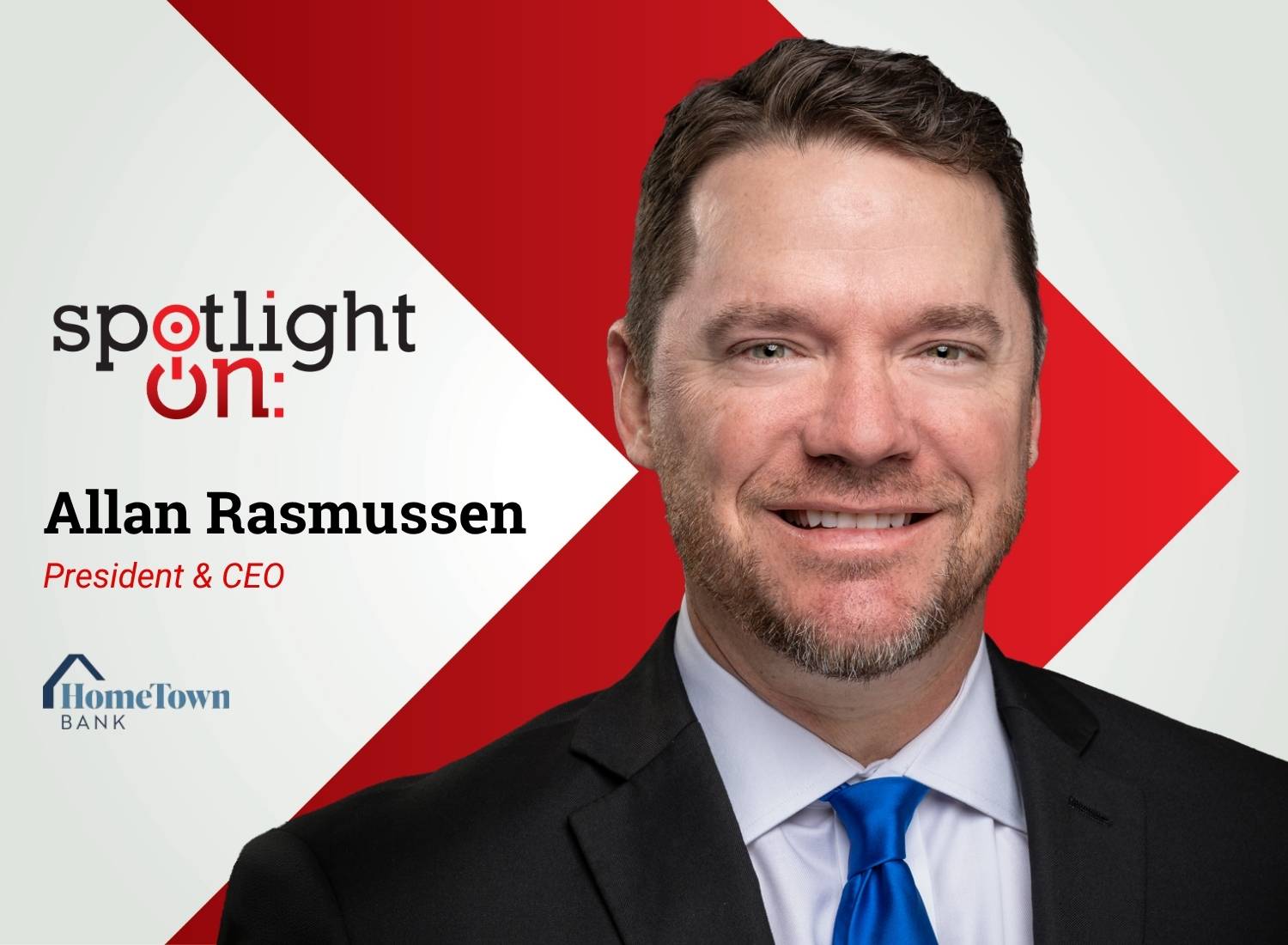 April 2026 — In an interview with Invest:, Allan Rasmussen, president and CEO of HomeTown Bank, discussed how the company is building on a strong 2025 by expanding into new markets, investing in technology, and staying closely rooted in the communities it serves. “We are not trying to be everything to everyone. We are trying to be the right fit in the right places,” said Rasmussen.
What trends have had the biggest impact on HomeTown Bank over the past year?
We had a strong year in 2025. It was a record year for loans, which was a big accomplishment for us, and our earnings were up significantly over 2024. We also introduced and launched some new products and services, and we are expanding into new markets. That has given us a lot of momentum going into 2026.
We feel fortunate to be in the Houston area because the regional economy is so diverse and resilient. Population growth continues, and both residential and commercial development remain strong. That creates opportunities for banks like ours to grow alongside the communities we serve. Our priority is to take advantage of that growth in a way that aligns with who we are as a community bank.
How is Houston’s growth influencing your lending strategy?
We are a community bank, and our culture fits best on the outskirts of Houston rather than in the downtown core. We are in a lot of smaller cities around the Greater Houston area, and when we look at potential new locations, we are studying the communities carefully. We look at school districts, family life, local businesses, and whether that area is a place where our culture can make an impact.
That shapes our lending strategy as well. We are focused on markets where we believe relationship banking still matters and where people want a bank that is part of the community. We are not trying to be everything to everyone. We are trying to be the right fit in the right places.
How are you balancing growth, credit quality, and profitability in the current environment?
We have been fortunate from an asset quality standpoint. Our losses have been minimal, if any, and that comes down to underwriting, communication, and knowing our customers. Sometimes there is a little bit of luck involved because life happens and circumstances change, but disciplined underwriting and strong relationships make a big difference.
Communication is probably our biggest strength. We stay in touch with customers through social media, through direct outreach, and simply by being present in the communities we serve. Because we are local and accessible, people know where to find us, and we know them. We know our customer. That is something community banks talk about a lot, but for us, it is more than a slogan. It is a practical advantage that helps us manage risk and maintain long-term relationships.
How are you thinking about scale as the bank expands?
Technology is the equalizer. That is the biggest thing. We are investing heavily in technology both for our internal operations and for customer-facing products because it allows us to compete on a much larger scale than we could have five or ten years ago.
We recently invested in a new credit and lending platform that includes an artificial intelligence component, and we are evaluating other tools with similar capabilities. Those investments help us improve efficiency, improve service, and create a stronger experience for both customers and employees. For a bank of our size, technology is one of the most important ways to scale thoughtfully without losing what makes us a community bank in the first place.
How are customer expectations evolving, particularly among small businesses and commercial clients?
Everything is moving in a more digital direction. Customers expect more functionality through their phones, their apps, and their online banking experience. That has been a big area of focus for us. We want to make sure our digital channels are keeping pace with what people expect from their bank today.
Zelle is a good example. When the standalone Zelle app went away, banks had to move quickly to integrate it into their own systems. We were able to launch that in the fourth quarter, even though there was a bottleneck across the industry. We also launched a secondary market for mortgages in the fourth quarter, which is something our bank had never had before.
We believe that is going to be a major benefit as we continue growing in communities with a lot of new residential development. Our Board of Directors wants to grow and expand, and my job is to make sure we have as many tools in the toolbox as possible so we are ready to meet those needs.
What is your approach to attracting and retaining talent?
Culture is a huge part of it, and that starts with leadership. It starts with me, with management, and with the board. Communication is central to that culture. When people feel informed, trusted, and empowered to make decisions, they become much more invested in what they are doing.
We have been fortunate with turnover. It has been low for years. We recently had a few employees retire who had, collectively, been with the bank for 70 years. We also have a 50-year employee and several people who have been with us for 20 or 30 years. That kind of longevity says a lot about the environment we try to create.
You have to be fair to people. You have to provide competitive pay, good benefits, and a workplace where they want to come every day. Just as important, you have to give them ownership. When people are only repeating the same task over and over again, they are less engaged. When you empower them and promote from within whenever possible, they start to feel that the bank’s success is their success too. That has been a big part of our growth.
What markets are you targeting for expansion?
We recently executed a lease in Mont Belvieu, which is on the east side of Houston. That is the type of market we like — a growing community with small businesses, residential growth, some light industrial activity, and a character that fits our brand and culture.
We have looked in all directions around Greater Houston, but we are being selective. We are looking for areas where we believe we can thrive as a community bank, not just add another location. That means communities where relationship banking still matters, where growth is happening, and where there is an opportunity for us to support families and local businesses over the long term.
What are your top priorities for the next two to three years?
A few themes are front and center for us. One is digital assets and stablecoin. I think the banking industry is still a ways off from where all of that may eventually go, but it is important that we stay informed. We are working closely with our state and national banking associations and making sure we are educating ourselves as the landscape evolves.
Artificial intelligence is another major area of focus. AI is changing every industry, including banking, and the question for us is how to use it safely and responsibly. It has the potential to improve efficiency and customer service, but it also introduces new risks.
That leads directly to fraud, which is one of the issues that keeps me up at night. I am not just talking about cybersecurity in the traditional sense, but also spear phishing, voice spoofing, face spoofing, and the increasingly sophisticated ways criminals try to deceive both employees and customers. We do ongoing employee training, a lot of social media education for our customers, and we have invested in technology to help reduce fraud risk. AI is going to make that environment even more complex, so vigilance is essential.
What is your outlook for the near term?
I am bullish on 2026. We made a number of strategic moves to our balance sheet that we think will benefit earnings this year, and we have budgeted for a record year. There is a lot of volatility in the world right now, and the interest rate environment still shifts quickly, so we try to focus on what we can control rather than what we cannot.
What gives me confidence is what we are seeing locally. Development is moving. New housing is coming online. Jobs are being created throughout the region. What is happening in Galveston with the cruise industry and shipbuilding, what is happening across the broader Houston economy, and the amount of residential growth all point to more opportunities ahead.
There are thousands of new residents coming into this area, and with that comes demand for homes, services, banking, and local businesses. All of those things support one another, creating optimism and paving the way for HomeTown Bank, N.A. to make an impact for generations. We have momentum from 2025, we made the right strategic moves, and we believe 2026 can be another strong year.
Want more? Read the Invest: Houston report.