






Spotlight On: Christopher Franklin, Chairman & Chief Executive Officer, Essential Utilities
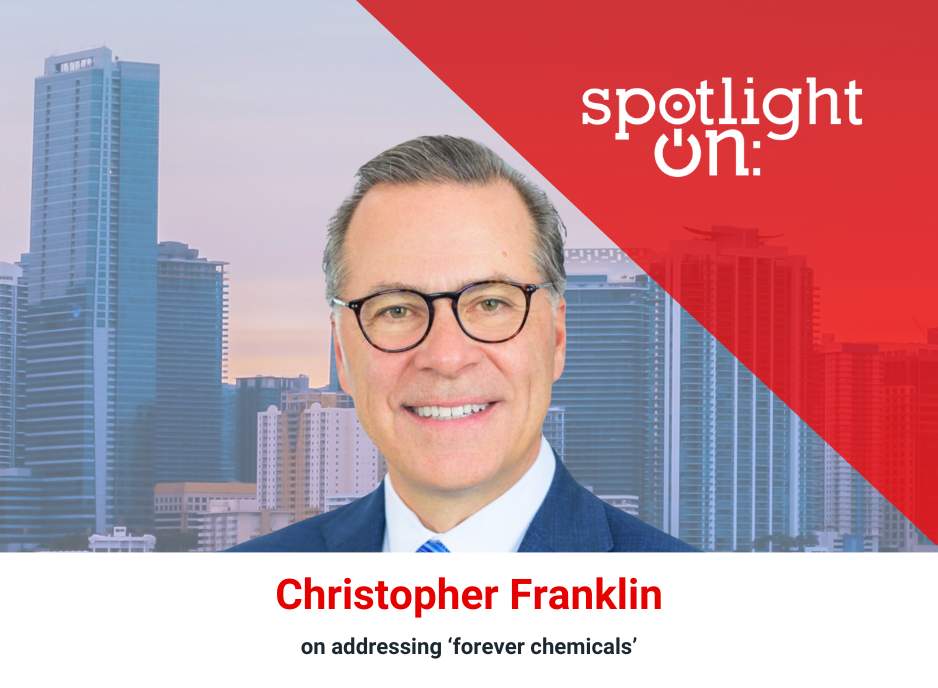 August 2025 — In an interview with Invest:, Christopher Franklin, chairman and chief executive officer of Essential Utilities, discussed regulatory readiness, infrastructure investment, and sustainability. “Our daily operations are rooted in our mission to safely and reliably ensure communities have access to Earth’s most essential resources, including water and natural gas — basic requirements for economic development,” he said.
What changes over the past year have most impacted your organization, and in what ways?
Our region’s utility and infrastructure industry is in a state of active transformation, balancing aging systems and increasing demand with a push towards modernization and evolving federal and state standards. Specifically, emerging contaminants have come under greater scrutiny, and the federal government has now set limits on them, particularly PFAS, commonly known as “forever chemicals.” For a long time, there were no restrictions on these chemicals in our nation’s drinking water supply. An initial advisory set the threshold at 70 parts per trillion (PPT). That was later lowered to four parts, which is equivalent to a drop of water in 20 Olympic-size swimming pools.
Fortunately, Essential didn’t wait to act – our water subsidiary began testing its water systems for PFAS nearly a decade ago, and with new regulations finalized this year, we had already sampled every water entry point in our nine-state system and knew exactly where PFAS was present. Our internal limit was already set at 13 parts per trillion, well below the initial advisory, and we began mitigation efforts early.
As regulations continue to evolve, we know this work cannot wait, which is why we invested $27 million in PFAS mitigation across our footprint in 2024 and anticipate spending about $450 million to mitigate PFAS over the next five years. We’ve sued the polluters responsible for spreading these dangerous chemicals and expect around $75 million in settlements that will continue to drive our efforts to safeguard our water supply. To further offset costs for customers, we aggressively seek alternative funding sources from government loans and grants, while the rest will be financed through standard utility methods.
To increase efficiency, we standardize our mitigation approach across systems. That reduces the need for extra permitting and engineering. We also have a patent pending on our PFOS filtration solution, which we plan to use internally and market to smaller municipal systems.
It’s been a complex and costly effort, but we believe we’re among the national leaders in addressing the PFAS challenge — and it’s the smart and right thing to do to protect public health in the communities we serve.
What trends are you seeing in water and natural gas, especially around customer needs and infrastructure demands?
It is well documented that our country and our region face a significant and dire need for investment to address our infrastructure challenges. The American Society of Civil Engineers’ (ASCE) 2025 Report Card for America’s Infrastructure recently graded our nation’s aging and underfunded drinking water infrastructure as a “C-” and wastewater infrastructure as a “D+.” The ASCE also projected a $3.7 trillion funding gap between current infrastructure investment plans and the funding needed to upgrade existing systems.
These grades underscore what we’ve known for years: our nation’s infrastructure requires urgent, sustained investment to address contaminants and meet evolving regulations as systems age. Over the past five years, we have actively invested in vital infrastructure to ensure the safety, reliability, and sustainability of essential services for generations to come. We will continue to be part of the solution with thoughtful, ongoing capital investment over the next five years.
In our natural gas operations, our top priority is always safety. Given that natural gas is a combustible product, minimizing risk for both our customers and employees is critical. This year, we were excited to implement the Itron Intelis 250 meter – a key development that enhances both safety and efficiency.
The Intelis 250 is significantly lighter than traditional metal meters and reads usage with higher accuracy. But its real advantage is its safety features, using advanced technology to detect high volumes of gas or extreme temperatures and shut down automatically if gas flow spikes or becomes excessive to add an extra layer of safety and protection in our customers’ homes.
We installed 30,000 meters last year and plan to install another 60,000 this year, with full deployment expected in the coming years. This initiative represents a major step forward in our commitment to safety and marks a transformative improvement in how we manage and monitor our gas operations.
How are customer expectations changing, and what are you doing to keep services affordable and reliable?
Affordability is a constant priority and a regular topic in our boardroom. Our natural gas utility benefits from its strategic location atop the Marcellus Shale, one of the world’s largest gas formations. This unique advantage ensures a stable, low-cost supply of gas, allowing us to keep commodity prices low.
With stable costs, our attention shifts to capital efficiency and making every dollar count. We are moving forward with aggressive infrastructure upgrades in both gas and water. On the gas side, we’re moving faster than ever, leveraging economies of scale to reduce material and labor costs. By combining the strengths of our in-house crews and trusted contractors, we’re maximizing efficiency and delivering more value with every project.
Consolidating fixed costs across more customers helps stabilize rates and improve affordability.
We’ve been acquiring systems for 20 years, with an acceleration in recent years. The U.S. has 50,000 water systems and 17,000 wastewater systems — far more fragmented than other countries like the U.K. We see a major opportunity to lead in regionalization, improving both efficiency and reliability.
While the need for upgraded infrastructure is great for both natural gas and water, we also understand that increasing rates can cause concern for our customers. The difference between customer assistance available for natural gas versus water is staggering, and we want to secure consistent funding to support customers. We aggressively work to seek out grants and low-interest loans to support our work and mitigate the customer rate impact.
Several of our states, including Pennsylvania, offer Customer Assistance Programs to help our vulnerable customers, keeping their services on while helping them meet their bills in a way that supports them. Last year, we provided around $32 million in aid, and our efforts continue to support more customers and ensure they have the resources they need.
How is the current economic landscape affecting your operations?
We know we must continue to modernize and upgrade our treatment plants, wells, pipelines, and infrastructure to deliver safe and reliable water services in our communities, and the truth is that this necessary work is costly. Interest rates, particularly on our short-term lines, have been a challenge. We file for rate adjustments every two to two and a half years in most divisions. When rates rise, we absorb the cost until the next case, then recover it through updated rates.
This regular cadence helps us manage impacts. It supports our large capital program while avoiding steep rate hikes. We aim for steady, inflation-aligned increases rather than sudden jumps.
Inflation has affected us most in chemical costs, which are critical for water treatment across our footprint. While prices have begun to stabilize in 2025, they remain elevated. In response, we’ve addressed cost pressures thoughtfully, including through rate case filings where appropriate.
Tariffs, on the other hand, have had a limited effect. Most of our key materials, like pipe, are made in the U.S., which provides some insulation from global trade disruptions. We do source some materials from Canada, so prolonged tariff issues could become a concern.
Overall, we’ve weathered economic pressures with resilience without needing significant rate increases tied to inflation or rising interest rates. Our strategic sourcing and proactive planning continue to help us maintain stability for our customers. We haven’t had to raise rates significantly due to inflation or interest rates.
How is Essential working to meet sustainability goals while still delivering reliable services?
The way we do business is a reflection of our commitment to a sustainable, safe, and healthy environment for all our customers. We’ve long seen ourselves as environmental stewards, protecting watersheds for over a century, and sustainability is ingrained in our business strategy – from planning, to construction, to operations and maintenance.
In 2020, when we added a natural gas company, we faced new challenges and responsibilities. We quickly committed to reducing our carbon footprint by 60% over 15 years, using a 2019 baseline level. We opted for a clear, measurable goal rather than a vague net-zero target set far into the future. We’ve made progress already — reducing our footprint by more than 25% through 2023 and remain on track, likely ahead, to meet or exceed the 60% mark.
In New Jersey, Pennsylvania, Ohio, and Illinois, we buy all our power from renewable sources. On the gas side, we’re replacing pipes and tightening the system to cut methane emissions. These are realistic targets and measurable outcomes that not only safeguard natural resources, but are a core competency of our work — and I’m confident we’ll reach our goal.
How do different regional needs shape your approach?
Regional needs shape nearly every aspect of our operations and vary widely, especially in response to weather. From prolonged droughts in Texas to flash flooding in other states, no two regions face the same risks, and that demands a distinct approach.
One powerful example came during a hurricane in Pennsylvania when water entered one of our largest plants for the first time. As conditions worsened, our team shut down power and evacuated. A manager, thinking quickly, told a younger employee to roll down the truck windows in the rain, a lifesaving precaution in case of flooding. The plant ended up with eight feet of water inside. That experience has shaped our engineering decisions in flood-prone areas. Today, we elevate critical systems like electrical panels above potential flood levels. Across our footprint, we engineer for local realities and to each region’s risks.
Regulatory requirements also vary by state, influencing how we manage our financial strategy. We favor using a future test year for setting rates, allowing us to project costs and recover them more accurately. In contrast, traditional methods, based on past expenses, often leave utilities struggling to catch up.
Rate cases are expensive and resource-intensive, typically costing between $1 million to $2 million. By extending the time between filings, we can ease that burden, helping reduce costs for our customers while maintaining high-quality service delivery and reliability.
What risks or challenges do you see ahead for the utility sector, and how is Essential preparing for them?
One of the largest challenges we actively address every day are contaminants like PFAS and lead in water. We address these challenges with ongoing action, and have regularly tested for PFAS since 2017, prior to any state or federal regulations, to ensure water safety.
We’re proud of the work we’ve achieved so far. We’ve constructed new PFAS treatment centers across our footprint and are evolving this work as our world-class technicians find opportunities to develop innovative engineering approaches to help expedite our plans to meet this new standard. A good example of this is in our industry-leading approach to removing PFAS from our customers’ water supply: our significant investment, coupled with our patent-pending treatment approach, allows us to rapidly address these contaminants while meeting new federal PFAS standards, reducing capital costs, and improving long-term maintenance efficiency.
Risk management is at the core of our work. PFOS and other emerging contaminants remain key concerns, and lead is another major focus. A previous federal directive set a 10-year goal to eliminate lead from water systems. Our main lines are lead-free, but some service lines, the connections between our mains and individual homes, still contain lead or galvanized pipe.
We’re well along in removing those lines. Some of the cost is subsidized to help customers who can’t afford replacements. In homes where plumbing still includes lead solder, we use orthophosphate, a safe chemical that coats the pipes and prevents lead from leaching into the water.
The Flint, Michigan, crisis occurred because the water source changed without reapplying that protective coating. We’re determined to prevent anything similar.
Even after removing lead service lines, we’ll continue using orthophosphate. We also educate customers to avoid lead-based materials during home improvements. Raising awareness is essential.
What are your top priorities for Essential over the next two to three years?
In March, we celebrated five years of being stronger together as Essential Utilities. We believe, five years later, our work has demonstrated strength, innovation, and growth – we brought together operational expertise, financial strength, and regulatory credibility to enhance infrastructure, improve environmental sustainability, and provide long-term value to our customers and investors.
Over the next five years, we plan to build on this incredible momentum. We have plans to invest nearly $8 billion in infrastructure upgrades through 2029, including PFAS mitigation and extensive pipe replacement in both the gas and water businesses to tackle critical infrastructure challenges while preparing for future needs.
Our daily operations are rooted in our mission to safely and reliably ensure communities have access to Earth’s most essential resources, including water and natural gas — basic requirements for economic development.
We know that the work we do has a direct impact not only on public health and the wellness of those we serve, but part of our mission is to improve economic prosperity for our customers and our communities. Good infrastructure attracts people and businesses. Pennsylvania, where we’re headquartered, is a great example – with its natural resources and strong communities, it’s well-positioned for growth if utilities and transportation systems are functioning efficiently.
That’s our bottom line: to support economic growth by providing dependable service. It’s a goal our team believes in, and one that benefits the regions we serve.
We’ll continue to set the standard in the water industry and natural gas leadership. As regulatory demands evolve, we are uniquely positioned to meet these challenges with innovation, expertise, and a relentless focus on operational excellence to support our communities and spur economic growth across our footprint.
For more information, please visit:
https://www.essential.co/