






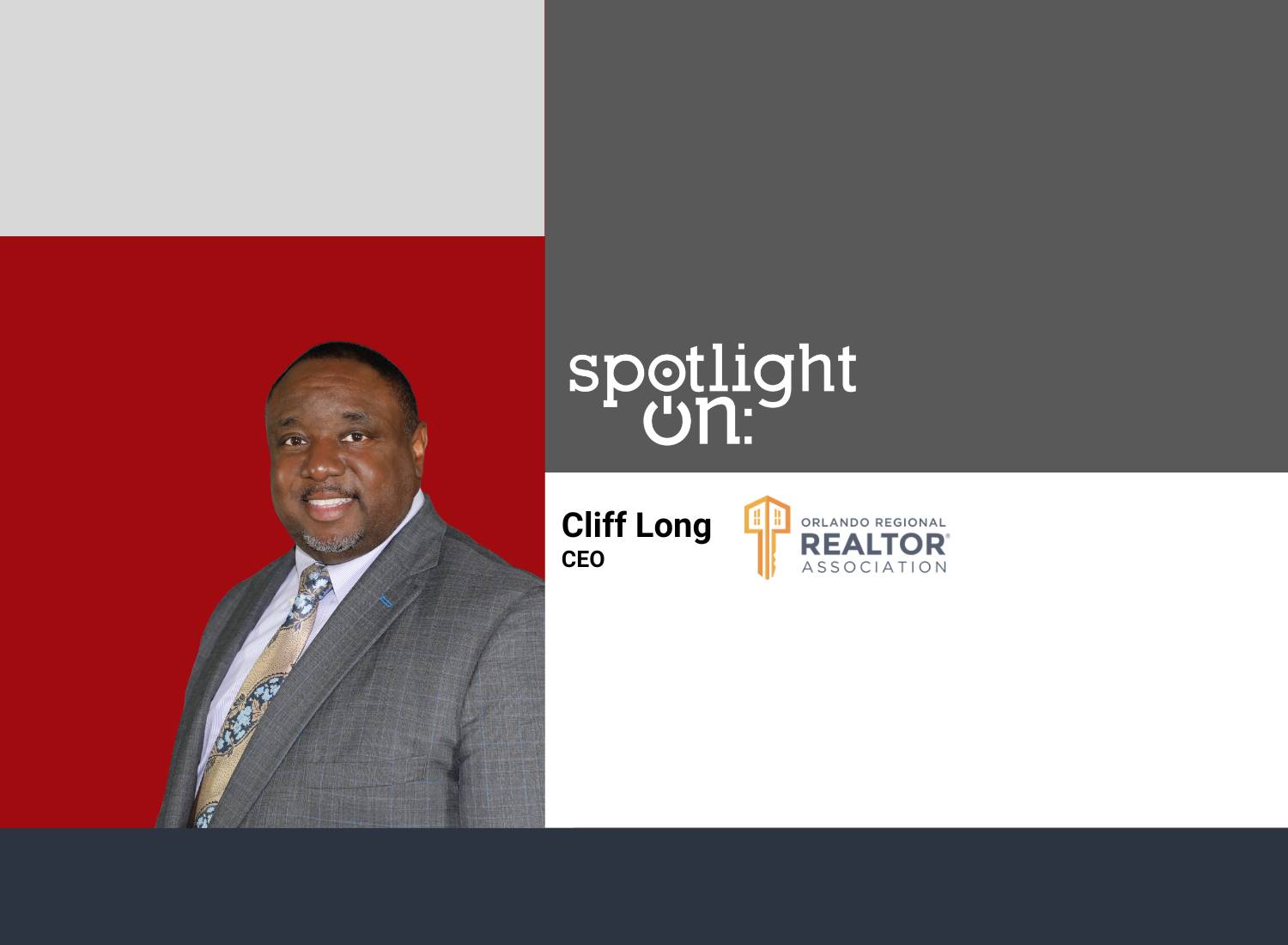
Spotlight On: Cliff Long, CEO, Orlando Regional REALTOR® Association
Key points:
- Orlando’s housing market remains flat to modestly growing, supported by steady population inflows and a tourism-driven economy.
- The association is investing in tech, multilingual resources, and mobile outreach to better serve a diverse, evolving membership.
- Future growth will center on mixed-use, walkable communities as lower rates and global connectivity reshape demand.
 February 2026 — Invest: spoke with Cliff Long, CEO of the Orlando Regional REALTOR® Association, about Orlando’s resilient housing market and how the association is adapting. With steady demand and a tourism-driven economy, activity has remained flat to modestly growing. Long pointed to new investments in technology, multilingual resources, and community outreach as essential to supporting realtors. “It’s about meeting realtors where they are and embedding the association more deeply in the fabric of the region,” he said.
Join us at caa’s upcoming leadership summits! These premier events bring together hundreds of public and private sector leaders to discuss the challenges and opportunities for businesses and investors. Find the next summit in a city near you!
Over the past year, how would you describe the state of the Greater Orlando housing market, and how does the association’s experience reflect broader real estate trends?
The Greater Orlando housing market has ranged from flat to growth, but it has not been a down economy. Our tourism-driven base — anchored by Disney, Universal, the space industry and other theme parks — tends to insulate us from some of the headwinds other U.S. markets face. Because of that, housing activity has been flat to positive rather than negative. Our experience at the Orlando Regional REALTOR® Association closely mirrors those trends.
When the economy is booming and homes are selling quickly, more people view real estate as an attractive career and our membership swells in direct proportion to that demand. When conditions are flatter, fewer people are willing to pursue commission-based work, and membership levels plateau or decline slightly as some professionals seek more traditional, stable roles. Those same cycles influence how our members feel about the association: when they’re thriving, engagement is high; when the economy tightens, expectations and scrutiny rise, and we’re challenged to demonstrate even more value.
Looking specifically at 2025, how have sales activity, pricing, and inventory evolved in Greater Orlando?
We continue to see elevated pricing, driven by fundamental supply-and-demand dynamics. According to data from the Orlando Economic Partnership, roughly 1,000 to 1,500 people per week are still moving into Central Florida. We are not adding 1,000 homes or 1,000 new apartments every week, so as the population grows, the cost of living and the cost of housing increase in direct proportion.
That pressure is reshaping the market geographically. With higher prices around the urban core, more buyers and renters are being pushed beyond the city center into western and northern areas outside downtown Orlando. I wouldn’t characterize the market as unaffordable across the board, but it is certainly more expensive than pre-COVID, and that relative concept of “expensive versus affordable” is increasingly top of mind for residents and policymakers alike.
What recent milestones has the Association achieved to strengthen Central Florida’s real estate ecosystem?
We’ve been very active on the institutional side while our members are out helping people achieve the dream of homeownership. In late 2024, we opened a new 45,000-square-foot headquarters that includes modern classrooms, creativity pods, a media studio and the first dedicated event center between downtown Orlando and Seminole County. Within that facility we launched our Innovation Lab, which is all about connectivity and forward-thinking solutions for our members. The building itself incorporates AI-enabled features, including facial recognition for security, reflecting the way technology is reshaping the industry.
At the same time, we’ve significantly expanded our ability to serve a diverse membership. Central Florida now has thousands of Portuguese-speaking realtors, so we’ve hired Portuguese-speaking staff and begun offering classes and materials in Portuguese. We’re also exploring a third language, French Creole, to better serve the growing Haitian community. Our goal is for our staff, our programs, and our literature to reflect the full spectrum of those we represent.
On top of that, we recently launched a program called “ORRA on the Go.” Think of it as an association pop-up: instead of expecting 18,000 members to come to our building, we bring staff, resources, lockboxes, and even classes into neighborhoods like Dr. Phillips and other key communities. It’s about meeting realtors where they are and embedding the association more deeply in the fabric of the region.
How are realtors adapting to rapid technological change and evolving member demographics?
Realtors have had to learn to integrate technology, particularly AI, into almost every aspect of their business. Two years ago, I listened to a technology expert in Washington, D.C., and he said something that really stuck with me: “AI won’t replace your job. But someone who understands how to use AI will.” That line perfectly captures where our members are today. They’re using AI for virtual office assistance, lead generation and outreach that continues while they sleep, with partners or systems working in other time zones to keep pipelines full. AI supports the creation of floor plans, enhances access to property information and helps build compelling listing presentations.
At the same time, we emphasize that technology must be used responsibly. With increasingly sophisticated virtual staging and image tools, realtors have to ensure that what buyers see online is an accurate reflection of reality — that the room really exists, the yard really looks like that and the pool is actually there.
On the demographic side, we’re seeing millennials and Gen Z emerge as the new heart of the association, but a significant share of our membership is still 55 and older, many of them women, and that group often prefers in-person connection to Zoom calls. So we’re balancing tech-forward tools with the human touch: creating high-tech, high-contact experiences that respect how different generations want to learn and do business.
In what ways are your expanded programs and training initiatives helping elevate realtor performance and customer trust across the region?
Education and information are central to our mission. We’ve expanded our training footprint not just in terms of language access, but also in the scale and focus of our events. A recent example is our “State of Real Estate” program, where we convened elected officials, developers and leaders from across multiple sectors to discuss where Orlando real estate is headed. That gives our members direct insight into where opportunities lie and where they should be concentrating their efforts.
We also provide a steady flow of market intelligence. Members receive weekly updates — what we call a Monday-morning quarterback — that recap weekend sales, as well as monthly statistics that show how and where Orlando is growing. That data helps realtors advise clients with confidence. On the advocacy side, we raised about a quarter of a million dollars this year for our political action committee. Those resources allow us to support candidates who understand the vital role realtors play in the economy and to engage effectively on policy issues that impact housing, property rights and community development. Together, training, data and advocacy help elevate professionalism and reinforce trust in both our members and the market they serve.
Where do you see Orlando’s growth in the near to midterm, and what should investors and developers be watching most closely?
The traditional American dream in my generation was a single-family house with a white picket fence, and that model held for a century. Today’s emerging buyers want something different. Younger generations gravitate toward walkable, mixed-use environments where they can live, work, dine and socialize in close proximity. When you visit cities like Madrid, Málaga, Milan or São Paulo, you see dense, vibrant communities where people interact constantly, and that’s the kind of experience many of today’s residents are seeking.
For Orlando, that points to a future built around mixed-use projects and 15-minute, walkable communities that prioritize sustainability and quality of life. Rideshare and connectivity will be just as important as highways. We already see rideshare pick-up zones at airports and major destinations; over time, communities will be planned with that kind of mobility in mind. Internet connectivity will be another foundational piece, because so many people now work remotely or in hybrid roles. In short, Orlando is going to have to evolve to look and feel more like those global cities — more interconnected, more urban in key nodes and more responsive to how younger generations want to live.
As you look further ahead, what is your long-term outlook for real estate in Orlando?
I’m very optimistic about where we’re headed. Interest rates have already been cut twice this year, and as mortgage rates trend down, more buyers will come off the sidelines. It may not transform the market overnight, but as lenders compete and financing becomes more attractive, we should see demand accelerate and the market heat up again. The underlying supply-and-demand fundamentals are strong, and that typically leads to renewed activity.
Beyond rates, I think the bigger story is how communities will be connected globally by 2030 and beyond. Remote work, high-speed internet and affordable travel mean that professionals can live in one place and work in another, or move fluidly between markets. That reality is going to reshape how and where people choose to live, and Orlando is well-positioned to benefit if we embrace those shifts. My hope is that my generation is ready for the transition and doesn’t cling too tightly to yesterday’s model. The future is coming either way, and I’m counting on the next generation of realtors, developers, and investors to help Orlando lean into that change and thrive.
Want more? Read the Invest: Greater Orlando report.