






Spotlight On: Daniel Diermeier, Chancellor, Vanderbilt University
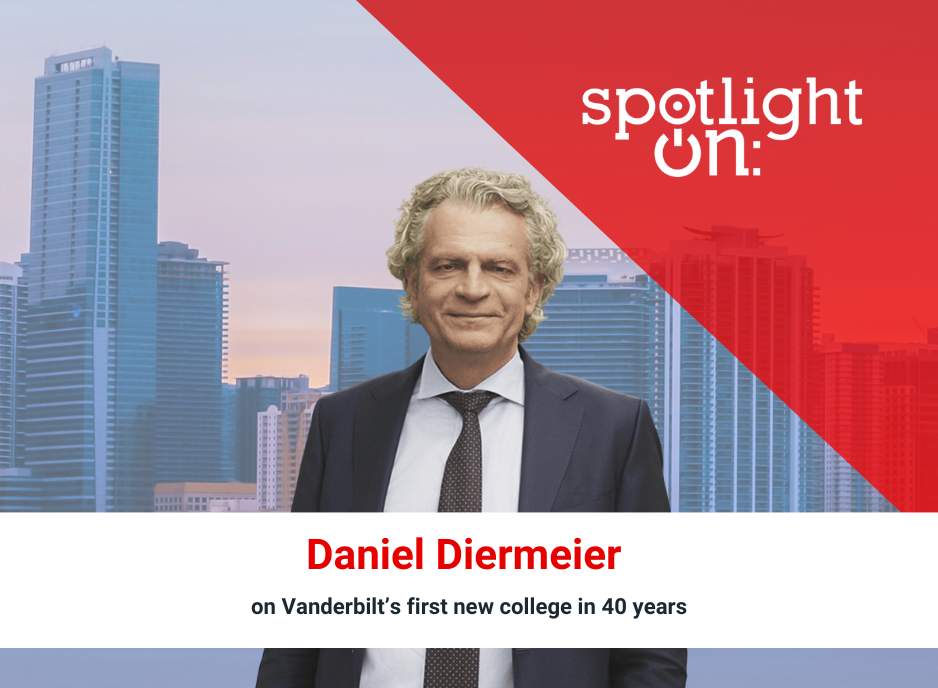 August 2025 — Daniel Diermeier, chancellor of Vanderbilt University, sat down with Invest: to discuss their campus expansion plans in West Palm Beach and New York, what the value proposition of higher education is in modern times, and how Vanderbilt is changing its curriculum to meet the demands of a fast-changing job market.
What changes over the past year have had the biggest impact on Vanderbilt University and in what ways?
We think about our direction at Vanderbilt in three categories. First, we want to be a leader in how we run the university in our core operations. We believe it is important to cultivate an environment where students, faculty, and staff can thrive, and we aim to be a destination for the top talent. By all standards, we have had one of the best years in our history and the demand for going to Vanderbilt has never been higher. The quality of students that we have been able to attract has also never been higher. We have opened a new variety of ambitious academic endeavors, one of which being the College of Connected Computing, and also experienced much success this year in college athletics.
The second component relates to the overall higher education environment. We want to be leaders. There is a tremendous amount of controversy surrounding higher education right now. We believe that it is essential that the American public remember us and trust in great research universities to provide the social impact that comes from being a great research presence and from teaching the leaders of tomorrow. Vanderbilt believes that it is important that every university be very clear about their mission and values. Our mission, our purpose, is to provide transformative education and pathbreaking research. That needs to be grounded in core tenets. For us, that is a commitment to growth and a commitment to providing a community that is both supportive and challenging, which we refer to as radical collaboration. When it comes to our longheld value of free expression, we are committed to ensuring open forums and the practice of institutional neutrality. This means that we will not take political positions on policy issues unrelated to the core functioning of the university.. We also have a commitment to civil discourse. These core components are crucial when it comes to reestablishing trust in higher education.
The third pillar consists of a variety of strategic projects such as the creation of the Vanderbilt Institute of National Security, our College of Connected Computing, and our envisioned campus in West Palm Beach. We have made a similar investment in the Chelsea neighborhood of Manhattan, and that is top of mind for us right now. These are projects that have the potential to be very transformative for the university, but do require sustained effort and investment.
What should be the value proposition of higher education in modern times?
Universities are a clear tool with a purpose. We have a long term, successful partnership between the federal government, general public, and great research universities. American universities are the envy of the world and have an enormous positive social impact on the country, both through their educational mission and as engines of research and innovation. One study has shown that every dollar that is invested in research , society gets at least $5 back. Much of that directly benefits the local economy. Universities have a noble mission of education and research, however we need to make sure that we are clearly communicating that mission and its benefits to the general public and that we are conducting our universities in a way that stays true to the purpose of university and the values that guide us.
How is Vanderbilt adapting its courses and curriculum to meet the demands of a fast-changing job market?
At the forefront of that is the developments in computing and AI, and we are very much engaged in this area. In order to ensure that our students and faculty have an environment where they can be at the forefront of these developments, we have taken all of our assets in computer science, data science and AI and put those into the College of Connected Computing. It is the first new college at Vanderbilt in over 40 years. Our vision for this college is to make sure that it is connected to the entire university, so we can provide students access to these technologies that are in fields other than computer science.
How is Vanderbilt attracting a new student population in order to drive growth?
Applicants have said that our clear commitment to our purpose and values is very attractive. We are not trying to tell people what to think about a certain political issue, rather provide an education that allows them to think on their own. That is a very important aspect of a transformative education. Secondly, we are an environment that allows students to grow both academically and as people. We aim to help develop them emotionally, socially, and educationally.Being located in Nashville is also a very attractive proposition to students.
What made Vanderbilt choose West Palm Beach as a new location for expansion and growth?
We strive to be a model for what a great university of the 21st century should look like. That means that you must be clear about your values. Universities realize their potential best if they are members of an innovation community in a deeply connected fashion. There is much evidence to back this up, and I first realized this when I was a faculty member at Stanford. I could see the creation of the internet economy as a partnership between Stanford and Silicon Valley. It was a magical time with tremendous benefits for the region, the country, and the world. That happens when you have a great university that has complementary strengths in the environment where they are located. For us, Nashville is arguably the healthcare management capital of the country. There is tremendous work in healthtech, and we have an enormous amount of strength in that space, as well as the whole biomedical space. On the biomedical side we are doing great, but there are other areas where we believe we can be leading contributors, and some of the most important work in those areas is being done outside Nashville. South Florida and Palm Beach County have become one of the leading centers in finance, and we are particularly interested in the intersection of finance and technology. When looking at this opportunity, it was natural for us to be right in the middle of a booming economy that has its roots and focus in finance and financial innovation. That was particularly attractive to us.
New York is a slightly different conversation. That is a smaller investment on our side, and there we are interested in being connected to industries where New York is particularly strong, those of which being media, art, policy, finance, and the digital economy. We are focusing on how to create a presence in an environment that has strengths in areas that we can both benefit from and contribute to.
How does Vanderbilt instill leadership and excellence values amongst students?
Vanderbilt has a tremendous track record in educating leaders in a variety of sectors, some of which include science, business, politics, and the military. We aim to create an environment where students can have access to a wide variety of leadership opportunities. A key characteristic right now is that our students need to be able to thrive in a highly politicized and polarized world. That means that even if you believe strongly in one particular cause, you need to be able to interact with those of different viewpoints. That is a cornerstone of our education. We have a whole program dedicated to that called Dialogue Vanderbilt that aims to make sure that we exhibit a culture of civic discourse that enables students to lead in a highly polarized world.
How is Vanderbilt leveraging technology and innovation in preparing students to become successful in the workforce?
You have to be able to provide an educational environment that exposes students to cutting-edge technologies, so it becomes part of their tool kit and is second nature to them. The College of Connected Computing was a key component of that. We have a course on generative AIfor students and the broader world that has around 400,000 participants and is one of Coursera’s most successful courses. It is very important that our students are exposed to leading technologies. Our pre med and biomedical students are working in the lab at 18 or 19, and many go on to publish papers when they leave.
What are the primary challenges facing the higher education landscape at the moment, and how is Vanderbilt working to address these challenges?
We live in two worlds. In the Vanderbilt world, things are thriving. We have fundraising, an unprecedented desire for students to join Vanderbilt, research funding and tech transfer all experiencing record years.
On the other hand, the turmoil, which really accelerated after the Hamas attacks on Israel in October 2023, has created an erosion of trust in higher education and a tremendous amount of political scrutiny. It has led to actions by both the executive and legislative branches. The “Big Beautiful Bill” has quite a substantial endowment tax that will affect us and other universities. We have seen an erosion of public trust in universities, particularly the great American research universities. There are concerns that they are drifting to one side of the political spectrum. Our job is to make sure that we are acting in a way that is appropriate and firmly focused on our research mission as well as the creation and transmission of knowledge.
We need to do a better job in reminding the public of the tremendous value, especially our research, we provide as an engine of innovation in health, energy, communication technology, national security, and economic development. That has been lost or overshadowed because of the drama on university campuses, but needs to be a message that’s front and center for us.
For more information, please visit: