Spotlight On: Douglas Hendrix, Interim Superintendent, Clayton County Public Schools
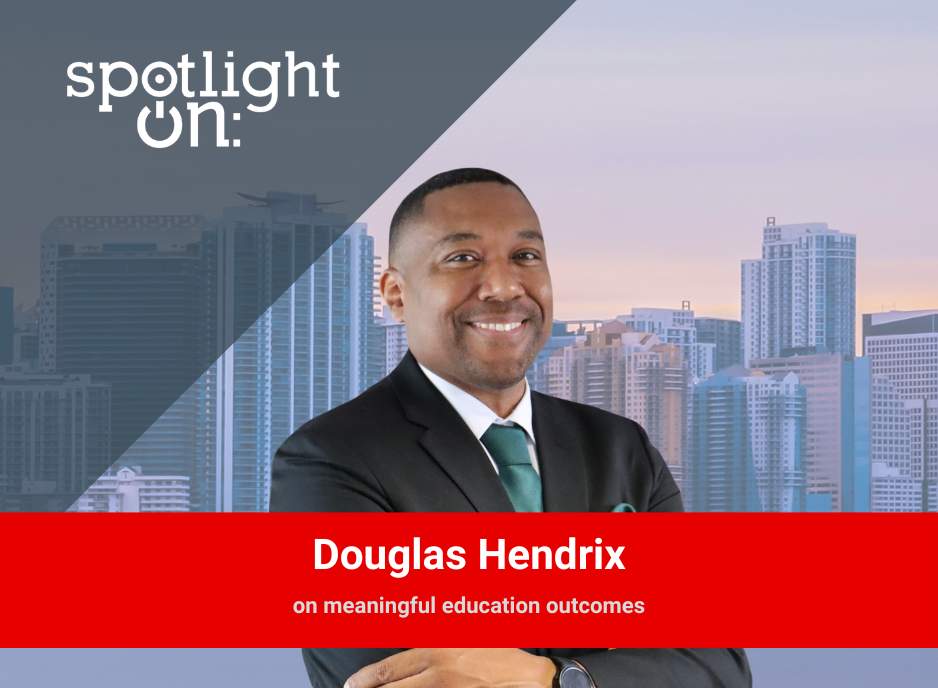 August 2025 — In an interview with Focus:, then Senior Deputy Superintendent – Chief of Staff Douglas Hendrix said, “we’re not waiting for the future — we’re designing the future,” and spoke to how Clayton County Public Schools is addressing that to keep up with the evolution of education. Hendrix also emphasized the shift toward proactive wellness and equitable opportunities to foster future-readiness.
What changes over the past year have most influenced Clayton County Public Schools’ priorities, and how the district is adapting?
This past year has been both a breakthrough and bold recalibration for Clayton County Public Schools. We have seen clear signs of upward academic momentum, with our College and Career Readiness Performance Index (CCPI) scores rising by 18.6 points. Thirty-one of our schools were recognized as “beating the odds” schools, which is up from just 11 a few years ago.
Beyond the numbers, what we have witnessed is a collective resolve to prioritize what matters most: literacy, student agency, wellness, and equity. This mirrors a broader trend in public education where we are seeing a shift from surface-level performance metrics to meaningful outcomes. Across the nation, districts are grappling with how to modernize instruction, ensure safety, integrate technology responsibly, especially with AI, and prepare students for an uncertain future. In Clayton County, we are not waiting for the future; we are designing it.
What are some current key strategies supporting social and emotional development, such as the YES Initiative and the Opportunity Room?
We still have those programs and continue to use them to understand why children respond the way they do. The YES Initiative and Opportunity Room help students reflect on their behaviors. We are proactive in our approach, as discipline for us is synonymous with teaching. Our goal is to educate and transform, not punish. Sometimes this means bringing students into these specialized spaces to identify challenges, address them, and reintegrate them into the classroom as better-equipped individuals.
Additionally, we have incorporated executive functioning training. This teaches self-regulation and organizational skills, which are often at the root of behavioral issues. We are implementing this as early as pre-K, so children carry these skills throughout their academic journey and beyond.
What specific investments or approaches are being prioritized to strengthen early literacy and numeracy across the district?
We always emphasize that our children grow up, so our efforts must start early. This year, we launched a K-1 initiative focused on two primary blocks: literacy and foundational mathematics. Our goal is to have all students reading by second grade. Historically, this has been challenging, partly due to gaps in teacher training and teacher-retention. To address this, we have collaborated with Learn4Life, The Rollins Center – Atlanta Speech School, and Hanover Research to develop a guaranteed, viable program ensuring every student transitions from learning to read to reading to learn by third grade, though ideally sooner.
We are not abandoning social studies or science but integrating them within these foundational blocks. Additionally, we are incorporating executive functioning to help children organize their thoughts and behaviors. Early literacy is a human crisis we are determined to solve, not just for our district but as a model for others with similar challenges.
How is the district expanding access to programs like Advanced Placement, Dual Enrollment, STEM, and the arts?
Education requires lifting both the floor and the ceiling simultaneously. While we focus on early intervention, we must also identify and nurture gifted students. We offer advanced placement courses at all of our high schools. We have the number one middle school in the entire state of Georgia — Elite Scholars Academy — who also boasts a 100% graduation rate. We have a growing number of STEM-certified schools at all levels. However, advancement is not limited to academic enrollment in a traditional higher education institution.
Our No Dead Ends:4E Framework — enrollment, enlistment, employment, and entrepreneurship — ensures every student has a path of promise after graduation. We provide internships, including opportunities to work with the school board and other school district divisions to gain firsthand experience in a myriad of career options. Partnerships with organizations like Clayton State University, Georgia State University, Mercer University, Georgia Power and Atlanta Gas Light further expand opportunities. And collaborations with companies like Delta Air Lines are helping us establish pipelines to viable professions such as aviation. Genius comes in many forms, and our role is to help students explore their interests. Success is not confined to one field, and we aim to cultivate talent in every discipline.
What progress has been made in closing opportunity gaps, and which strategies are most effective?
Future readiness is key. Our No Dead Ends: 4E Framework ensures students plan early for post-graduation through internships, career training, and partnerships. Delta, for example, contributed $2.5 million to support these efforts.
We are also addressing distractions. With Georgia’s Distraction-Free Schools Act, we are balancing technology use as we prepare students for the future without sacrificing human connection. Wellness remains central, with school-based health clinics, wellness rooms, and even grocery stores in schools to remove non-academic barriers. As AI becomes prevalent, we are integrating it responsibly to enhance instruction while preserving creativity and equity. Our goal is to provide every student with the tools to flourish.
What plans are in motion to ensure that all students are future-ready with emerging technological tools while also being safe and maintaining the human element?
AI is prevalent, and we believe in harnessing this technology. We believe that the opportunities for our children will live in all the new advancements. Right now, we are in the early stages. We have just started writing guidance documents to ensure academic integrity, children’s safety, and all of those critical factors are in place as we begin exploring how AI can assist us without replacing human relationships, critical thinking, and creativity.
Our fear sometimes is that when you hear certain conversations, you hear that AI could take the place of teachers or diminish people’s creativity because now they do not have to think, as all they have to do is input prompts, and it regurgitates information without requiring deep thought. We want to ensure that our children are forerunners with AI. They should know how it works, how to interact with it, and how to take ideas and infuse them with AI to create something greater than imagined. It should be human-powered, not AI-powered. Ideas must stem from human creativity, human wonder, human desire to solve problems, human empathy, and the human desire to help others.
We are in the very early stages with AI, to be honest, as we are preparing policies to deal with it. But we are looking toward the future. We are examining how it can assist us with tasks that traditionally take a long time, how it can enhance education, how it can streamline operations, and how it can prepare students for the future without replacing the human element or stifling creativity. Right now, our focus is on policy, but very soon we will dive deeper, particularly in our STEM locations, to integrate AI as part of the learning experience. We want our children to explore these tools early with a problem-solving mindset. Education without empathy is empty.
How do you see the role of public education evolving over the next decade, and where does Clayton County fit into that future?
The evolution of education is necessary because, frankly, public education has not kept pace with the evolution of humanity. I often ask: When was the last time you visited a Blockbuster Video? When was the last time you rode to work in a horse and buggy? And yet, if you walk into many classrooms today, you will see rows of desks, a teacher at the front, and a board used for communication, which are all methods designed for a generation that no longer exists in a world now shaped by AI and other advancements. We are teaching children from our past rather than their future.
Additionally, empathy is the highest form of intelligence, and education must nurture it. If done right, the future of education will not only reveal new capabilities in our children but also make humanity better. It starts with education.
Another point to consider is our available resources. We need to be doing more with less. In some cases, there are fewer teachers available. How do we address that? One powerful solution is integrating human capital with technology by leveraging master teachers who instruct multiple classrooms with in-person support. This approach could also elevate the teaching profession, reinforcing its value. We must also move beyond textbooks and teach children to solve real-world problems collaboratively. Imagine students, even in elementary school, working with the water authority to develop solutions for safe water. We underestimate young minds, but the future of education should unlock their potential in ways we cannot yet imagine.
What are some district developments that you are most excited about?
I would like to highlight some exciting developments in our school district. In the near future, we will open an 8,000-plus-seat arena and convocation center, complete with a Junior Achievement Discovery Center. This will allow Clayton County students to learn about entrepreneurship, financial management, and business growth firsthand.
Our early literacy initiative is gaining traction. Collaboration with nationally recognized organizations like The Rollins Center, Atlanta Speech School, and Metro RESA will help us advance structured literacy and the science of reading.We are also proud of our partnership with Clayton State University, providing affordable housing for teachers so they can focus on educating without financial stress.
Economically, metro Atlanta continues to grow, and as we expand our efforts, we are strengthening our community. We serve over 50,000 students with purpose, not just responding to educational needs but reimagining them. Our goal is to be a beacon not just for Georgia, but for the nation.
For more information, please visit: