






Spotlight On: Joel Samuels, Executive Vice President for Academic Affairs & Provost, University of Miami
Key points:
- • The University of Miami is advancing interdisciplinary research and aligning academic programs with regional needs.
- • Investments in faculty, grant support, and global partnerships are strengthening research and innovation capacity.
- • Strategy focuses on community impact, AI integration, and long-term student career development.
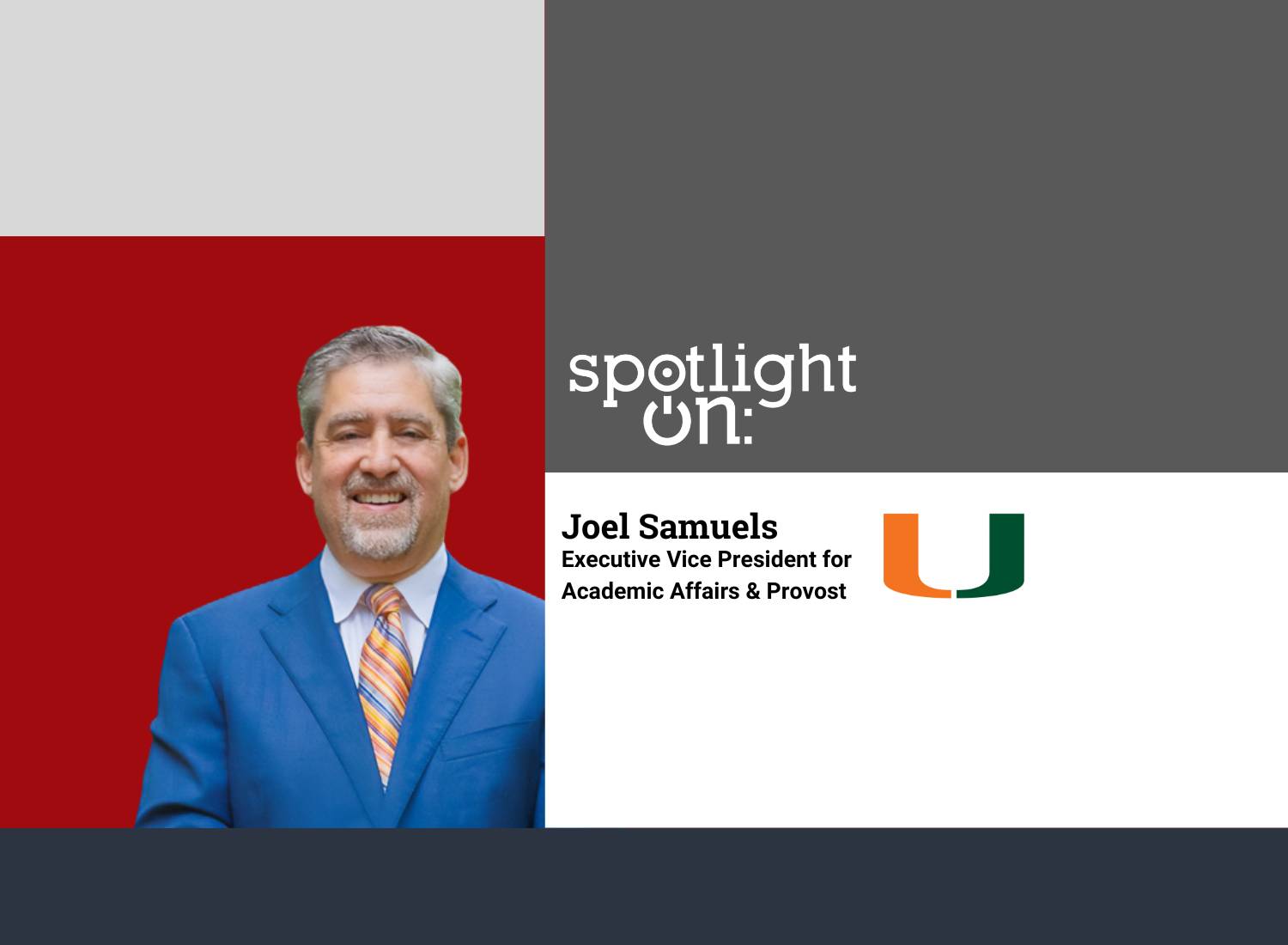 April 2026 — Invest: spoke with Joel Samuels, executive vice president for academic affairs and provost of the University of Miami, about South Florida’s higher education growth and the university’s push for interdisciplinary research, talent, and community impact. “We’re driven by excellence,” Samuels said.
How would you assess the current higher education landscape in Miami, and how is the university positioning itself to thrive within this context?
Like much of the region itself, Miami’s higher education landscape is growing quickly, attracting new talent, and coalescing around a focus on impacting the lives of our community members. At the University of Miami, we are aligning student success, research productivity, scholarly achievement, and outstanding patient care in ways that serve South Florida’s needs.
Our focus is on strategically driving excellence in everything we do. Practically, that means growing in intentional ways and building pathways that connect the work we do across the university. For example, we can take top-ranked programs related to real estate and urban development from across our business school, school of architecture, college of engineering, and school of law, and unite them in a focused way, ensuring that the university remains a strong partner in Miami’s continued growth.
We are preparing students and advancing research to reflect the interconnections across fields and disciplines, and doing so in a way that has a tangible impact on the community. That kind of alignment helps students see how knowledge intersects in careers and in civic life.
What steps are being taken to elevate the university’s research profile, expand federal grant funding, and foster innovation across different disciplines?
We are investing heavily in supporting grant-funded research, including the internal capacity that helps faculty compete for and manage major awards. At the same time, we are building an ecosystem that brings together researchers across disciplines, supporting scholarship that is more connected, more ambitious, and more relevant.
The goal is impactful work that will attract funding, but even more importantly, work that creates enduring change by helping solve some of the world’s biggest challenges.
Following the centennial milestone, how do you plan to build on that momentum to drive academic and research initiatives over the next few years?
I am a relative newcomer to Miami. I joined the University of Miami in August of 2025, and the centenary was one of the driving forces for me to come here, because shaping the next 100 years of the university’s legacy is powerful.
As a community that spans three campuses, we are deeply embedded in this region and are now shifting from celebrating the first 100 years to imagining what comes next. A central focus is excellence in our academic endeavors and bringing together diverse disciplines to develop solutions that address major problems. For a long time, universities and industries often approached problem-solving in silos, but more recently, we have seen real progress when expertise is intentionally connected.
One concrete step is creating a new leadership position on my team: a vice provost for interdisciplinary and international programs. That role will focus on interdisciplinary research and the design of interdisciplinary student-facing programs, while also advancing international partnerships that reflect the university’s role as a gateway not only hemispherically, but across the globe.
How are you encouraging interdisciplinary collaboration across schools and colleges to strengthen teaching, research, and societal impact?
My background is in interdisciplinary research and program development. At the University of South Carolina, I built a center of 60 faculty members dedicated to the rule of law around the world, and I saw how faculty from predictable discplines such as law and political science, and other disciplines like public health, business, education, and the visual arts could come together to advance access to justice in places like West Africa, South Asia, Ukraine, and Moldova.
Having witnessed the power of that collaboration first-hand, I hope to bring a clear understanding to Miami of how interdisciplinary approaches can help us make impactful scholarly contributions to complex problems, and how they can translate into stronger programs for students to prepare for careers.
What strategies will you prioritize to attract, develop, and retain top faculty talent in support of academic excellence and research growth?
Faculty are the lifeblood of any university. For the University of Miami, that means identifying models that make it feasible for top talent to build a sustainable life in an expensive region, while also building communities of practice where scholars can thrive. Interdisciplinary collaboration plays a key role in retention of top talent. We are prioritizing models that support faculty in creating communities of practice where faculty can build research portfolios and catalyze student-facing priorities around the topics that brought them into academia
Many are drawn to the career because of the opportunity to develop an intellectual agenda, find a problem worth pursuing, and pour into it, whether that becomes a lifelong focus or evolves over time.
As an institution, our responsibility is to create the space, support, and environment for faculty and staff to succeed in everything they do, including the ability to find partners, build momentum, and extend the impact of their scholarship.
How can the university further connect its academic mission to community needs and real-world challenges through research, clinical service, and partnerships?
The University of Miami has two active offices whose sole function is to focus on community engagement and community connection. Community-engaged research is a cornerstone principle of the work we do, and I view it as a fundamental responsibility of every institution of higher education.
For us, it is imperative to connect the work we do on our campuses in Coral Gables, on Virginia Key, and in downtown Miami to the lived experiences of communities across Miami and South Florida. That can show up through research partnerships, clinical services that meet community needs, and collaborations with public and private organizations that can translate scholarship into practical outcomes. Because of this approach, we are able to generate solutions that are both academically rigorous and practically meaningful – ensuring that the university contributes directly to the well-being and resilience of the communities we serve.
How do philanthropic partnerships and major gifts factor into your strategy for advancing academic and research priorities that benefit students and faculty?
Philanthropic partnerships play a key role in advancing academic excellence and research growth, whether through individuals or foundations. They are a cornerstone for successful research and academic achievement. Strategially, major gifts help strengthen areas such as faculty recruitment and interdisciplinary research.
We are fortunate to have philanthropic partners across Miami, the country, and the world who support the work we do here every day.
Looking ahead to the next two to three years, what is your vision for elevating the university’s national and global recognition and influence?
We are driven by excellence, and as we move forward with our strategic vision, we hope that will place the University of Miami in a prominent position nationally and globally. We are not driven by recognition. We are driven by the work itself, and I expect recognition will flow from that.
One example is that we are developing an entirely new model for career services for our students. Instead of focusing only on the first job out, we are building a holistic model that begins when a student is admitted and carries through the life cycle of a career, preparing students not just for a career but for life.
On the research side, we are taking an aggressive approach to AI and its role within a university framework, using it to support research and teaching, and preparing students for a world where it will be integral to nearly any career path. Recognizing that developing skills and competence in that space will be a benefit to our students is an important part of the strategy.
Want more? Read the Invest: Miami report.