






Spotlight On: Kevin O’Grady, Chairman, Co-CIO, and Partner, Concord Summit Capital
Key points:
• Capital markets hesitation slowed early activity, but Miami’s fundamentals have reignited deal momentum.
• Demand is diversifying beyond luxury condos, with condo hotels, multifamily, retail, and office all gaining strength.
• Miami is evolving into a full-service real estate market, creating long-term value-add and mixed-use opportunities.
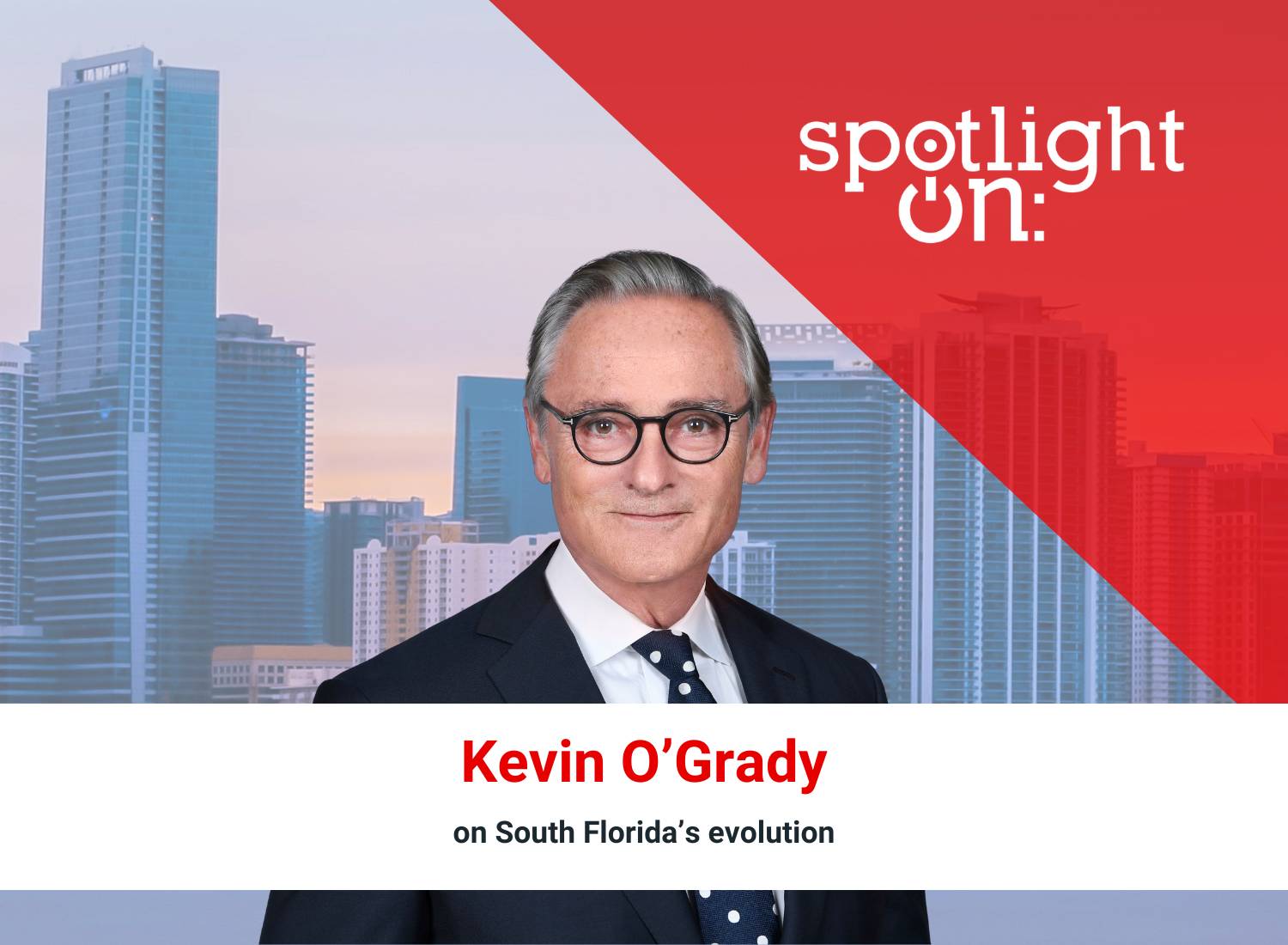 January 2026 — Invest: spoke with Kevin O’Grady, chairman, co-CIO, and partner at Concord Summit Capital, about how shifting capital markets, Miami’s evolution and diverse real estate demand are shaping deal activity. After a slow start to the year, Concord Summit saw momentum return as Miami’s fundamentals strengthened. As O’Grady explained, “You’ve got now a city landscape that is full of all kinds of diversity with regard to product lines, and it makes Miami a full-service real estate market.”
Join us at caa’s upcoming leadership summits! These premier events bring together hundreds of public and private sector leaders to discuss the challenges and opportunities for businesses and investors. Find the next summit in a city near you!
Over the past year, what key milestones and changes have most influenced Concord Summit Capital in Miami, and in what ways?
Coming into the year, the biggest influence on us wasn’t so much Concord Summit-specific as it was the broader capital markets. With the change in administration, most of us expected rapid, forceful policy shifts that would immediately move the Treasury curve and unlock a lot of activity. Instead, many of the early moves created more confusion than clarity, and for the first six or seven months, it was actually harder to navigate the capital markets than people anticipated.
During that period, conditions still felt stagnant. There was lingering inflation, overhang from prior policies, and residual effects from COVID. We were incredibly busy, but because our business is focused on value-add and development projects, not financial engineering around distressed assets, the environment wasn’t ideal. Our sister company, Summit Investment Management, buys nonperforming debt, but Concord Summit is built around a “glass-half-full” view of the market, and we were expecting more forward momentum than we saw in the first half of the year.
What’s changed is that things have begun to relax and normalize. Activity has picked up across firms involved in financing and investment property sales, and Miami’s fundamentals have reasserted themselves. This is now the second-strongest real estate market in the country behind Dallas, and it’s hard to hold things back here. Capital and political flight from other states has continued to flow into Miami, keeping project dynamics strong. We’ve closed 18 deals so far this year, totaling about $3 billion in financings. It’s shaping up to be a good year, even if it’s below the roughly $5 billion volume we thought was possible going in.
Concord Summit recently arranged a $30 million construction loan for a condo hotel project, Brickell Station. How does this transaction reflect current market conditions?
Condo hotels are a compelling alternative product type in a market like Miami. They serve buyers who may not want or be able to purchase a full-scale primary residence at today’s pricing but still want a foothold in the city. A typical two-bedroom condominium of around 1,700 square feet on the mainland might carry a price tag in the range of $2.75 million. By contrast, a condo hotel unit might be closer to a 500-square-foot suite. Even at similar per-square-foot pricing, you’re looking at something on the order of $800,000 instead of a multimillion-dollar commitment.
For many buyers, that works both as a lifestyle and investment play. They can use the unit when they’re in Miami and put it back into a rental pool the rest of the year without managing it themselves. In many cases, the properties are branded by major hospitality or lifestyle names that can “drive heads into beds” and support occupancy and rate.
The Brickell Station transaction was actually a boutique, self-managed, self-branded property. Our role there was to recapitalize the project by refinancing out a construction lender that was having issues. The loan was supported by the fact that all of the units had already been sold, so it wasn’t a highly speculative deal. More broadly, the strong pre-sales we’re seeing in condo hotel and branded residential projects—from boutique properties to marquee offerings—underscore just how deep demand is for this type of product in Miami.
Beyond condo hotels, how is demand shifting across asset classes in Miami, particularly in multifamily and other segments?
What we’re seeing in Miami is the maturation of a once more one-dimensional market into a diversified urban economy. A major driver has been in-migration, led by inflows from California and other high-tax or more heavily regulated states, with another wave likely from New York. That population growth has accelerated the city’s evolution well beyond the old “sex, sand, and sin” stereotype into a more complex ecosystem.
On the ground, that has shown up in layers. Hospitality shifted from a narrow, seasonal window to a year-round business. That in turn supported waves of condo development, then more primary residential living, and a significant expansion of the rental apartment base as new residents arrived as renters rather than buyers. As the residential envelope expanded, so did the retail envelope, with far more restaurants, services, and neighborhood amenities than the city had a decade or two ago.
Post-COVID shifts in major gateway cities have also produced an exodus of office users from markets like New York and other parts of the Northeast. From Palm Beach down through Miami, there has been a surge in office demand. Today, Miami is home to a much more diversified mix of product types—hospitality, condos, apartments, retail, and office—than in the past.
Our own building in the Brickell Financial Center is a good example. When I moved in about five years ago, rents were around $67 a square foot; today they are roughly $145, and there is essentially no vacancy. In nearby Coconut Grove, office rents have climbed into the $120 triple-net range, housing prices have more than doubled in the past two years, and the area is filled with new restaurants, boutiques, and walkable streets. You’ve now got a city landscape that is full of all kinds of diversity with regard to product lines, and it makes Miami a full-service real estate market.
Looking ahead, where do you see the most compelling value-add and development opportunities in Miami over the next few years?
One of Miami’s core advantages is that it still has room to grow. You have a pro-development government and a population that is generally tolerant of thoughtful development. There are still a lot of surface parking lots and underutilized sites that can be redeveloped. In more mature cities, there is little raw land left in core locations, so projects tend to be more complex, involve heavy assemblage, and require replacing existing improvements. Miami is transitioning toward that phase, but it’s not fully there yet.
As that transition continues, you will see more sophisticated mixed-use urban projects. The expertise required to execute large-scale urban mixed-use is both an art and a science, and it will either be imported from experienced developers coming in from other markets or learned locally through trial and error. Developers who cut their teeth building straightforward condo towers are now evolving into sponsors of larger lifestyle and entertainment-driven mixed-use communities. Some of those early efforts were uneven, but the learning curve is clear, and we’re already seeing more confident, integrated concepts coming to market.
The other big theme is Miami’s search for its next identity. Over the decades, the city has cycled through different personas—from the South Beach nightlife scenes to the Miami Sound Machine era to a heavy emphasis on branded luxury towers bearing the names of automakers, designers, architects, and celebrity chefs. That branding focus has resonated particularly with international buyers, especially from parts of Latin America where status is tied to brand associations as much as, or more than, a particular street address.
What we see emerging now is Miami as a hub for health, wellness, and longevity. Early signals came from projects like Canyon Ranch on the beach, and they’ve been followed by a growing ecosystem of health and wellness-focused developments and brands. Coupled with major institutional healthcare campuses and the city’s climate and lifestyle, that’s creating a strong foundation for health tourism. Over time, we believe this will be a key pillar of Miami’s international positioning and a significant source of real estate and financing opportunities as the market evolves from a “sex, sand, and sin” image toward a more mature, globally relevant role.
Want more? Read the Invest: Miami report.