





Spotlight On: Mark Celoni, Regional Vice President, Greater Philadelphia, Pennoni
 July 2025 — Mark Celoni, regional vice president for the Greater Philadelphia region of multidisciplinary engineering and consulting firm Pennoni, sat down with Invest: to discuss the outlook on infrastructure in the region, how the firm continues to embed sustainability into its operations, and various ways it is nurturing the next generation of leaders. “We emphasize career development and retention, aiming to grow talent from within,” Celoni said.
What changes over the past year have most impacted the organization and in what ways?
2024 was a strong year for Pennoni, with profitable growth — one of our founding pillars. We focus primarily on engineering design for civil infrastructure and construction projects. While there’s some caution in certain sectors, the overall market has been positive. We approached 2023 and 2024 with cautious optimism, and both turned out to be great years. So far, 2025 is continuing in that vein. We’ve had very few cancellations or delays. The only exceptions have been some EV charging stations and solar projects put on hold, but overall, the market has remained steady.
Has there been any shift in client expectations?
Clients are coming to us with tighter deadlines, driven by hopes that interest rates will soon drop. We’re focused on anticipating their needs and staying ahead of market shifts so we can deliver projects quickly and correctly, especially in a fast-moving environment.
How would you describe the economic landscape, and what strategies do you have in place to navigate potential headwinds?
Many private development projects are highly sensitive to interest rates. Over the past two years, there’s been a lot of waiting and hoping for meaningful rate reductions, which haven’t materialized. We’re also seeing the effects of both domestic and international construction materials pricing and tracking cost escalation trends that could impact delivery.
How is the firm adapting its services to support clients navigating complex grant and funding environments?
We piloted a new project delivery method with PennDOT. Traditionally, engineers submitted large paper format drawings and detailed specifications, and we have also transitioned to electronic uploads, primarily 2D PDFs. Now using AI, we’ve begun creating 3D models for clients that serve as both bid and construction documents. Notably, we completed the first bridge in Pennsylvania designed and constructed entirely through this electronic process, a major milestone for a government-led project.
Pennoni is adapting by providing clients full-lifecycle support — from identifying funding opportunities to managing post-award compliance — while leveraging our technical depth, multidisciplinary teams, and policy awareness to help clients position projects for successful funding. This strategic approach is especially valuable in today’s fast-evolving and competitive grant landscape.
What role has data and digital technology played in reshaping engineering workflows?
Technology is transforming how we communicate and stay organized. We’ve begun testing new AI tools and are embracing a pilot-first approach. While we haven’t implemented them at full scale, we have moved from paper to 2D images, then to uploads, and now to full 3D model deliveries. The shift is changing how business gets done.
How is the firm embedding sustainability in early planning, as well as long-term design?
We’re involved in large-scale projects in Philadelphia that prioritize resiliency and sustainability. One major example is The Navy Yard, a historic adaptive reuse site spanning 1,200 acres. The site was recently certified by U.S. Green Building Council as the largest LEED Neighborhood project in the U.S. Similarly, The Bellwether District, a 1,300-acre site is being improved as a new home for logistics, life science and innovation leaders. Both sites include new infrastructure elevated and protected against flooding and wave action. The goal for these transformative projects is to build long-term resilience for tenants, with facilities that remain operational over time. They are large and exciting projects, currently under construction, with many buildings already completed.
One of the most rewarding parts of the job is seeing an iconic project move from the design phase to a completed structure in the built environment. There’s a real sense of pride and gratitude in being part of that process.
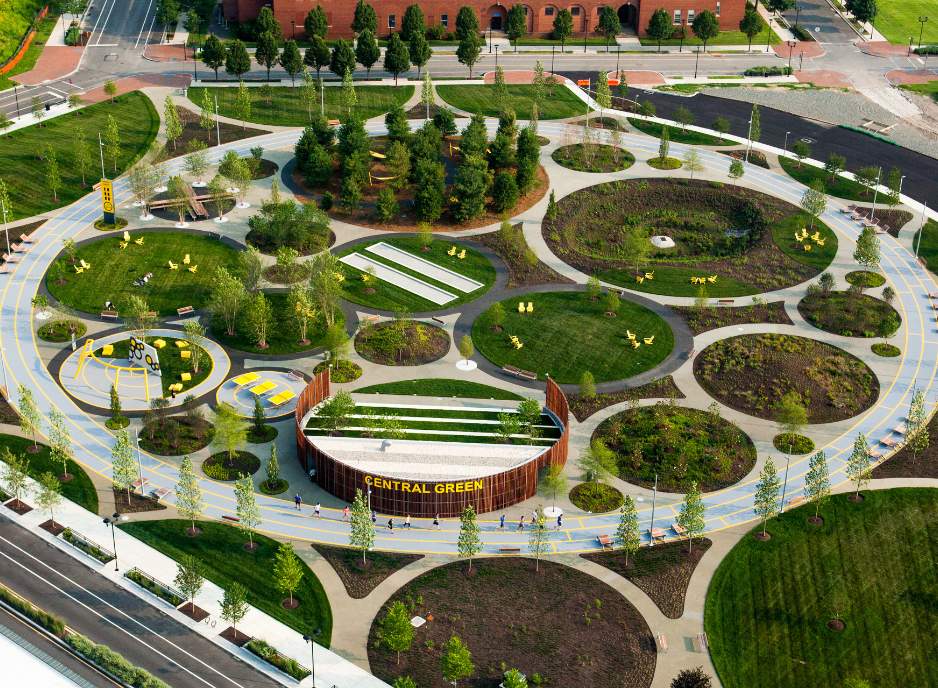
Image provided by Pennoni/Halkin Mason
How is the firm nurturing the next generation of leaders?
Pennoni has been around since 1966 and now operates more than 40 offices along the East Coast. While we’ve been employee-owned since 1994, we recently transitioned to 100% employee ownership. This opens new opportunities for all our employees. One of our biggest challenges — like many firms — is attracting new engineering talent. Fewer engineering graduates and more competition among firms means we need to stand out. We emphasize career development and retention, aiming to grow talent from within. We also look beyond traditional four-year engineering degrees, tapping into environmental sciences, surveying (now tech-driven), and even technical high schools. Skills like drone piloting and operating scanning equipment don’t require a degree, but are vital. We’ve relied on that nontraditional pipeline to remain productive.
The city has also placed increasing emphasis on inclusion and partnering with minority-owned businesses. We’re seeing this not only in procurement but also in development. Pennoni has a long history of leading design projects that intentionally include minority business partners, and we’re meeting new participation requirements with enthusiasm.
Looking ahead, what is your infrastructure outlook for the Greater Philadelphia area, as well as Pennoni’s role in bringing that vision to life?
The outlook is very strong. We expect modest growth in 2025 and 2026, and we’re hopeful we’ll exceed those projections. Major projects like the Navy Yard, Bellwether District, and the I-95 CAP — which will create an 11-acre park reconnecting the historic city center with the riverfront — are particularly exciting. That $300 million project will have a strong return not only for the adjacent neighborhoods like Old City, but for the entire city. It will greatly improve waterfront access and experience. By investing in public infrastructure, we enable private developers to focus on their buildings instead of foundational elements. This supports long-term economic vitality for the region and signals the start of the next cycle of large-scale public projects.

Image provided by Pennoni
Are there any other noteworthy projects in the works?
One major development underway is FDR Park, part of Fairmount Park — one of the largest city park systems in the United States. Adjacent to the sports complex, this $250 million investment will modernize a long-standing public space, transforming it into a high-quality community asset.
Another major development is the South Philadelphia Sports Complex. It is designing a new masterplan with a vision towards upgrading sports facilities and creating a new live-work-play district. The $2.5 billion plan is anticipated to be completed over the next ten years and will significantly improve the city’s ability to host major events.
We didn’t mention it earlier, but 2026 marks the U.S. Semiquincentennial, the nation’s 250th anniversary. Major events like the FIFA World Cup, MLB All-Star Game, PGA Championship, and NCAA March Madness will take place here as part of a year-long celebration. We rarely get opportunities to collectively celebrate our history at this scale.
Throughout 2026, each week will also highlight a “Philly first.” The city has more than 52 notable firsts, and this initiative will generate civic pride and global interest, putting Philadelphia on the world stage.
For more information, please visit: