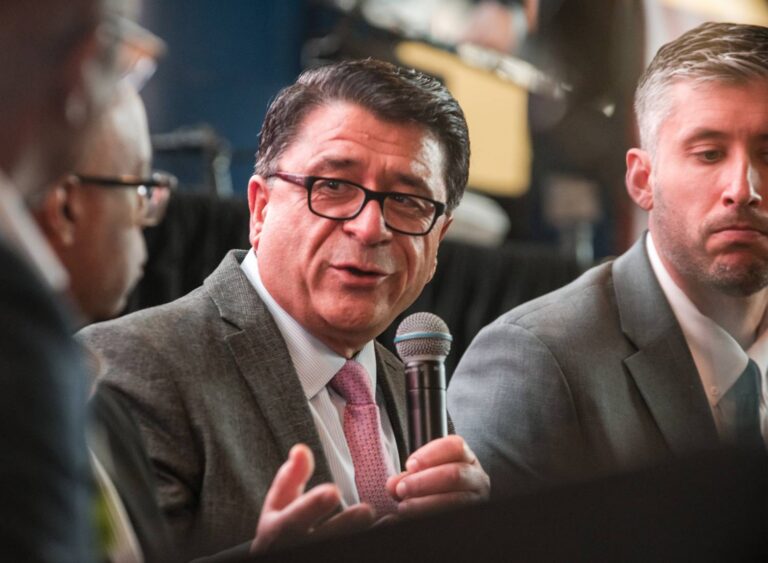
Tom DeLuca, President, Specialty Rolled Products, ATI
 In an interview with Invest:, Tom DeLuca, president of ATI Specialty Rolled Products, discussed the company’s transformation, labor stability, and the growing demand in aerospace, defense, and energy. “We’ve been transforming over the past four years, and last year brought us much closer to our goal. This shift has focused on moving away from commodity products and toward more specialized offerings, particularly in aerospace and defense,” he said.
What changes over the past year have most impacted the company?
We’ve been transforming over the past four years, and last year brought us much closer to our goal. This shift has focused on moving away from commodity products and toward more specialized offerings, particularly in aerospace and defense.
When I stepped into this role, 17% of our revenue came from aerospace and defense. Today, it’s about 42%. That shift required consolidating operations by taking work once done across multiple plants and streamlining it into one. It also meant rationalizing product lines and investing in certain equipment and intellectual property.
In 2025, one of the biggest challenges has been the tariff environment. At the year’s start, there was optimism around a pro-business stance by the incoming administration, but that didn’t materialize. The tariffs we faced were initially not on finished metals but on raw materials like nickel and titanium sponge. Costs also rose for nearly all operational items ranging from things like safety gloves and coil interleaving paper.
At the same time, shifting government policies created instability, and business does not thrive in that kind of environment.
Many of the products we make support the capital goods industry. When markets are uncertain, customers delay capex projects, which negatively impacts demand. We also finalized the sale of one plant and product line, marking a key milestone in our overall transformation.
What impact have recent long-term supply agreements had on ATI’s growth strategy?
Two major developments have driven our growth strategy. The first is our six-year labor agreement, now about six months in, which gives our workforce and our business long-term stability. The last contract negotiation in 2021 led to a strike and customer loss, but we’ve since recovered and actually expanded. This stability is essential to sustaining operations and meeting demand.
Second are the commercial wins. We secured major long-term contracts with Airbus and Boeing. ATI is now Airbus’s largest flat roll supplier and Boeing’s second largest. These contracts are cornerstones in our high-growth aerospace market.
We also introduced a new product: titanium alloy sheet. It is complex to produce and made by only a few companies globally. We made a significant investment in Pageland, South Carolina, and we are in the final stages of commissioning and qualification, for major OEM’s and sub-tier aerospace customers.
This product filled a critical gap in our portfolio. Without this product offering, competitors had portfolio leverage. Now, we can compete across the full range of offerings.
How significant is the new labor agreement with United Steelworkers?
This contract was approved by both parties, and we believe it’s a fair and balanced agreement. It includes meaningful incentives for our employees. When employees are motivated, it tends to lead to stronger output, better engagement, and overall company performance.
What steps are being taken to attract and train the next generation of skilled workers in Southwestern Pennsylvania?
Skilled labor is difficult to find — this is not unique to the region in which we operate — particularly workers with electrical and mechanical aptitude for maintenance-related roles. Our positions are 24/7 and involve shift work, which can make attraction more challenging.
We’ve developed a rigorous testing program and offer highly competitive wages to attract the right talent. Beyond that, we’ve worked in partnership with the United Steelworkers to establish a training center. Original equipment manufacturers (OEMs) provide smaller-scale equipment, and we use that to train operators into becoming skilled craftsmen.
This approach creates advancement opportunities for workforce enrichment while also raising skill levels and boosting productivity on the shop floor.
Where are you seeing the most growth opportunities, and how are you preparing to meet that demand?
Let’s start with aerospace and defense alloys, which are primarily titanium and nickel-based, along with some engineered stainless steels. Every aircraft has a fuselage and at least two engines. We’re fortunate in that our products are used in both.
We’re benefiting from increased build rates at Boeing and Airbus, along with growing market share. That’s a key part of our growth story.
In defense, we’re seeing growth in ground vehicles, air systems, and submarine propulsion. There’s also an emerging opportunity in space. As the United States and other countries invest in technologies such as hypersonic missiles and satellite deployment, the need for specialized materials continues to rise. These platforms align well with our capabilities, both for established programs and for new, advanced systems.
What challenges are you facing, and how are you turning those into opportunities?
One way to think about it is this: ATI’s materials are essential to commercial aerospace platforms.
The biggest challenge has been tariffs and supply chain disruptions. The cost of raw materials has increased in the United States, while international competitors have not faced the same pressures. That allows competitors to offer more attractive pricing, creating a disadvantage for us.
As mentioned previously, skilled labor remains difficult to find. It’s a tough industry to recruit for, so we’ve had to be proactive. We start early by working with trade schools to attract skilled candidates, and we also run college internship programs that serve as a pathway to onboarding. These programs help us assess potential employees, and they give candidates a real sense of the work environment.
I began my own career here as an intern more than 40 years ago. That experience shaped my path, and I share it with new employees to highlight the long-term opportunities available at ATI.
How do ATI’s materials contribute to innovation across key industries?
Our materials serve as enablers across multiple industries. In aerospace, companies such as Boeing and Airbus turn to titanium to reduce aircraft weight. Lighter planes use less fuel and improve efficiency.
In defense, lighter tanks and vehicles offer a logistical advantage. They are easier to move to the battlefield, and once on the battlefield to the front line, requiring less fuel and supply chain challenges to support operations.
In the energy sector, our materials are integral to system performance. Whether it’s a gas turbine, a fossil fuel plant, an SMR (small modular reactor), a nuclear reactor, or a fusion unit, the alloys we produce allow those technologies to operate safely and efficiently under extreme conditions. That’s the value we bring: enabling the performance required for the next generation of innovation.
What are your top goals and priorities for ATI over the next two to three years?
It begins with the markets. We’ve discussed aerospace and defense, but the energy sector, particularly in Southwestern Pennsylvania, is another major area of opportunity.
The rapid expansion of artificial intelligence is placing new demands on the energy grid. This demand is creating a shortfall between supply and the power needed to support AI platforms. In response, energy infrastructure is being expanded. Companies such as GE Vernova and Westinghouse are moving forward with large projects, including plans to build new nuclear facilities.
Western Pennsylvania sits on significant natural gas reserves, which makes it relatively easy for companies to tap into natural gas pipelines and generate power locally. This benefits operations ranging from hospitals and universities to manufacturing plants. There is also renewed interest in traditional power sources and new modular nuclear technologies. All of these require high-performance materials, which is where we excel.
On the more commoditized industrial steel products, the existing tariff structure creates a fairer environment, which helps limit the impact of unfair imports from overseas producers.
Fusion energy is another area to watch. Unlike traditional nuclear power, fusion creates energy by combining atoms rather than splitting them. The process involves intense heat, which is used to drive turbines. These systems rely on magnetized fields and require highly specialized materials. The technical demands are extremely high, and that puts us in a strong position.
Overall, the growth outlook is promising. At the same time, we must continue navigating economic and geopolitical uncertainty. Geo-political developments, in Ukraine, Gaza and the South China Sea, continue to impact capex spending and the global business environment.