






10 key metrics behind Miami’s decade of growth
Writer: Eleana Teran
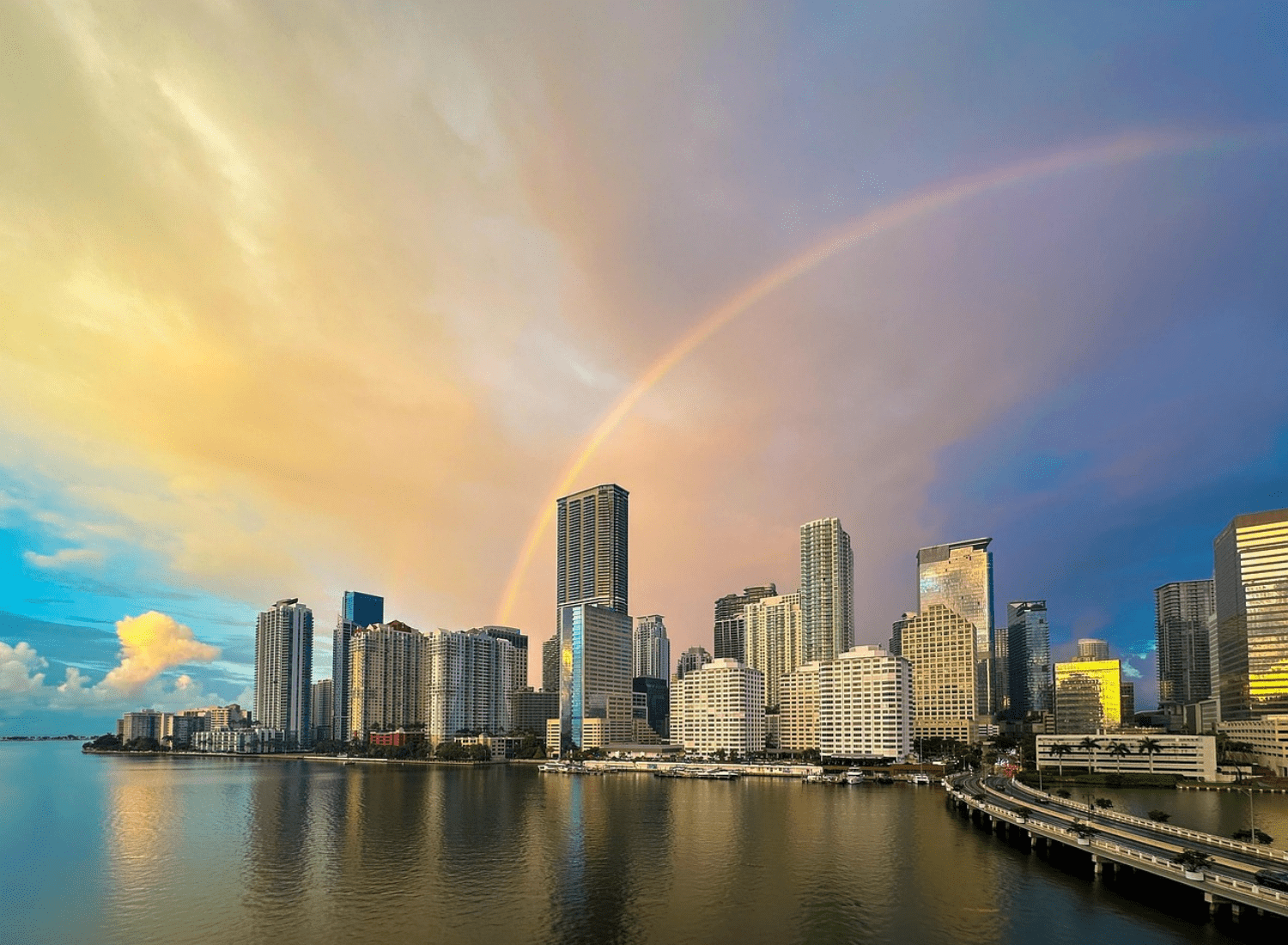 February 2025 — Over the past decade, Miami has transformed into a global economic powerhouse, attracting investment, business, and talent from across the world. The Magic City’s strategic location, business-friendly environment, and rapid economic expansion has solidified its position as a key player in the national and international markets.
From record-breaking population growth to surging foreign investment, Miami’s momentum shows no signs of slowing down. Here are 10 key figures that highlight the city’s remarkable transformation over the last 10 years.
1. Booming population fuels demand
Miami’s population has surged over the past decade, reinforcing its status as one of the fastest-growing metro areas in the U.S. Between 2014 and 2024 the region had over 500,000 new residents.
“Miami’s proximity to Latin America and its diverse talent pool are critical as wealth management evolves,” said Catherine Lapadula, managing director at UBS Florida International to Invest:. “Beyond Latin American migration, Miami is seeing significant internal U.S. migration. Post-COVID, the flow of money has accelerated, driven by favorable tax policies, remote work, and quality of life. The tech scene here is thriving, with fintech and blockchain attracting major players like SoftBank and startups.”
This influx of new residents reflects broader statewide growth, as Florida’s population surpassed 23.3 million in 2024, making it one of the fastest-growing states in the nation, according to the U.S. Census Bureau. The state saw a net gain of 467,347 residents in the past year alone, second only to Texas.
2. Miami leads in business growth
Entrepreneurship is thriving across the country, with new business applications reaching historic highs. In 2023 alone, a record-breaking 5.5 million applications were filed nationwide, underscoring a surge in entrepreneurial activity.
Miami-Dade County has been at the forefront, leading Florida with 127,895 business applications — the highest in the state. The county’s robust business ecosystem continues to attract startups, small businesses, and corporate expansions.
“Miami has long been a logical entry point for Latin American entrepreneurs looking to access the U.S. market. It serves as a gateway, and many companies that start in Latin America aim for Miami as their second market or even establish themselves as U.S. companies from the beginning. Safety concerns also drive this move,” Claudia Durán, managing director of Endeavor Miami, told Invest:. “Domestically, entrepreneurs from states like California and New York are drawn to Miami for its business-friendly tax policies, appealing lifestyle, and relatively lower costs.”
3. Transforming mobility and infrastructure
Miami’s continued growth has driven significant investment in infrastructure to enhance transportation, public safety, and environmental resilience. At the start of her second term, Miami-Dade County Mayor Daniella Levine Cava emphasized the county’s commitment to affordability and transit improvements, highlighting key projects designed to continue to modernize mobility and connectivity.
The Better Bus Project aims to revamp the county’s bus system for greater efficiency, while the South Dade Transitway, a bus rapid transit (BRT) system, is set to launch in summer 2025. Additionally, Miami International Airport’s $9 billion Future Ready initiative is upgrading boarding bridges, escalators, elevators, and other critical infrastructure to enhance its role as a global travel hub.
“MIA is more than Miami-Dade County’s economic engine; it’s Florida’s top economic driver. We generate $118 billion in annual business revenue and support over 700,000 jobs statewide. Our goal is to sustain and grow this impact, ensuring the airport remains central to Miami’s economic future,” said Ralph Cutié, director and CEO of Miami International Airport (MIA) to Invest:.
“The investment is divided into two key components. The first, totaling $1.7 billion, is dedicated to deferred maintenance and modernization, focusing on critical updates such as restroom renovations, conveyance replacements, and infrastructure upgrades. The second component, amounting to $7.4 billion, is allocated to the capital program, which emphasizes expanding and modernizing terminals, adding gates, and enhancing passenger throughput to meet future demands,” Cutié added.
READ MORE: Spotlight On: Ralph Cutié, Director & CEO, Miami International Airport (MIA)
4. Record-breaking cruise industry
PortMiami, the world’s busiest cruise port, continues to strengthen its position as a global leader in the industry. In FY24, the port recorded a historic high of 8.2 million cruise passengers, marking a 12.79% increase from the previous year’s record of 7.3 million travelers.
“The cruise industry has evolved significantly. One of the biggest shifts is how cruise lines are embedding themselves in the local community. When you drive down the MacArthur Causeway, you now see branded cruise terminals lit up at night, reflecting their investment in our city,” said Hydi Webb, director and CEO of PortMiami to Invest:.
This investment is evident in PortMiami’s continued expansion of its terminal infrastructure. “We’ve opened Cruise Terminal V for Virgin Voyages, expanded Cruise Terminal F for Carnival, and unveiled the new Cruise Terminal B for Norwegian Cruise Line. Looking ahead, MSC is building the world’s largest cruise terminal at PortMiami. This facility, at the far east end of the port, will accommodate three ships from two brands simultaneously. Additionally, we will soon be breaking ground on a new terminal for Royal Caribbean Group,” Webb added, reinforcing Miami’s status as the global cruise capital.
5. Expanding global trade connections
PortMiami and MIA are also key trade hubs, with PortMiami handling $40.3 billion in goods in FY23, while MIA recorded $20.2 billion in total trade activity in 1Q24 alone, including $11.7 billion in exports and $8.4 billion in imports. PortMiami’s top export destinations included Honduras, the Dominican Republic, and El Salvador, while MIA’s exports were led by Brazil, the United Kingdom, and Chile.
MIA continues to lead the U.S. in international freight, handling 2.8 million tons of cargo in FY22, representing 83% of all U.S.-Latin America and Caribbean air imports. To accommodate growing trade volumes, the airport is undergoing a modernization program, further solidifying Miami’s status as a global logistics powerhouse.
“We maintained our position as Florida’s top international cargo container port and ranked 11th in the nation. For the 10th consecutive year, we handled over a million TEUs (twenty-foot equivalent units), a benchmark we’re very proud of,” said Webb. “One of our key advantages is the diversity of our trade patterns, which helps insulate us from political or geographic disruptions. About 48% of our trade is with Latin America and the Caribbean, but we also have significant trade with Asia (31%) and Europe (20%).”
READ MORE: Spotlight On: Hydi Webb, Director and CEO, PortMiami
6. A magnet for foreign investment
Miami continues to be a leading destination for foreign investment, ranking No. 6 in the latest FT-Nikkei Investing in America ranking for Top U.S. Cities for International Business. While Houston claimed the top spot, Miami continues to attract multinationals due to its strategic location and global connectivity. In 2022, it ranked No. 1, drawing the highest foreign direct investment per capita nationwide.
7. Top U.S. market for foreign buyers
The city also leads the U.S. in foreign homebuyers, with $3.1 billion in real estate purchases in 2024, accounting for 10% of South Florida’s total residential sales — far exceeding the 2% national average. Buyers from Argentina (18%), Colombia (14%), and Canada (8%) dominated transactions, with Miami-Dade County capturing 65% of all international sales.
8. Strengthening climate resilience
Miami-Dade County continues to secure significant funding to address climate challenges, with over $39 million awarded through the Resilient Florida Grant Program to support flood mitigation, stormwater improvements, and sea level rise adaptation projects. Recent grants are funding efforts such as raising canal banks, restoring environmentally endangered lands, and protecting critical wastewater infrastructure from storm surges.
Additionally, Miami is at the forefront of climate innovation, receiving $2.3 million from the U.S. Economic Development Administration as part of a $19.5 million federal investment in the ClimateReady Tech Hub. This initiative is advancing sustainable concrete technologies, coastal protections, and workforce development in the green economy. Mayor Daniella Levine Cava reaffirmed the county’s commitment to environmental resilience in her State of the County address, highlighting efforts to expand tree canopy in heat-vulnerable neighborhoods and modernize outdated septic systems.
9. GDP on the rise
Miami-Dade County’s economy continued its upward trajectory in 2023, with GDP growing by 3.5%, outpacing the national growth rate of 2.9%. While the broader Southeast Florida region experienced robust economic performance, Miami-Dade’s steady rise underscores its increasing role as an economic powerhouse.
Key sectors driving this growth included arts, entertainment, and recreation (8.6%), health care and social assistance (6.6%), and information services (5.4%). Notably, Miami-Dade was the only county in the region where finance and insurance expanded (2.4%), solidifying its position as an emerging financial hub in the South. With major firms relocating to the area — such as Citadel’s planned Supertall Tower headquarters, set to break ground this year — Miami’s financial sector is poised for continued expansion.
10. Strong job market despite shifts
Miami’s job market remained strong in 2024, with total nonfarm employment rising by 1.7% as of November. The construction sector led the way with a 6.5% gain, reflecting the city’s continued expansion in infrastructure and real estate development. However, unemployment edged up to 2.5% in December, a 0.9 percentage point increase from the previous year’s historically low rate of 1.6%. Despite this slight uptick, Miami’s labor market remains resilient, with steady job creation and a low unemployment rate compared to national averages.
For more information visit:
https://www.ubs.com/
https://endeavormiami.org/
https://www.miami-airport.com/
https://www.miamidade.gov/portmiami/