Spotlight On: Paul Pavlou, Dean, University of Miami Patti and Allan Herbert Business School
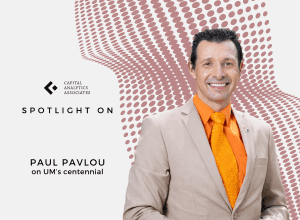
December 2024 — In an interview with Invest:, Paul Pavlou, dean of the University of Miami Patti and Allan Herbert Business School, highlighted the school’s significant milestones, including improved national rankings, and its focus on career success and enhancing connections with Miami’s startup ecosystem.
What significant milestones has the business school achieved since you became dean?
We received great news regarding U.S. News & World Report’s 2025 Best Colleges rankings for our undergraduate programs. Our Real Estate program ranked 12th in the country for the first time, a significant achievement given Miami’s booming real estate market. Our International Business program also ranked at No. 20, with two other programs in the Top 50. However, I’ve told my colleagues not to be satisfied. Our goal is to be among the Top 20 to 25 business schools, and in some specialty areas, the Top 5 or 10. This is part of our long-term strategy.
Two key milestones are ahead: the University of Miami’s centennial in 2025, and the business school’s in 2029. We are shaping our vision around these milestones. My vision is to establish Miami Herbert as the top source of talent for Miami, which is evolving into a diverse business hub of real estate, finance, technology, healthcare, and AI. We aim to provide the best talent for these industries. A major focus is ensuring career success for all our students, from undergraduates to graduates. We’re enhancing career services with personalized coaching from day one, embedding experiential learning across the curriculum, and connecting students with industry partners through internships and year-round engagements. We remain committed to collaborating with industry leaders in Miami and beyond to co-develop the talent pipeline.
How does the business school engage with Miami’s startup ecosystem and connect students with entrepreneurial opportunities?
Entrepreneurship is another area I’m eager to enhance. We’re already ranked in the Top 20, but my goal is to make it a major strategic priority. Miami is becoming a hub for tech and healthcare entrepreneurship, as well as startups across various sectors. On a recent trip to Palo Alto, I expressed my goal to replicate the success of Silicon Valley, where Stanford University has driven innovation and entrepreneurial talent. We’re leveraging connections in Silicon Valley and beyond to equip our students for success, providing training, resources, seed funding, and support to start their own businesses. Entrepreneurship is a university-wide effort, collaborating with engineering, sciences, and other disciplines to develop strong teams for launching startups. Ultimately, we aim to strengthen our role in Miami’s startup ecosystem, helping create and support more successful businesses in the area.
How is the business school adapting its curriculum to address emerging trends like AI, digital transformation, and business analytics?
One area we’ve focused on is analytics, closely tied to AI. AI has been the focus of my research and teaching for over 25 years, and Miami Herbert is fortunate to have a 38-year-old AI institute, giving us a unique foundation in the field. Our approach goes beyond technical mastery. It’s about democratizing AI — embedding it across the curriculum so all students, not just those in technical fields, can use it to enhance their work. For example, AI aids in marketing with customer segmentation, personalized content, and optimizing social media, and similar applications are integrated into finance, accounting, healthcare, and more. We’re committed to training all 4,300 of our students to use AI effectively, boosting productivity and preparing them for the future. While AI has seen hype cycles like blockchain and crypto, we believe it’s here to stay. Like the internet, AI will evolve, and we aim to prepare our students to harness its full potential throughout their careers.
How does the business school support access and student success?
We take access and affordability very seriously, primarily addressing it through financial aid and scholarships. We regularly raise funds for scholarships to attract top students and provide them with the financial support they need. We want financial concerns to be the last consideration for deserving students who want to attend Miami Herbert Business School. I’m also passionate about the return on investment education provides. Yes, education is expensive, even at public institutions, considering tuition, living costs and the opportunity cost of not working. Whether it’s four years for an undergraduate degree, two years for an MBA, or a year and a half for a specialized master’s degree, it’s a major commitment.
That’s why I focus on career success. My measure of success is ensuring our students secure high-quality, well-paying jobs. Last year, we had a 98.3% placement rate for undergraduates, with an average starting salary of nearly $80,000. My goal is to increase the value of a Miami Herbert degree as our reputation grows. But it’s not just about the first job. Education is a lifelong investment that pays off over 40 or 50 years. Networking, professional development, and lifelong career success are critical. The connections students make here—with fellow students, faculty, guest speakers, or executives—are invaluable. While education costs may seem high, the long-term return on investment is tremendous.
What role will the business school play in supporting Miami over the next decade?
I see the business school playing a key role in Miami’s future. Over the last 90 days, I’ve met with more than 200 executives, both locally and across the country, including California. The consistent feedback is that, while Miami offers great attributes, such as business climate, tax advantages, and beautiful weather, companies are most worried about talent. Traffic and real estate costs are concerns, but talent is the top priority. Companies want highly skilled employees in fields like finance, technology, analytics, AI, and healthcare. That’s where we come in — not just producing talent, but co-developing it, working with companies to understand their needs.
I’m also asking companies what they will need in five to 10 years. It’s a hard question to answer, but it’s critical. We need to anticipate the skills our students will need by the time they graduate. Experiential learning is key. I want students to work on real-life projects with local companies, interning in the city, and train alongside professionals. We aim to place many graduates in Miami, helping both companies and the city grow. Miami is now competing with Wall Street for finance jobs and Silicon Valley for tech jobs. Real estate is booming, too. Overall, I believe the city is on a strong growth trajectory, and we want to be a part of that by supplying top-tier talent to take Miami’s businesses, and the city as a whole, to the next level.
For more information, please visit: