


A unified vision for San Antonio’s urban transformation
Key points
- “You have a group of people that want to make it better, and they want to work together to make it better,” said panelist Parker Hensley, market president for the Bank of Texas, about the spirit of partnership in San Antonio.
- Other large-scale collaborative projects are now on the horizon with the passing of Proposition 1, an amendment that will distribute $850 million for the construction of the new campus for the Texas State Technical College (TSTC) in Seguin.
- “I think that one of the most important parts of making sure that we keep our fabric the same here in San Antonio is hiring locals,” he said, adding that Alamo City’s firms and workers are the ones who often invest in the community themselves.
 November 2025 — As urban regions grapple with the dual challenges of expansion and preservation, San Antonio emerges as a model of cross-sector collaboration.
Join us at caa’s upcoming leadership summits! These premier events bring together hundreds of public and private sector leaders to discuss the challenges and opportunities for businesses and investors. Find the next summit in a city near you!
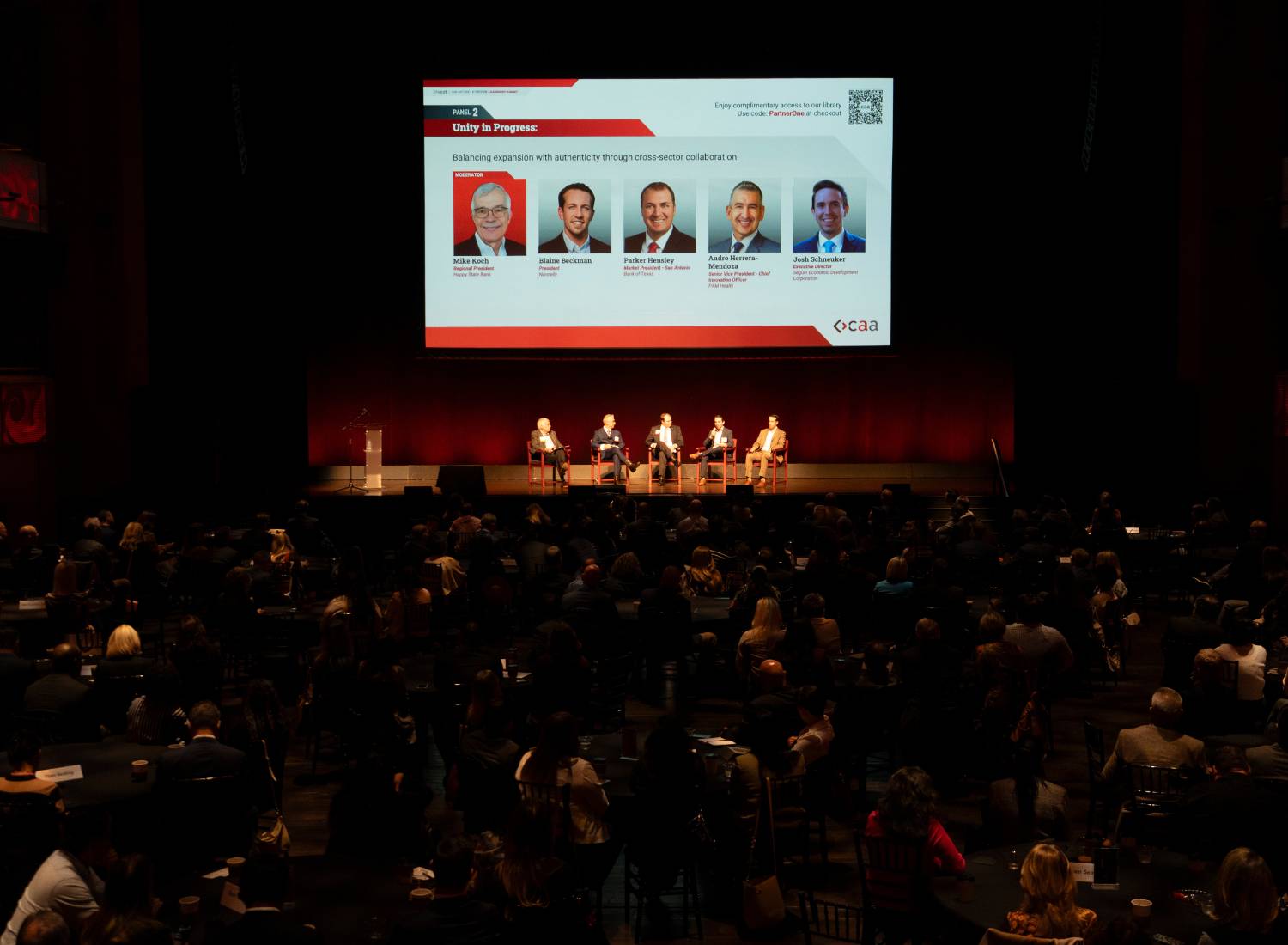
At the recent Invest: San Antonio Leadership Summit, leaders from construction, healthcare, and the public sector gathered to discuss the concept of “Unity in Progress,” focusing on how diverse sectors can come together to foster sustainable development while preserving the unique identity of the region.
“Balancing economic progress, quality of life, and the unique aspects of community are challenging for every region across the country, and San Antonio is no exception,” said panel moderator Mike Koch, regional president of Happy State Bank, to a room of 250 C-level executives.
San Antonio has been one of America’s most populous cities for years, rivaling the likes of bigger metros such as Chicago, Miami, and Phoenix. Yet, this rapid population surge brought on a wave of new development, transforming what was once considered a small, walkable town into a bustling metro area.
In the last ten years, the region’s economic output has grown by 40% — well above the national average of 28%, according to McKinsey & Company.
But that growth, while positive, threatens to rewrite the make-up of the regional economy — which is where collaboration is making a difference, according to panelist Blaine Beckman, president of Nunnelly General Contractors.
“We have to focus not just on the new product that we’re building, “ said Beckman, “but also the area we’re impacting.”
For Beckman and his team at Nunnally, that means growing alongside the culture, the people, and the businesses that are already firmly rooted in the community.
This collaborative approach was underscored by the recent approval of $1.5 billion development in the city’s downtown areas by San Antonio voters. This project, which Beckman described as “exciting”, encompasses a brand new entertainment district and stadium to house the city’s NBA team, the San Antonio Spurs.
Additional plans for the development include an expanded convention center, a hotel tower, revamped Alamodome facilities, new retail spaces, residential lodgings, and upgraded infrastructure.
“You have a group of people that want to make it better, and they want to work together to make it better,” said panelist Parker Hensley, market president for the Bank of Texas, about the spirit of partnership in San Antonio. “I think (collaboration) really is in the DNA of our city and it’s what makes us a little bit unique compared to some of the other mega cities in Texas.”
Other large-scale collaborative projects are now on the horizon with the passing of Proposition 1, an amendment that will distribute $850 million for the construction of the new campus for the Texas State Technical College (TSTC) in Seguin.
According to speaker Josh Schneuker, executive director at Seguin Economic Development Corporation, this endowment will support the growing needs of both future and existing industry in the area.
“This project will ensure that both Seguin and the San Antonio region have the talent in place to remain economically competitive for the success of future industries,” he stated.
The new TSTC campus will train the next generation of workers on essential skills, like manufacturing maintenance, welding, construction, and the trades, which remain in short supply.
“That was really a collaborative effort between city, county, regional organizations, industry, and TSTC to get that institution here,” said Schneuker of the project.
Beckman also observed that these types of projects bolster the regional workforce and help keep talent local — which is pivotal to preserving San Antonio’s cultural identity and “town feel”.
“I think that one of the most important parts of making sure that we keep our fabric the same here in San Antonio is hiring locals,” he said, adding that Alamo City’s firms and workers are the ones who often invest in the community themselves.
For Hensley, that level of local investment is what sets the city apart. “Authentic growth for San Antonio has always been defined and will continue to be defined as capital investment from people who understand our culture, who understand our community, and who are focused on the long-term growth of San Antonio,” he explained.
Want more? Read the Invest: San Antonio report.
Subscribe to Our Newsletters
"*" indicates required fields