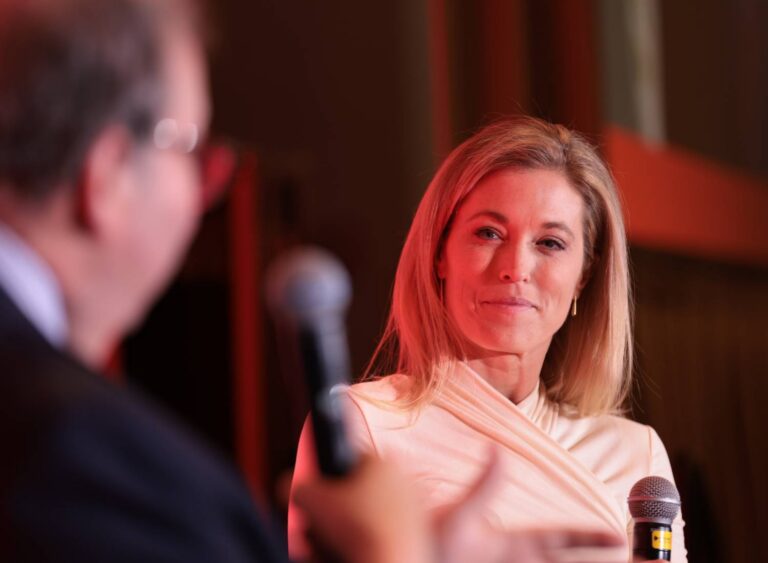







Dana Markham, President, Pine Crest School
 In an interview with Invest:, Dana Markham, president of Pine Crest School, said that equipping students with future-ready skills while instilling ethical values is key to navigating today’s educational landscape. “We know we’re educating students for jobs that don’t exist yet, so our focus remains on developing ethical, collaborative, critical thinkers.”
What have been some of the most significant changes at Pine Crest, specifically in Boca Raton, over the past year?
We’ve had an exciting year. Our students and teachers continue to impress us with their creativity, collaboration, and achievements. One of our high school students told me that he wrote a paper on artificial intelligence (AI) over the summer, on his own accord, and it was accepted at a European conference. He’ll now be traveling to Portugal to present it. These are the moments that truly energize us as educators, especially when we see that our students and teachers are deeply engaged in relevant topics like AI.
We’ve also seen strong philanthropic engagement from our community, which speaks to the strength and support in Palm Beach County. Our five-year strategic plan is progressing, and with the recent growth in the region, we’ve continued to enhance our offerings on both campuses. Over the past several years, we’ve developed a robust entrepreneurship program spanning from pre-K through 12th grade. We’ve built out our AI curriculum, which has been in place for several years alongside our computer science and virtual reality (VR) initiatives.
Enrollment in independent schools, along with public charter and private schools, is strong. We’re seeing new families entering the market. According to the Florida Council of Independent Schools, there are nearly 10,000 children enrolled in Palm Beach County private schools.
How is Pine Crest leveraging technology and innovation to prepare students not just for academic success, but also for their future careers?
I imagine classrooms 10 years from now where every student has their own intelligent learning companion, like an AI learning assistant. This assistant will know students’ strengths, challenges and learning styles. AI tutors will adjust lessons in real-time, offer instant feedback, and even spark curiosity with immersive virtual experiences. We already see examples of these types of AI learning opportunities beginning in our classrooms and with our faculty and staff integrating them in our everyday work life.
Pine Crest is data-driven and regularly study reports from sources like the World Economic Forum (WEF). For instance, a recent WEF report predicts that due to AI, a quarter of jobs globally will change and about 69 million new roles will be created, while 83 million workers may be displaced by 2027.
We’ve been integrating AI across all grade levels from pre-K through 12th grade to enhance learning and spark creativity. But more than that, we want to develop ethical, moral leaders. Our goal isn’t just for students to navigate AI as consumers, but to understand, innovate, and lead.
As AI expert and author of “The AI-Driven Leader: Harnessing AI to Make Faster, Smarter Decisions” Geoff Wood put it, we’re not merely keeping up with technology, we’re helping define how it’s used responsibly in education. That includes teaching students how AI platforms function, how to assess the accuracy and intent behind information, and how to use these tools effectively and ethically. We’re helping students become critical thinkers who ask better questions and can discern truth in a world overflowing with information.
Our “future-ready graduate” framework ensures that students leave Pine Crest with not only the skills but also the mindset to use technology wisely, responsibly, and with integrity.
What should modern K–12 education offer students, and how are schools adapting their curriculum and programs to meet evolving needs?
It really depends on each family’s educational philosophy and what they want for their child. While we can’t customize education entirely for each student, we offer a comprehensive program that resonates broadly.
Our mission focuses on raising children with strong values and ethics. At a recent conference in London, we heard global education leaders emphasize three priorities: developing global citizens, fostering moral and ethical leaders, and cultivating critical thinkers. Hearing that reaffirmed what we already focus on.
One of our standout programs is our entrepreneurship curriculum, which runs from pre-K through 12th grade. It culminates in hands-on experiences, including a partnership with the London School of Economics (LSE), where all Upper School students participate in an Innovation Festival. Students who have an interest in gaining a deeper understanding of social entrepreneurship can apply to a competitive three-year, for-credit course. Throughout the program, students participate in an LSE boot camp in London, a pitch competition with University of Chicago through the Polsky Center for Entrepreneurship, and a global research project with Pioneer Academics, among other enrichment activities. Teaching students to develop an entrepreneurial mindset helps them learn how to collaborate, think critically, lead, manage stress, accept feedback, and, importantly, fail forward. Failure isn’t the end, it’s part of the process. It’s how students build resilience, adaptability, and reflective thinking.
To facilitate the school’s financial sustainability and faculty retention, we launched Pine Crest neXt, which is an organization dedicated to creating customized professional development solutions for educators worldwide. This dual focus initiative is a key differentiator for us.
How does Pine Crest blend academics with sports, arts, technology, and other areas to develop well-rounded individuals?
Some of the most meaningful lessons are learned outside the classroom—on the field, on stage, or through club participation. Recognizing that some students may not gravitate toward athletics or the arts, we created innovation labs more than a decade ago. These innovation labs are where our robotics and entrepreneurship programs thrive. We have four innovation labs across our campuses, and they’re integrated into the curriculum starting as early as pre-K. We want students to see that making mistakes is okay, and it’s what you do afterward that defines you.
How is Pine Crest helping students stay engaged while also managing stress and growing responsibilities?
As a parent, grandparent, and school leader, I know that phones and social media present tough challenges. At Pine Crest, we create space for real connection. We encourage students to put their phones down and just talk. Often, they’ll discover common ground they didn’t know existed.
Pine Crest counselors are well-trained, and we ensure that our faculty receive ongoing professional development in this area. We bring in experts and partner with Nova Southeastern University for additional counseling support.
We also engage parents to help model healthy phone and social media use. We aim to protect childhood for as long as possible, helping kids find their strengths, interests, and sense of purpose. That clarity helps them tune out the noise and focus on what really matters.
Are there new programs or expansions on the horizon?
Yes. While we’re not planning to increase enrollment, we are expanding our facilities. We recently opened a new Center for Teaching and Learning on the Fort Lauderdale campus and added a building to the middle school on the Boca Raton campus.
AI continues to be a major focus. Richard Culatta, the CEO of the International Society for Technology in Education and ASCD, published a profile of what an AI-ready graduate should look like. We’re referring to the profile to guide our future planning. We know we’re educating students for jobs that don’t exist yet, so our focus remains on developing ethical, collaborative, critical thinkers.
For some initiatives, we like to say we’re building the plane while flying it. This mindset led us to develop strong partnerships like with the London School of Economics. We literally flew to London and pitched our vision. Two years later, we’re proud to call them partners.
Pine Crest neXt is a new initiative dedicated to creating customized professional development solutions for educators worldwide. Revenue from Pine Crest neXt will help sustain us financial and retain high-quality teachers.
Could you tell us more about the school’s current and upcoming collaborations with universities, companies, or other organizations?
Our partnership with LSE is expanding to include a venture-building global sustainability school, culminating in a student immersion trip to Japan in early 2026. We’re also looking at similar programs to Italy and Portugal.
We work with the Pioneer Research Program and the Polsky Center at the University of Chicago, where our students conduct and present research with global experts.
We’ve partnered with the University of Delaware’s Horn Entrepreneurship Program and are launching the inaugural Open Dialogue Summit in September 2025 in collaboration with Vanderbilt University. It will be held on Vanderbilt’s campus, and independent school leaders, students, and educators will be brought together to discuss respectful dialogue in education.
What are your top priorities moving forward?
Pine Crest operates thanks to the strength of our team. No one does this work alone. From safety and security to college counseling, arts, athletics, communications, and finance, everyone plays a role so our teachers can focus on teaching.
Teachers are truly the heart of the school. There is a growing concern across the country with fewer students choosing to pursue careers in education. With the rising cost of living in South Florida, we’re thinking critically about how to recruit and retain top faculty. In some cases, we are now competing with industries to keep talent in schools. Faculty recruitment and retention is one of the most important challenges we face, and we’re committed to meeting it head-on.