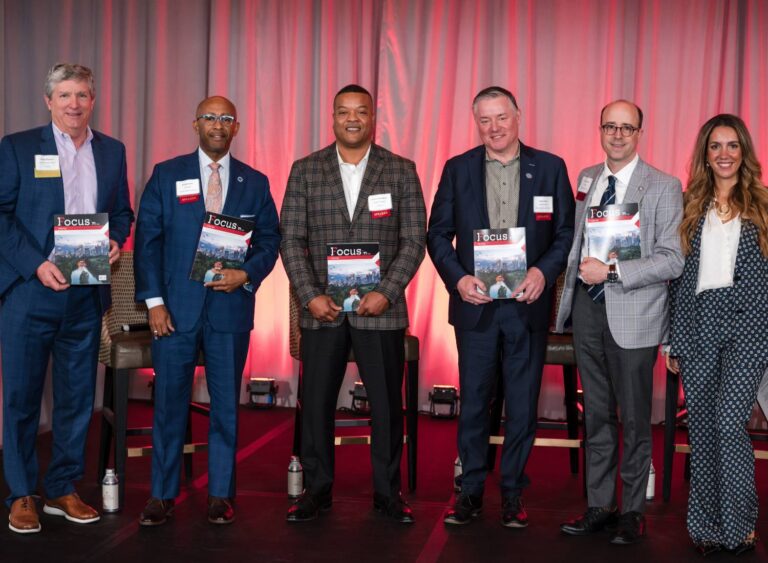







David Morehouse, Executive Vice President for Strategy, Pittsburgh Steelers
 In an interview with Invest:, David Morehouse, executive vice president of strategy at the Pittsburgh Steelers emphasized the team’s role in the city’s revival through events like the upcoming NFL Draft, which is expected to generate up to $200+ million. “Hosting the NFL Draft will be the biggest event Pittsburgh has ever had,” he said. He also noted the Steelers’ global media impact and Acrisure Stadium’s evolution into a year-round destination beyond football.
What changes over the past year have impacted the Steelers and Acrisure Stadium, and in what ways?
Like most cities, we’re coming out of a post-COVID economic environment. The city and the region are working to build back to what things looked like before the pandemic and to emerge stronger. That includes our business community. Because of these efforts, we’re seeing a lot more investment coming into the city and region.
For the Steelers, we’ve focused on evaluating the impact we have on the region as a baseline for how we can support this growth. We had PricewaterhouseCoopers analyze our economic footprint. To complement that work, we just finished a research project with a company called Trajektory. They performed an impressions analysis — essentially looking at how many times Pittsburgh was mentioned in the media ecosphere over the course of a year and the percentage of those mentions tied to the Steelers
So off the field, we’ve been focused on better understanding the role we can play as an economic engine . On the field, we’ve been focused on getting back to the Super Bowl.
Pittsburgh has always been a region built on innovation. At the turn of the 20th century, it was steel and how steel was made. That innovation helped build the country. Now, that same spirit of innovation is being directed toward AI/robotics, life sciences and healthcare, energy and advanced manufacturing. A lot of that is driven by the universities here. We try to support that momentum however we can.
One major way we’ve done that is by bringing the 2026 NFL Draft to Pittsburgh. It’s one of the two biggest events the NFL holds each year, the other being the Super Bowl.
What role do the Steelers and Acrisure Stadium play in the current economic landscape of Pittsburgh?
Art Rooney, our president, felt strongly that the Steelers should do what we can to give the city’s economy a boost. One major way we’ve done that is by bringing the 2026 NFL Draft to Pittsburgh. The Draft draws about 50 million television viewers, with many more watching through social media and digital platforms. Cities that have hosted the world-class event have seen between 500,000 and 800,000 visitors in recent years.
Hosting the Draft in Pittsburgh has created a lot of economic activity even before the event itself. Projects that were on the books from the city, the county, and the state are being accelerated to get ready for April 2026. And geographically, we’re well-positioned. We’re within driving distance of 11 NFL cities and 35 Division I college football programs.
The projected economic impact is $200M+. Beyond that, it gives us a national and global platform to showcase how Pittsburgh has evolved, especially with the growth in robotics, AI, energy, life sciences and tech broadly.
Beyond the Draft, the Steelers and Acrisure Stadium generate regular economic impact throughout the year. Over a four-year period, the Steelers created $3.4 billion in economic activity in Allegheny County alone. There are 3,000 permanent jobs supported by the Steelers and Acrisure Stadium. And on game weeks, about 58% of fans in the stadium come from more than 75 miles away. That results in a $61 million spending uplift per home game week.
We’ve been sold out since the 1970s, and that sellout streak continues today. That consistency drives major value for the local economy.
What kind of visibility do the Steelers bring to Pittsburgh, both nationally and globally?
The NFL is one of the most powerful marketing platforms in the world. The Super Bowl remains the most-watched television event in the country, and NFL programming dominates television ratings year-round.
Pittsburgh benefits from that. The impressions analysis we did with Trajektory showed that 50% of all global mentions of the word “Pittsburgh” are tied to the Steelers. That means half of the time someone sees or hears “Pittsburgh” in the media, it’s in the context of our team. If you removed the Steelers from the equation, that’s how much global visibility Pittsburgh would lose.
That shows the role we play in telling Pittsburgh’s story. Our audience reach through TV, digital, social media, and live attendance is significant. That’s something we work hard to maintain and grow.
What are your goals and priorities for the next three to five years?
Our focus is to improve and expand on what we’ve already been doing. We’ve had success as a team, as a brand, and as a development partner in the city. We want to build on that momentum.
That means continuing to bring in big events, generating attention for Pittsburgh, and using that attention to bring in new investment.
A good example is the Dublin game. We didn’t just go over there to play football. We also took a group of business executives through the Allegheny Conference. There, they met with Irish business leaders to discuss potential synergies and opportunities to invest in Pittsburgh.
The Dublin game was about more than just football. It was about building international relationships that can benefit the region long term.
How does the organization engage with the Pittsburgh community off the field?
The Rooney family has owned and operated the Steelers for three generations. They’ve always believed that giving back to the community is one of the most important responsibilities of owning a sports team. We see it in big moments, like bringing the NFL Draft to Pittsburgh. But it also happens every day, in smaller ways, through our philanthropic partnerships and community programs. That commitment has been a part of the franchise for decades, and it continues today.
How is Acrisure Stadium being used beyond football, and how does that tie into your long-term vision?
Where the stadium sits today used to be a junkyard. Then Three Rivers Stadium was built, with parking lots all around it. Since then, the area has been transformed. The city’s central business district has essentially expanded across the river to the North Shore.
Now, the stadium is surrounded by restaurants, music venues, bars, office space, and retail. It’s a mixed-use district, and it’s where people come to gather year-round.
Taylor Swift’s concert is a great example. People were sitting on the hill at Point State Park across the river, listening from a distance. There were tens of thousands of people outside the stadium just enjoying the music. Inside, we had about 80,000 fans. That event showed how the stadium has become much more than just a sports venue. It’s a destination.