






Greater Orlando’s leaders address the future of sustainable living
Writer: Pablo Marquez
 November 2024 — There is no shortage of projects taking place in Orlando that are expected to have a sizable impact on the community, combining exciting design elements for high quality community development.
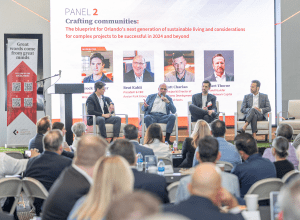
At the Invest: Greater Orlando 2023-2024 Launch Conference, the second panel “Crafting communities: The blueprint for Orlando’s next generation of sustainable living and considerations for complex projects to be successful in 2024 and beyond,” delved into Central Florida’s development pipeline and how spreading that pipeline across socioeconomic factors helps ensure a sustainable, equitable future in the region. Moderated by Brock Shrader, president of Wilson & Girgenti, the panel included Beat Kahli, president and CEO of Avalon Park Group; Matt Charlan, principal and director of business development of CBA Architects; and Robert Thorne, CEO and founder of Urban Network Capital Group.
The discussion began with the panelists covering the concepts of sustainable living, sustainable growth and urban development. Kahli stressed the importance of people-focused sustainability. “I sincerely believe that sustainable communities focus on their people first, and not on cars or infrastructure. People already spend enough time on cars and we don’t need to build more roads. Instead, we should build places where people can live, learn, work and play. We should build mixed-use communities that don’t need massive transportation infrastructure. Mixed-use towns are the solution for sustainable communities,” he pointed out.
Supporting Kahli’s sentiment, Charlan focused on sustainable community developments and architecture. “We live in the experience of time, your quality of life and day-to-day satisfaction is largely determined by traffic,” he said. “It’s no one’s ideal to always be spending time sitting in their car. As architects, we focus on sustainable community development that gets people to be inspired and passionate about their community. One way to do this is by growing smart, high-density developments that are more resilient, built on the best construction and sustainability practices.”
Thorne contributed by pointing towards the importance of improving the quality of living that we spend indoors. “We spend 90% of our time indoors, so the time that we spend inside matters. We need to be conscious about how we build the spaces in which people spend the majority of their lives, regardless of whether we are talking about horizontal or vertical spaces. Part of what we do is that we provide healthy air via probiotic infusion through air conditioning systems. Basically, we improve the quality of the indoor air that most people breathe all day. We place these air-cleaning systems in all homes that we build. As developers, we have a huge responsibility in providing healthy spaces for people to live in,” he highlighted.
The conversation then shifted to infrastructure playing a critical role in the success of sustainable communities. Shrader asked all the panelists how they ensure that transportation, energy and public services are integrated into their respective designs in order to meet sustainability goals.
Kahli addressed the importance of preplanning and integrating infrastructure plans before large cities are built. “You have to build real towns where the infrastructure is already integrated. Being from Switzerland, my hometown of Zurich is a good example of this. You don’t need a car in Zurich because you have public transportation options every 90 yards. You can’t just build 5,000 homes and then hope that the government will somehow figure out the infrastructure around it. Ideally, all of this should be pre-planned and thought of in advance,” he explained.
Charlan added to Kahli’s public transportation example by elaborating on the potential opportunities for growth that still exist for the railway system in the United States. “In Europe, the rails are owned by public entities. In America, all the rails are owned by private corporations. Regardless, there are still plenty of opportunity zones to connect Florida and other states via the railway system. America’s landmass is not as complete as Europe’s territory when it comes to passenger railway connections. This is where we should be looking to in terms of public transportation since there is still plenty of space left to grow,” he stated.
Thorne quickly followed by highlighting the importance of reducing traffic and air pollution via better public transportation systems. “There is the challenge of looking at how land development affects the environment. In Central Florida, it remains clear that traffic along the Interstate 4 highways is one of the main contributors to environmental pollution. Cities are the biggest challenge due to the high amount of population density. We should think of innovative transportation solutions, drawing inspiration from other large metropolitan areas that face similar challenges. The example of Mexico City using cable cars and air gondolas to reduce traffic congestion comes to mind,” he stressed.
As the discussion wrapped up, the panelists pointed out examples of emerging trends in sustainable living that are expected to have the biggest impact on community development in Orlando. Thorne referenced the use of different materials that are being used to carry out sustainable developments. “Construction materials are key to guarantee sustainable development. People live and breathe in the buildings that we design, so it’s important to be mindful of the materials that are used to make this environment sustainable and liveable,” he added.
Charlan took a different approach and focused on challenging the elements. “Florida has proven to be a state that is highly susceptible to nature and the elements. Whether its hurricanes, floods, stormwaters or rainy season, we need to focus on developing infrastructure that is more resilient and adaptive to adverse weather and climate conditions,” he stated.
Kahli closed the discussion, citing affordability as a key issue. “It’s easy to design and build infrastructure in all ways that we could possibly imagine, the hard part is doing it at a cost that it’s affordable,” he said. “The cost of construction is at its highest point in decades. Everything that we have discussed today ties back to pricing and cost, we need to carefully consider and study this before committing to large changes.”
For more information, please visit: