






Spotlight On: Adam Thomas, Office Managing Partner, Forvis Mazars
Key points:
- Forvis Mazars expanded its Tampa footprint through the MSL integration, strengthening healthcare, public sector, and not-for-profit capabilities while planning physical office growth.
- Talent strategy centers on culture, apprenticeship-style development, and delivering an “Unmatched Client Experience” that drives long-term retention.
- Looking ahead, the firm is focused on disciplined growth, AI-enabled efficiency, and deeper strength in healthcare, financial services, tax, and private equity.
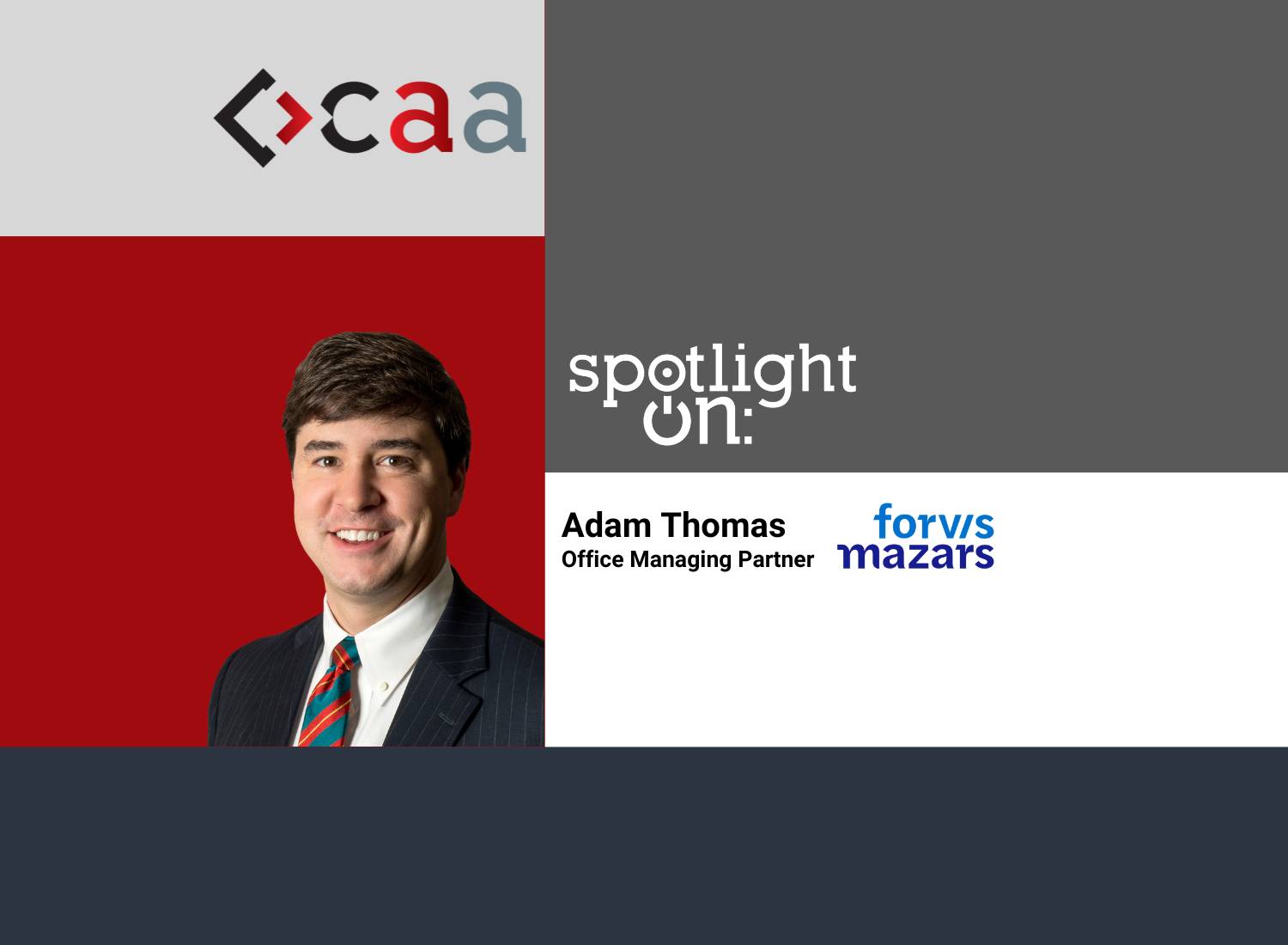 February 2026 — Invest: sat down with Adam Thomas, office managing partner at Forvis Mazars, to discuss the firm’s continued growth in Tampa Bay, its integration of new teams, and how talent development and client experience are shaping priorities for 2026. “We don’t grow for growth’s sake. We grow to create opportunities for future partners and to better serve our clients,” Thomas said.
Join us at caa’s upcoming leadership summits! These premier events bring together hundreds of public and private sector leaders to discuss the challenges and opportunities for businesses and investors. Find the next summit in a city near you!
What key changes over the past year have most impacted your operations, and in what ways?
The biggest accomplishment for our Tampa office over the past year was the integration of the team that joined us from MSL, which we acquired in November 2024. We added about 20 professionals locally as part of that transaction, and more than 100 across Florida. A major step forward has been getting everyone under one roof, but the flip side is we have outgrown the space we are in.
We are all based downtown in the iconic “Beer Can” building, and with the additional headcount, the office is simply tight. During 2026, we plan to expand our footprint in the building by roughly 25%. That physical expansion is really a reflection of the growth and momentum we have seen in Tampa, both through acquisition and organic growth.
From a capability standpoint, the team that came over strengthened areas that have been increasingly important in this market: healthcare, the public sector, and not-for-profit work. They brought a lot of experience working with cities, counties, and other governmental entities, and also a meaningful not-for-profit client base. We were doing some of that already, but it bolstered our team and qualifications in those areas in a noticeable way.
At the same time, we continued to grow organically. In Tampa, we have been intentional about building our team in four main pillars: financial services, healthcare, construction, and private equity. One example of the momentum we had in 2025 was serving as auditor for three Tampa-area companies that went public, which was a significant accomplishment for our office.
Finally, the recent launch of the Forvis Mazars global network has allowed us to better serve clients with international needs. Not all of our clients are multinational, but if they are, we can now seamlessly serve them across borders worldwide.
How is Forvis Mazars attracting and retaining top accounting and advisory talent in a competitive market like Tampa Bay?
Tampa Bay is highly competitive. There are a lot of really good firms here, so we have to be clear about what makes us different when we are recruiting and retaining talent.
Culture is a big differentiator, and that shows up in how we develop people. We focus on growing leaders, starting on day one. Right out of college, we want to be developing people, mentoring them, and building strong teams where learning is constant. We emphasize an apprenticeship model, where people get exposure, feedback, and opportunities to stretch, because that is how you create long-term careers.
Our secret sauce, though, is our commitment to client service. We call it an “Unmatched Client Experience.” We try to drive that into all of our team members from the beginning. The things clients expect are often not complicated, but they are essential: being responsive, truly listening, and helping solve problems. Sometimes the solution is within our immediate team, and other times it is pulling in the right specialists across the firm, but either way, the client should feel supported.
The goal is to build relationships where clients do not hesitate to call, whether they are speaking with a partner, a senior associate, or an associate. They know we are going to help them work through issues and make smart decisions. When people feel part of that kind of client relationship, it becomes a powerful reason to stay and grow here.
Which trends are most influential today, and how are you positioning for them?
Artificial intelligence is the trend that comes up in almost every client conversation. Everyone wants to know what we are doing with AI, and they expect professional services firms to embrace it. I do not think that is going away.
For us, AI is about streamlining work and improving efficiency so we can spend more time doing the things that matter most: sitting down with clients, building relationships, and listening. It also means having more time to invest in our people, through mentorship, training, and the apprenticeship model that helps our teams grow.
Clients are rightfully expecting firms to find efficiencies. Over time, that may change how work is delivered, how quickly problems can be solved, and how engagement teams are structured. But to me, the most exciting part is not just doing tasks faster. It is using the time we save to drive more value for clients and to invest more deeply in developing our staff.
Another trend that is reshaping the industry is private equity entering the accounting profession. It is something we watch closely. As a firm, we have not taken private equity money, and we do not intend to at this point. We are committed to the partnership model and being long-term stewards of the firm’s success.
We believe the partner-led model supports quality, which is the most important thing a CPA firm can deliver. It also aligns well with our people strategy. It gives professionals something to work toward, including the opportunity to become a partner if that is their goal. In our view, client strategy and people strategy both fit well within a partner-led structure.
How have client priorities in Tampa Bay shifted amid economic uncertainty and private equity activity?
There has been a lot of uncertainty, and it impacted the economy throughout 2025. I think many people expected that uncertainty to ease more quickly, but it has been persistent.
That said, I still think there is a lot of dry powder among private equity clients that want to make deals. Anecdotally, based on conversations with clients and with our professionals who work closely with private equity, it feels like there is a strong pipeline and good potential activity in 2026.
A lot of clients tried to get transactions done before year-end. Some of that activity did not close and rolled into 2026. The uncertainty has not disappeared, but in many ways it has become more normal. Clients are learning how to plan through it, and it does feel like 2026 has the potential to be a stronger year for deal activity and investment decisions.
Looking ahead over the next two to three years, what are your key goals and priorities for the firm?
Growth continues to be a goal, and we have had strong growth for a number of years. We will keep building on that momentum, even if the pace is not exactly the same every year.
We don’t grow for growth’s sake. We grow to create opportunities for future partners and to better serve our clients.
Strategically, we want to continue expanding in areas where Tampa is strong and where we have momentum. Healthcare and financial services are prominent industries here, and those are two areas where we do very well. We also plan to keep investing in construction and private equity, which remain core pillars for our Tampa office. At the same time, we have seen momentum in manufacturing and the commercial space, and that could be an area where we focus additional energy.
Tax is another priority. We want to keep growing tax in general, and private client services is a big area we are continuing to build. We are still working to find the right leader to help accelerate growth in our private client tax group in Tampa.
Operationally, we will continue integrating the MSL team fully. We have made strong progress, but it would not be accurate to say integration is complete. Alignment takes time, and we are focused on doing it the right way. We are very happy to have them on our team, and we want to make sure everyone feels fully integrated and moving forward together.
Finally, we want to ensure we have the right solutions for clients as new needs emerge, whether those opportunities come through AI, technology, new consulting demands, or international growth. The goal is to have the right talent and capabilities in Tampa so we can keep helping clients navigate what is next.
Want more? Read the Invest: Tampa Bay report.