






Spotlight On: Christopher Lewis, Founder & Managing Director, Greenwood Capital Advisors
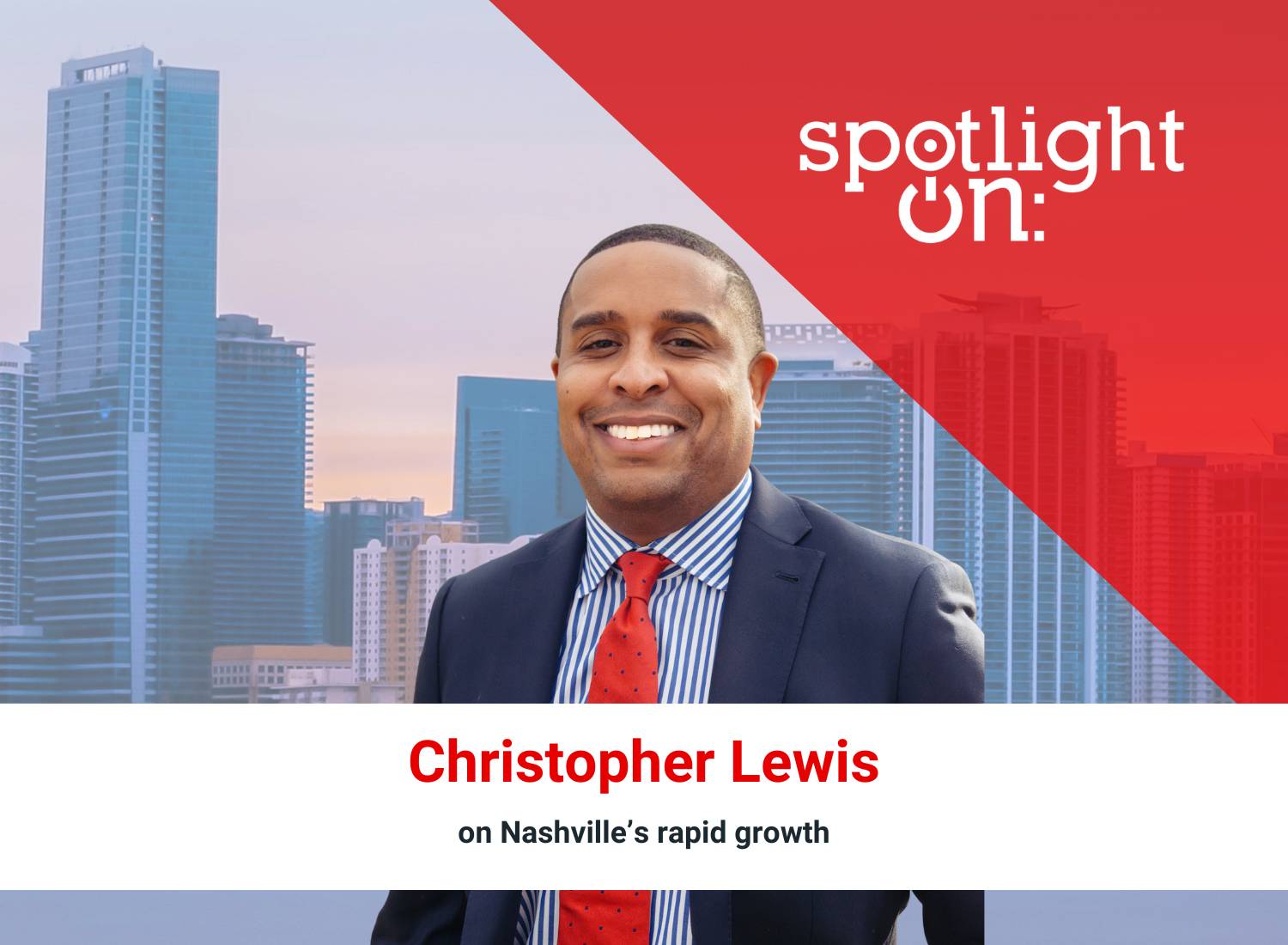 December 2025 — In an interview with Invest:, Christopher Lewis, founder of Greenwood Capital Advisors, shared how he’s bringing Wall Street expertise to Nashville’s middle market through full-service investment banking and strategic CFO support. “Our tagline is “Built for Founders, Forged on Wall Street.” We bring Wall Street-level sophistication to the middle market, but focused specifically on founders,” Lewis said.
Join us at caa’s upcoming leadership summits! These premier events bring together hundreds of public and private sector leaders to discuss the challenges and opportunities for businesses and investors. Find the next summit in a city near you!
How are you closing market gaps and evolving Greenwood Capital Advisors?
I worked on Wall Street for over a decade, doing about $25 billion in deals across different sectors, so I really got grounded in transactions in a sophisticated way. When I came back to Nashville, I ran a few smaller regional boutiques and noticed a gap in the market, both in skills and services. A lot of people who put themselves out there as investment bankers or business brokers weren’t really trained for the job. Many came from accounting or had sold their own companies but didn’t have the reps or depth of transactions needed to truly advise founders.
I also saw that most boutiques focus exclusively on M&A, which is the last thing you do as a business owner. There was a big gap in helping founders evolve to the point where they could sell for the highest value. Another gap was on the CFO side. Many clients didn’t have a CFO, or if they did, that person was more controller-based, looking backward, not forward.
I built Greenwood Capital Advisors to fill those gaps. We do full-service investment banking: M&A, capital raising, and capital structure advisory; however, we also have a strategic CFO service line that covers the other four key CFO functions: financial planning and analysis, investor relations, treasury work, and corporate development. Those are the strategic pieces that help founders run and grow their businesses better.
Because that combined approach can be hard to communicate, I developed what I’m calling the Dual Track model — we’re in the process of trademarking it. It combines strategic CFO-integration with investment banking into one service line. We embed as a fractional CFO a year to 36 months before a transaction, so we can build KPIs and strategic advantages that make our clients look better in the market. That reduces execution risk and improves valuations when they’re ready to sell or recap. The Dual Track model is a new evolution we’ve added to help clients understand and benefit from that combined approach.
Why did you bring this model to Nashville?
When I was working in New York, I remember mentioning Nashville for the first time and seeing people’s faces light up, that’s when I knew Nashville had arrived. I started coming home more, got a few clients here, and realized a few key things.
First, Nashville is growing very quickly. But second, there’s a gap in sophisticated business services — there are great law firms, healthcare companies, and infrastructure, but not much depth in business services like investment banking and CFO services.
Also, in big markets like New York, LA, or Chicago, the market share is already captured, so it’s tough to break in as an entrepreneur. Nashville, especially in investment banking and CFO services, is still open — there’s room to grow and gain market share.
Lastly, there’s a cultural aspect. Even with so many people moving here, Nashville is still a local town. People want to work with someone from here. So being both a Nashville native and New York-trained lets me bridge that gap. That combination helps me build trust with founders here in a way that outsiders can’t. That’s why I came home.
What challenges come with educating the local market?
There’s the challenge of being in investment banking generally, plus the challenge of being an entrepreneur in this space. Even though there’s a gap in the market, there’s a double-edged sword to that. Many founder-led, middle-market companies don’t fully understand what investment bankers do. Larger corporations get it, but founders often don’t.
There’s also a mistrust of investment bankers. Some people conflate private equity with investment banking because they’ve dealt with firms that combine them under one roof — “merchant banks” that might buy a company for cheap under the guise of advising. Others have dealt with business brokers or bad bankers who didn’t add value. So there’s skepticism about what we really do.
Our job is to solve strategic issues and execute strategic transactions. But if clients don’t trust that, they hesitate to accept the help we offer. That creates a huge educational component I didn’t expect. In New York, that part wasn’t necessary — everyone understood the value. Here, there’s a lot of education around what investment banking really is, how it’s different from private equity, and how we add value. That’s been a big challenge.
How do you guide clients through economic uncertainty, particularly the tariffs that have markets on edge?
Every situation is different depending on the sector, but broadly speaking, tariffs are often secondary to what our clients are focused on because the economy here is mostly service-oriented. Tariffs might impact their clients, which trickles down.
The bigger issue is the uncertainty related to communications in the media. For example, what’s going on with tariffs. Business leaders can plan for good or bad conditions if there’s certainty, but uncertainty causes people to pull back. That’s when talk of recession picks up.
For the Federal Reserve, the good thing has been the transparency around interest rate policy. That helps businesses plan. So my advice has mostly been to stay focused on what they can control, plan for possible changes, and remember that administrations like Donald Trump’s tend to be pro-business. Long term, tariffs are more of a negotiation tactic than a lasting policy.
What is your outlook and long-term vision for Greenwood?
I’m very positive about the outlook. Our biggest priority is education and helping founders really understand what we do and how the Dual Track model combines strategic CFO work with investment banking to create real value. Once they understand that, scaling will come naturally.
Greenwood was always intended to be the first part of a larger financial ecosystem I’m building. The goal is to build out five companies under the Greenwood brand: private equity, private credit, asset management, strategy consulting, plus what we’re doing now with investment banking and CFO services.
The vision is for Greenwood to be an international, world-class financial ecosystem that gives founders and high-net-worth individuals access to the kind of sophisticated services that are usually reserved for bigger players. That’s our ethos: providing access to services that help founders grow, create wealth, and build value long-term.
Want more? Read the Invest: Nashville report.