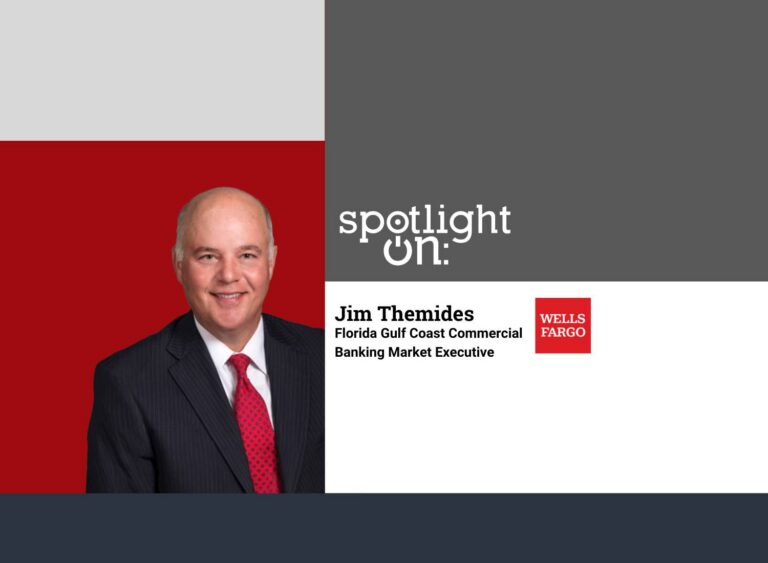







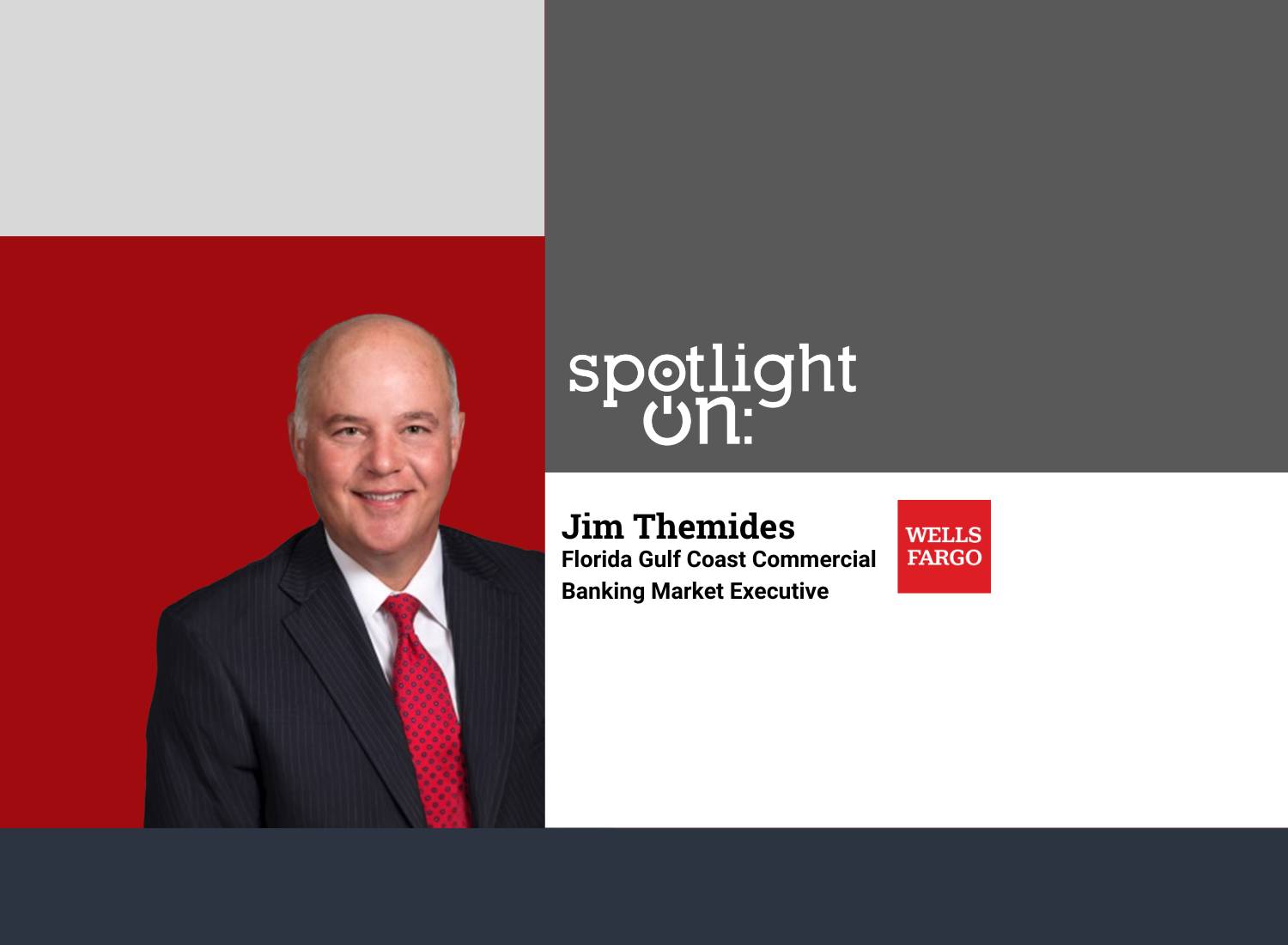
Spotlight On: Jim Themides, Florida Gulf Coast Commercial Banking Market Executive, Wells Fargo
Key points:
- • Wells Fargo’s growth in West Florida is driven by talent expansion and the lifting of its asset cap.
- • Lower interest rates and increased focus on AI are shaping commercial banking decisions.
- • Long-term strategy centers on relationship banking, community investment, and supporting clients through all growth stages.
 March 2026 — Invest: spoke with Jim Themides, Florida Gulf Coast commercial banking market executive of Wells Fargo, about the bank’s renewed growth trajectory, talent strategy, and the commercial banking landscape in West Florida. “The one thing that I always tell them is that they can’t outgrow us,” Themides said.
What changes over the past year impacted Wells Fargo in Tampa Bay, and in what ways?
I’ll start with a little context. I’ve been with Wells Fargo, and predecessor bank Wachovia, for almost 40 years, so I’ve lived through several economic cycles. I lead commercial banking in West Florida, covering the Tampa Bay market through Sarasota and Naples, and also including Lakeland. We work with privately held and publicly traded companies with annual revenues generally ranging from $25 million to $2 billion, across a wide range of industries.
At the company level, the biggest change over the past year was the lift of the asset cap. To me, that reflects the hard work that thousands of employees have done over many years to strengthen the company and improve outcomes for our stakeholders. Just as importantly, it means we can grow again after nearly a decade of limits on growth.
Locally, we’re expanding our commercial banking team in West Florida. We’re adding bankers to meet the needs of companies that are growing here and relocating here. We’re also adding specialized bankers in industries that require deeper subject matter expertise. Healthcare is one example. In 2025, we made the decision to have a dedicated healthcare banker covering healthcare companies throughout Florida, and that person happens to sit in our Tampa office. Those moves are directly tied to what our clients are asking for and how the region is evolving.
How is Wells Fargo attracting, developing, and retaining top banking and financial services talent in a competitive market like Tampa Bay?
Technology has evolved tremendously, but the importance of high-quality people has never wavered. If anything, it’s even more important today, because relationships still matter, and clients want bankers who understand their business and can help them navigate through change.A big part of our talent strategy is what we call the Early Talent Program. It starts with college students through internships with our commercial banking teams across the country. They spend time learning what the work looks like, how teams operate, and how we serve clients. After graduation, many join our Early Talent Program, beginning with two years as commercial banking analysts. That phase builds a strong foundation in credit knowledge and the disciplines that support client relationships.
After that, they move into an associate program in local markets, where they continue developing on the credit side while also spending time with senior bankers, meeting clients, and learning what strong engagement looks like. It’s designed as a four-year investment before someone is placed on the front line as a relationship manager.
After that pathway, people can move into relationship management, portfolio management, or product specialties such as treasury services, depending on their strengths and interests.
The benefits of the city of Tampa also helps us recruit. There are only a handful of cities that are especially attractive for young, college-educated professionals to launch their careers, and Tampa is one of them. The quality of life and the market’s momentum make it a compelling place for talent, which strengthens our ability to recruit and retain.
What trends in commercial banking are most shaping the financial services landscape in Tampa Bay right now?
One major trend over roughly the last 18 months is that short-term interest rates have come down meaningfully. That affects how middle-market CEOs and CFOs evaluate the cost of debt capital. With borrowing costs lower than they were, companies are more willing to use debt to support growth. It’s simply easier to make expansion decisions when the cost of capital is more attractive than it was 18 months ago.
Most economists have also suggested that in 2026 there will be one to two more rate reductions, and whether that prediction lands exactly or not, the overall sentiment is that financing conditions are less restrictive than they were.
The other trend that has accelerated, especially since the COVID years, is investment into technology and AI. In meetings with owners and CFOs, those topics come up frequently. Companies are looking for ways to improve efficiency, mitigate risk within their company, and create new paths to growth by using technology and AI more intentionally. From what I see, many organizations are still in the learning stages with AI, and we’re in the early innings of understanding what it can do at scale.
How is Wells Fargo engaging with Tampa Bay’s business community, nonprofits, and economic development organizations to support inclusive growth?
Community engagement is a core part of how I think about leadership. I’ve always felt that we serve four constituents, and none is more important than the others: our customers, our employees, our shareholders, and the community.
There are two primary ways we give back. One is with our money, and the second is with our time. Through the Wells Fargo Foundation, we’re a significant investor in nonprofits throughout Tampa Bay, contributing upwards of a million dollars a year to organizations that help make the community stronger. One example is the $1 million Wells Fargo gave to Volunteer Florida to help people after the hurricanes of late 2024, particularly with housing-related needs. We also provided $315,000 to St. Petersburg College to support personal finance literacy.
The second part is volunteerism. Across our lines of business, our employees contribute thousands of volunteer hours each year, ranging from hands-on work like Habitat for Humanity builds to serving on board positions with important local organizations. Our people understand that giving back is part of our DNA, and I believe giving time can be as important as giving money because it builds long-term capacity and trust.
How would you assess the overall health of Tampa Bay’s banking and finance sector right now?
Very healthy. Florida has been one of the faster-growing states in the country for several years. Growth may be slowing, but companies and people are still relocating here, and that immigration supports economic momentum.
The banking industry follows business activity, so as companies move in and expand, more banks come here. I view that as positive. Competition makes institutions better, and it’s good for clients. Tampa Bay has a healthy, robust economy, and I believe there’s room for strong banks to be successful as long as they execute well and stay focused on serving clients.
Looking ahead, what are your key goals and priorities over the next two to three years?
We are very bullish on Florida and Tampa Bay. The state has a strong business climate, an overall business-friendly atmosphere, and a quality of life that continues to attract people and employers. Those fundamentals support continued growth.
Our priorities are to keep adding bankers as needed, continue building specialized expertise where client demand requires it, and keep serving our clients as they expand. We want clients to feel confident that Wells Fargo can support them through every stage of their life cycle. The one thing that I always tell them is that they can’t outgrow us. We bank very small companies that one day become very large companies, and we can be there for them throughout that life cycle.
Want more? Read the Invest: Tampa Bay report.