



Spotlight On: Matt Carlson, Chief Executive Officer, DeSoto Economic Development Corporation
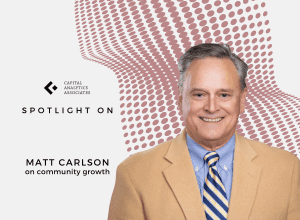 October 2024 — Matt Carlson, executive director of the DeSoto Economic Development Corporation, spoke with Invest: about the DeSoto community’s place in the greater economic ecosystem of Southern Dallas. With so much growth on the horizon, how will the community adapt and develop to meet these changing needs?
What have been the key milestones and successes for the city of DeSoto and for your office over the past year?
We’ve had a lot of successes but the biggest has to be the continued development of the Bio-Life Science Innovation Core. It’s a 90-acre greenfield development purpose-designed to expand the DFW ecosystem into Southern Dallas. Pegasus Park is the undisputed nucleus of bio-life sciences in DFW. By leveraging our geospatial advantage of being just 15 miles south of Pegasus Park, and the influx of health interests by UTSW, Parkland and Children’s Health System, and Dallas College at The Shops at Red Bird redevelopment we can better deploy DeSoto’s robust workforce of healthcare and life science talent.
The Innovation Core allows for the creation of a walkable and highly amenitized, semi-urban environment that is supported by research and education. We anticipate over 1.5 million square feet of new development with wet labs for research and development, retail space, hospitality and event space, residential, and a satellite higher education campus. Our vision for the Innovation Campus is to create a dynamic hub that fosters innovation, advances research, facilitates learning, and inspires creativity.
We’ve also had major expansions of our existing industry. Solar Turbines, for example, has expanded once again (this is the company’s sixth expansion). Solar Turbines, which is a subsidiary of Caterpillar, and is headquartered in Irving, Caterpillar’s current CEO used to be the president of Solar, so there is a lot of overlap there. They are a jet-driven turbine company, and they are all over the world. We’ve had some significant successes there. Allied Interiors also has doubled its production and its size and is considering an expansion now that would give it a million square feet in DeSoto. Allied Stone currently employs about 650 people; a huge success for a tier 1 suburb.
We also attracted a manufacturer out of California last year that has doubled its production here in DeSoto with its new facility. With the new facility, they will be manufacturing at a rate twice what they were capable of prior.
DeSoto has a keen interest in advanced manufacturing, where we’re breaking the mold. But we also have a long tradition of being a logistics and transportation area. Last year was no exception. We added four new large logistics companies, both third-party logistics as well as direct. Interstate Batteries consolidated a number of its distribution centers into a single distribution center here in DeSoto. We traded the largest industrial property (by cost) right here in DeSoto. Additionally, Reese Industries consolidated a number of its sales and distribution industries from across the region into a single half-a-million-square-foot facility here. There’s a lot going on. I often talk about setting the table differently. Southern Dallas has historically been transportation and logistics. But the mold needs to be broken, and we’re leading that charge.

The EDC website highlights that DeSoto’s workforce is growing at a faster rate than the national average. How is your office able to attract and retain talent?
The attraction part is the easy part: people just keep moving here. We present a great value. DeSoto’s history is one of retail and rooftops. We’ve always been a suburban city. We’re 75 years old this year, and that has always been our history: we are a suburb of Dallas. But I don’t think of us that way. From day 1, I started talking about DeSoto differently. Our friends at Dallas College conducted a workforce study to tell us about what we have here in southern Dallas, and it’s a tremendous story. The workforce here is tremendous, it’s huge, and it’s ever growing because we present such a great opportunity from a residential standpoint as a place to live, work and play. This is a place that people want to call home. There is a rich cultural diversity, with strong African-American and Hispanic representation. We are a minority-led community. That is refreshing to see because it is such an integral part of what Dallas is.
What are some of the biggest updates in terms of housing and transportation?
I’ve mentioned a bit about changing the focus of our economic development traction and even growing our existing companies here, but attracting companies when you don’t have housing is a mistake; we need to address that. We have to understand housing as a cycle. You can’t just pick any one segment of it and say, that’s who we are. If you do, you’re stifling what you can be. We have to diversify our housing stock to remain competitive in an evolving global economy.
DeSoto recognizes that our history has been an upper-market single-family residential environment. This has left us without the starter home and midmarket levels that attract young professionals and families. We’re woefully deficient in the apartment and townhome product, and we recognize that fact in our most recent comprehensive plan that was adopted just last year. The plan starts to address where density can and should happen in our city. Not that we want to be inundated with multifamily projects, but there are places where we need that product. Let’s communicate that to the development community. But that’s just the first stage of the cycle.
Then it’s the starter homes, where people will grow and develop with their family. We need to consider millennials and Gen Z and provide a product suitable for them to thrive. Finally, there’s the part of the cycle where people are looking to age-in-place, when homes again become smaller. These are places where people can age gracefully and remain part of the community they call home.
Transportation is another huge issue. We are not a DART city, but we do have an on-demand STAR Transit that allows people to move freely to both personal and work appointments and it has been tremendously successful. Part of that resetting of the table for the next 20 years is to envision how we engage autonomous vehicles and enhance our connectivity with some form of transit. Our challenge is to determine what are the pieces and parts that are going to help us to be more conscious about how people move around.
Looking ahead, what are some initiatives and projects you are looking forward to?
We want to remain true to our ethos, because doing so will bring the right projects. We’re not going to mortgage our future; we need to imagine where we want to be. What unique assets do we have, and how do we maximize those? Today, we see four major projects. One is the Aquatics and Recreation Center at Curtistene S. McCowan Park, an investment of $52 million, but there are surrounding properties in the private sector where we talk about investments like a sports, medicine and training opportunity. We produce great athletes here. We have numerous local athletes who have gone on to play in the NFL and other professional leagues. We want to make this the place where these athletes are raised, trained, and live.
We also have envisioned a 100-acre experiential retail and recreation environment on the I-35 corridor. Ten Mile Creek is a natural amenity running through the site. We can maximize this natural environment and make it a place the whole family can come, enjoy a sports tournament, and make it an entire weekend away. It’s a place where your family can entertain all kinds of opportunities.
For more information, please visit: