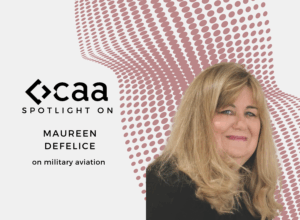
Spotlight On: Maureen DeFelice, Executive Director & CEO, Order of the Daedalians and Foundation
May 2025 — In an interview with Invest:, Maureen DeFelice, executive director and CEO of the Order of the Daedalians and their Foundation, shared how the organization is inspiring the next generation of military aviators. “We’re here to promote the legacy of military aviation,” she said, highlighting initiatives like the VMAX high school simulator competition, an annual air power symposium, and a new aviation museum in San Antonio.
How has the organization advanced its mission over the past year, and what key achievements would you highlight?
Three key changes have taken place since we last spoke. First, we’ve sponsored the VMAX program, a high school-level simulator competition, with students from Poteet, Floresville, and Pleasanton competing for scholarships and flight training, sparking interest in aviation careers.
Second, we’re organizing an air power symposium in San Antonio in April, bringing together military leaders to discuss air power and global threats, educating the community on current issues like Ukraine, Iran, and China.
The most exciting development is the creation of a new aviation museum in downtown San Antonio. Despite setbacks with a property, we’ve secured funding and gifts to build a 7,000–8,000 square foot museum featuring simulators, World War I research, and exhibits to inspire STEM and aviation careers. With 90 years of history, we’re eager to share our artifacts and educate the public. We’re here to promote the legacy of military aviation.
What trends are emerging regarding young people’s interest in military and commercial aviation careers today?
In the 1980s and earlier, being a pilot was seen as prestigious and “cool.” Today, many young people are more drawn to careers as social media influencers or stars, making it challenging to attract interest in aviation and military paths. To address this, the organization runs a flight training program, operational since 2003, which takes about 50 students per year through flight training. These students gain confidence and a sense of accomplishment, especially when they solo an aircraft for the first time. The program has a 92% success rate of students earning pilot certificates.
Beyond flight training, the organization offers academic scholarships, high school awards, and military recognition. Around 1,800 high school awards are given nationwide each year. While expensive, the program is highly rewarding, transforming lives by building confidence and providing valuable skills.
Overall, there is an emphasis on the importance of hands-on experiences and confidence-building in shaping young people’s futures, especially in fields like aviation that no longer hold the same cultural appeal.
How are the Daedalian Foundation’s scholarship and mentorship programs equipping the next generation of military aviators, and what unique resources does it offer?
A lot of the uniqueness comes from the fact that the people in our organization are military aviators who have served their full career and retired from military aviation. All of them are officers, including flag officers — one, two, three, and four-star generals and admirals — who are part of our mentorship. They help students from a top-level perspective, guiding them to understand the career paths they can choose. It’s not just about being a pilot; they might want to be a navigator, flight surgeon, or air battle manager. All these roles are important in the military and are aviation positions. Many people don’t know about these opportunities. For a student, hearing this from someone who understands and can mentor is a unique aspect of our program.
While many programs offer academic scholarships, I can safely say that if you qualify academically for our scholarships, we haven’t turned anyone away due to lack of funding. We’ve been able to provide scholarships to nearly every student who has applied. The only reason we wouldn’t is if they are academically unqualified, which requires a 2.5 GPA. If you qualify, you’re likely to get funding.
Beyond a generational shift, what are the biggest challenges in promoting military aviation careers today?
One of the big challenges in military aviation is that it’s a military career, and the military isn’t for everyone. There are physical standards students must meet to join, which is a significant hurdle. Finding students who are driven to put in the hard work is another challenge, as becoming a pilot is not easy. However, the benefits are substantial. If you complete the program, the career rewards after military service are significant. Military service isn’t for life — you can retire after a 20-year career with retirement benefits and then pursue a second career.
The career options are vast, especially in the RPA (remotely piloted aircraft) sector. Those trained as sensor operators or pilots in these programs have excellent career opportunities after service. These are high-paying careers. Not only do they receive free training and military benefits, but they also have the chance to embark on a second career that can be life-changing. This is particularly impactful for the students we work with, as we focus on financially needy families. For them, it’s truly life-altering.
What role do technologies like flight simulations and AI-driven training play in preparing future aviators?
Simulator training and AI are significant parts of the changes happening in aviation. AI is impacting everything from defense to flight training. Simulator training is something we’re particularly involved with at our level because we aim to introduce it to high-school students. It’s something we can bring into high schools, and the schools can also adopt it themselves. We provide mentors who have flying experience to offer guidance and education during this training.
There are also competitions being developed around this, including drone training. While drones aren’t the same as remotely piloted aircraft, which are much larger, the concept of flying an aircraft from a remote position is similar. A lot of technology is involved — almost everything in flying an aircraft relies on technology, aside from the basics of visual flight training. Beyond becoming a pilot, there are many applications for learning to use these different technologies.
What upcoming initiatives or events in 2025 will have a significant impact on your organization and on your mission?
Our involvement with military leadership is significant because we aim to support their efforts in safety and recruitment, not mission execution. We’re not here to drive any military mission but to assist with flight safety and recognize those who have achieved significant milestones. Our goal is to promote the legacy of military aviation. We leave leadership discussions to the professionals at the Pentagon.
The symposium we’re hosting, and will continue to host annually, helps people understand why military airpower is so important. Anyone who’s had a snowball fight knows throwing from above is more effective than from below.
Finally, the museum will be a major addition to our work, providing a physical presence for the public. In San Antonio, there are no public military museums in downtown San Antonio, so this will be the first in “Military City USA.”
How do you see military aviation evolving over the next two to three years, and what role will your organization play in shaping that future?
Military aviation’s evolution will likely revolve around technology and AI. While we won’t play a role in driving those changes, our focus is on recruiting talented students who can step into these roles and make a difference. Superior airpower — across all services — is critical for national freedom. The students we support will play a significant role in decision-making, which is vital for national security.
Military recruiting benefits from all the help it can get to attract strong students, and ensuring they receive financial support is key. That’s where we come in, providing the support they need to succeed in college. Balancing a full-time job, classes, career exploration, and ROTC is incredibly challenging. By offering substantial scholarships, we remove the burden of full-time work, allowing students to focus on their education. This support is a crucial piece of the puzzle during the early years of college.
For more information, visit: