






Spotlight On: Richard Becker, Managing Director, Cross Keys Capital
Key points:
• Cross Keys Capital specializes in disciplined sell-side M&A for lower middle market businesses in South Florida.
• Deep sector expertise and process rigor help clients navigate complex, high-stakes transactions.
• M&A activity is broadening into new niches as cycles reset and opportunities re-emerge.
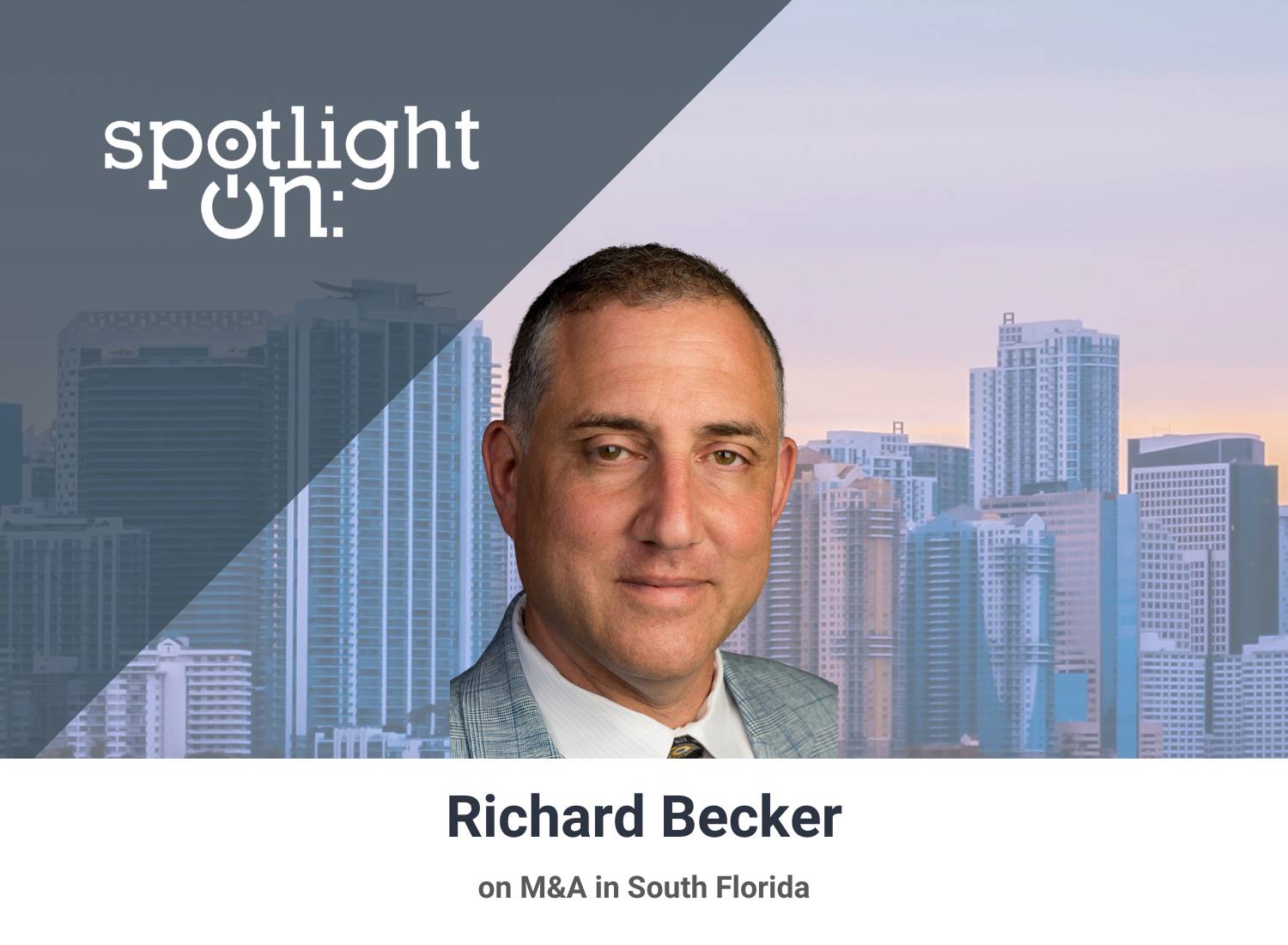 January 2026 — Richard Becker, managing director at Cross Keys Capital, shared with Invest: how the firm supports lower middle market privately-held business owners across South Florida, why process discipline and sector knowledge matter in sell-side M&A work, and what he sees in today’s cycles. “M&A has now spread to the masses and to companies in niches that are not just your traditional big three of services, manufacturing, and distribution,” Becker said.
Join us at caa’s upcoming leadership summits! These premier events bring together hundreds of public and private sector leaders to discuss the challenges and opportunities for businesses and investors. Find the next summit in a city near you!
What is Cross Keys Capital’s approach to delivering value for middle market clients, and what differentiates your advisory process?
Cross Keys Capital is a middle market sell-side investment bank serving privately held businesses that are profitable and growing.
There are plenty of investment banks that do this work, but not many who specialize with a full-service offering focused on the sub-$150 million level.
We’re entering our 20th year, and I think we’re differentiated because we have a strong focus on the South Florida geography. To us, South Florida is inclusive of both coasts. You can count on one hand the investment banks in Florida providing the same level of full-service investment banking for transactions of this size.
We’re proud of what we do and our success rate in doing it.
How do you tailor sell-side advisory services to support clients’ long-term business and financial goals?
To get introduced — our entire business model is referral-supported, and to have the trust of a type-A entrepreneur who likely doesn’t know about us for something that’s so important, we make sure that we network very well with all the lawyers, accountants, wealth managers, planners, and others in the community.
For a sell-side process, we do what’s tried and true, what we know works, and we maintain relationships with approximately 6,000 buyers to make sure we can find the proper home for our engagements.
Cross Keys has completed more than 200 transactions. What lessons or patterns have you learned from that deal experience?
The more work you do and the longer you’ve been doing it, the more you see trends and situations repeat themselves.
The most important thing we bring to the table is an even-keel attitude. We don’t get upset, emotional or angry. We know that we have to earn our clients’ trust and that this is often the first and only time our clients have gone through something of this magnitude. We’ve known when the deal pulse is on the right track, and we know when things are appearing to go off the rail and require modifications.
We use timelines, tools, and technology to our benefit, and that is very different than when we started in 2006. The multiple tools and technology have made it easier to find suitors, structures, and research that helps bring a transaction to closing as efficiently as possible.
Due diligence takes longer today as the asset-class has developed and purchase price multiples have increased, but we strive diligently to complete almost all of our transactions within a six to seven-month period.
How does deep industry expertise in sectors like healthcare, industrial, and technology influence the way you advise clients?
It’s invaluable. Half of our firm is dedicated to healthcare services, not biotech, not med devices, but pure services such as physician practice management. When you have that level of deep understanding on a national scale, and you’re dealing with the same buyer base repetitively, it’s super helpful.
For good local niche industry leaders that don’t fall within light manufacturing, distribution, 3PL, or one of the buckets where national investment banks potentially have industry specialists, we’re able to come in and take these leading companies that won’t fit in a perfect square of multiple buyers, and we’re able to bring forth opportunities. This is especially useful for platform add-ons or on the smaller-end of the lower middle-market (LMM), defined as transactions from $2 million to $6 million of adjusted EBITDA.
Whether it’s home services, engineering, professional services, or a manufactured product in a small addressable market, we’re able to bring forth tremendous value-add on those endeavors.
This matters for owners who have built phenomenal businesses and want to retire while simultaneously remaining confident their company will continue for the next few decades and that their employees will have the best chance of continuing to flourish.
What innovations or new capabilities are you focused on as client needs evolve?
Client needs haven’t really changed. This has been and continues to be the most important life-cycle event of an entrepreneur’s livelihood. They don’t want it to fail, they demand confidentiality, and they want to know that their advisor can identify the right buyer and suitor for their particular situation.
Candidly, it’s been shocking to us that valuation multiples have not come down, but what has definitely gone up is the intensity of the due diligence process. We’ve been able to use AI tremendously to our benefit to get through data and understand how other companies are describing their data, and to peel the onion back a little deeper.
So, in essence, we’re meeting the same needs. We’re probably being asked to do more and more, which is fine, and we’re keeping up with the challenge.
How do client testimonials and feedback influence how Cross Keys refines its services and prioritizes relationships?
Clients want to know that this is not your first rodeo, that you’re going to be helpful to them, and that you’re going to do what’s promised.
There are out-of-town firms now advertising on the radio locally that they’re able to help on sell-side investment banking engagements. There are business brokers who are trying to go upstream. The marketplace has definitely gotten a little more crowded.
However, clients want to know you’ve been in their industry, you understand their situation, and you can handle their size transaction. For instance, if we’ve done a truck upfitting deal, not just one but three, then when we’re in front of the next truck upfitter, it’s a lot easier to explain what we’ve done, the issues we’ve come across, and how we can move forward.
That applies across niches, from electrical construction and engineering to garage door sales and servicing. Even if the niche is small, if you’ve done something analogous, clients get much more comfortable and grant you that level of trust required. But being referred into the situation from another advisor, nothing is more important than that.
We know we can successfully perform the work, we just have to prove it to a new one-time relationship.
What role does confidentiality play in your advisory process, and how do you balance transparency with strategic discretion?
At the end of the day, confidentiality has to be paramount. We don’t take chances. No one gets the name of our client until a non-disclosure agreement is executed.
With the use of technology and databases, we pay for a decent number of databases and we’re able to get into the C-suite. As long as you’re not haphazard in the approach to identifying suitors, you can keep processes today extremely quiet.
I’m really pleased to say we have not had a leak on confidentiality in over three years now. It’s something that happens in this world, so you do your best, and we’ve had a pretty good track record.
How has Cross Keys expanded its market presence, including connecting clients with international buyers?
We only work with domestic-based companies that are headquartered in the United States.
Nonetheless, a decent number of our transactions are sold to international suitors. Finding international suitors who want a presence in the United States has become easier, and with technology we’re able to execute on that mandate when appropriate.
Finding new buyers is relatively easy. Things haven’t really changed domestically or broadened out. It’s the same business, but the more experience you have, it does seem like it gets easier after 20 years to know where to go with opportunities and to know where valuations can be and should be.
What unique challenges and opportunities do you see in the middle market M&A landscape today?
There didn’t used to be a market for specialty contractors, for instance, plumbing, electrical, mechanical, garage flooring, etc.
M&A has now spread to the masses and to companies that are not just your traditional big three of services, manufacturing, and distribution. Opportunities have expanded across the accounting and professional services professions, as well.
Everyone is being tapped on the shoulder right now. There are law firms that are creating, for the first time, the opportunity to evolve themselves into M&A opportunities on an acquisition and consolidation scale that was never there previously.
We’ve become much more open-minded to situations such as workers’ compensation, asset managers, 401(k) providers, and insurance services that were historically not the purview of mergers and acquisitions, but today are having multiple bids from various groups.
Is there anything else you would like to highlight for our audience?
The years 2020 through 2024 were phenomenal years for small transactions, what we call add-ons in a consolidation play.
This past year of 2025, there were significantly fewer M&A transactions done, and much larger transactions ruled the day. The M&A statistics look very good in 2025 because the dollar value of transactions is very high, but the number of deals has come down dramatically.
From everything we’re reading, I think that may change back in 2026 and forward, but there really are cycles to the M&A marketplace.
Additionally, 2025 was the year of uncertainty, whether it was tariffs, changes in Washington, and not really knowing what might be coming, and that made successfully consummating deals difficult. Yet the big deals were getting done because they were needed for strategic reasons.
I think 2025 will go down as a year of difference and uniqueness, and I would expect 2026 and 2027 to be more replicable toward what we were seeing in 2020 through 2024.
Want more? Read the Invest: Greater Fort Lauderdale report.