





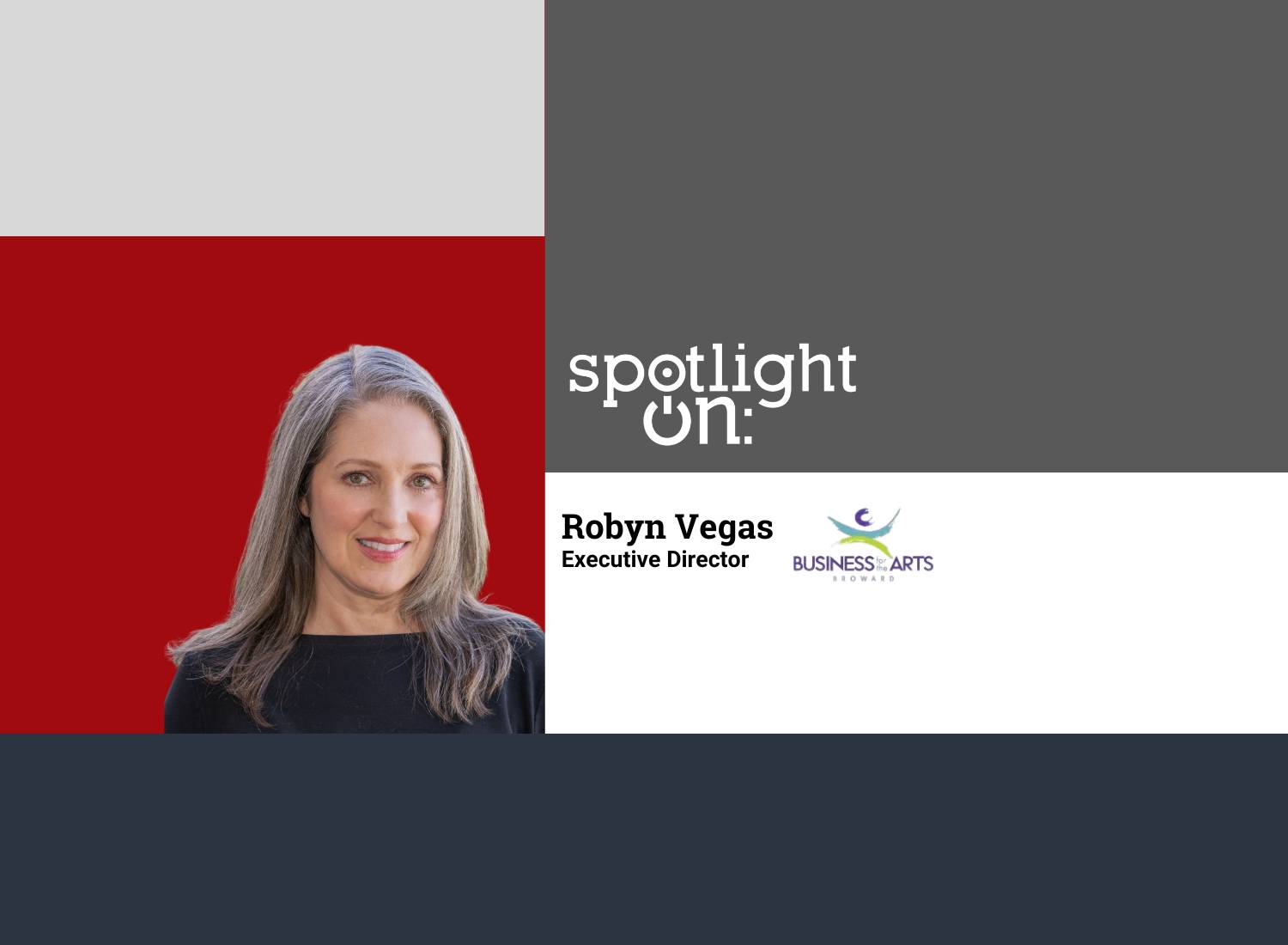
Spotlight On: Robyn Vegas, Executive Director, Business for the Arts Broward
Key points:
- • Arts and culture are increasingly viewed as economic drivers that support talent attraction and quality of life in Broward County.
- • Programs like Art in the Workplace and public murals strengthen employee engagement and community connection.
- • Funding challenges remain, but expanding public art and artist development are key priorities for the region’s cultural growth.
 March 2026 — Invest: spoke with Robyn Vegas, executive director of Business for the Arts Broward, about how arts and culture support Broward County’s economy, talent attraction, and quality of life. “The business community is recognizing that investment in the arts supports employee satisfaction, quality of life, and the region’s ability to attract new businesses,” Vegas said.
How has the role of the arts in regional economic development in Broward County evolved over the past few years?
When I first moved to Broward County, there weren’t as many arts offerings. Over the 25 years I’ve been here, there’s been a huge boom in the arts across South Florida, and specifically in Broward.
People are noticing more murals and public art, more events, and more performances. We’re also seeing more recognition for the cultural offerings we already have, and an influx of artists and creatives, including people moving from Miami-Dade into Broward. It’s an exciting time for the arts in Broward.
From a business perspective, are companies viewing arts as an investment and part of business strategy, rather than a philanthropic add-on?
BFA’s mission is educating the business community that the arts are an economic driver. One example I share often is Boeing’s headquarters relocation from Seattle. They considered Chicago and Dallas. Dallas offered stronger financial incentives, but Boeing chose Chicago, and one of the reasons they cited in the New York Times was Chicago’s cultural offerings. They wanted employees to have a great place to live and enjoy amenities, including arts and culture.
I also hear this locally. At a presentation in Broward County, Senator Steven A. Geller said one of the first questions he gets from businesses considering Fort Lauderdale and Broward is about cultural offerings. Do you have a theater? Opera? Music? Performances? What do you have going on? This illustrates that arts and culture are becoming part of the decision-making conversation.
The business community is recognizing that investment in the arts supports employee satisfaction, quality of life, and the region’s ability to attract new businesses.
How do programs like Art in the Workplace and public art initiatives influence employee engagement, retention, and company culture?
We view the arts as essential to a thriving organization and community — not as an optional add-on. The arts play a critical role in supporting mental health and well-being, and they have a unique ability to bring people together in ways few other activities can.
Through our Art in the Workplace program, we embed an artist directly within a business and invite employees to participate in a hands-on creative experience together. You might see the CEO working side-by-side with someone from finance or HR, all equal at the table. The experience breaks down hierarchies, re-energizes participants, and engages a different part of the brain — supporting higher-level thinking, creativity, and problem-solving.
Our public art program is centered on accessibility and community connection. Launched in 2021, it is designed to make art a shared, everyday experience.
In 2024 and 2025, with the support of Wayne and Lucretia Weiner, we expanded this effort through a Mural Mentorship program that provides hands-on training in both the creative and business aspects of public art. The goal is to build confidence, strengthen artistic voice, and create real opportunities for the next generation of muralists.
The first mentorship mural was completed at Broward Health Hospital on a 250-foot-long curved wall. The response has been overwhelmingly positive from visitors, employees, and the broader community. Many have shared that the space feels more welcoming and compassionate, with artwork that reflects the hospital’s core values.
Ultimately, our goal with public art is to unite people and celebrate what’s happening in the community in a way that feels inclusive, human, and inspiring.
What challenges are arts and cultural organizations facing right now, and how do those challenges ripple into the broader local economy?
The arts are part of the economy here, and they generate significant activity. For our organization alone, last year we paid roughly $450,000 to artists, nonprofits, and creatives in Broward County. That money goes right back into the local economy.
Most of our arts and cultural nonprofits rely on state and government funding, which has been reduced. Now more than ever, there is a great need for everyone to step up and ask their elected officials to support the arts at every level. When organizations have to scale back programs, this is felt not only by their audiences and participants, but also throughout the local economy.
Let’s take a mural project, for example. People often think it’s just the artist and the wall building owner, but a mural project involves a wide ecosystem: lift companies, pressure cleaning, priming, protective coatings, sign companies, sponsors, catering for ribbon cuttings, photographers and videographers documenting the work, marketing support, lawyers writing contracts, storage rentals, hardware stores, paint companies, and more.
Since 2021, we’ve completed about 20 mural projects, and across those projects we worked with 99 different businesses, vendors, artists, nonprofits, and organizations. It touches a whole community of businesses and professionals. So when funding is reduced, the ripple effect is real and widespread.
What opportunities do you see for the arts to play a larger role in shaping Broward County’s economic future?
I’m seeing more leaders recognize that the arts are thriving and that their cities want to be part of that growth. Some cities have had arts advisory boards and public art initiatives for years, and now others are asking how they can build that infrastructure, too.
From our perspective, Business for the Arts Broward is at a high growth point. More people are stepping forward to value the arts as integral, not an optional luxury. I’ve also had conversations with elected officials on both sides of the aisle, and they agree the arts matter. The opportunity is to keep that momentum going and keep the spotlight on arts and culture as an essential part of Broward’s future.
What are your top priorities for the organization over the next three to five years?
We continue to expand public art and murals because they are one of the most accessible forms of cultural expression — available to everyone, regardless of background or income. Our approach is intentional: we place murals throughout Broward County in partnership with cities and community organizations, ensuring that art reaches a wide range of neighborhoods and public spaces.
One of our key initiatives is the Lead with Love mural project, a partnership with the Community Foundation of Broward and artist Cey Adams. The project consists of nine murals spelling the word “love,” installed across nine different cities. Four murals have been completed so far, with additional installations planned over the next several years. These works are strategically placed in diverse settings, from downtown districts and business corridors to neighborhoods that historically have not received the same level of investment.
One mural that left a lasting impression is located at Kingsley Park in Plantation. The park had been underutilized for years, and as part of the city’s revitalization efforts, the mural became the final element installed before the park reopened. During the painting process, neighbors gathered to watch and asked, “They’re doing this for us?” At the ribbon cutting, residents even requested small pieces of the ribbon as keepsakes — a powerful reminder of how meaningful these moments can be when communities feel seen and valued.
Building on this momentum, we are launching the inaugural BFA Art Walls Mural Fest at the end of February. The festival will feature 12 Florida artists paired with 12 Broward arts and cultural nonprofit organizations. Each artist will create a pop-up mural on an 8×8 wooden wall inspired by their nonprofit partner. After the festival, the artworks will be installed at the nonprofits’ own locations. The goal is to create a free, community-centered event that also highlights the vital work being done by arts and culture organizations across Broward. We envision this mural festival growing into a signature cultural event for South Florida.
With funding from Wayne and Lucretia Weiner, BFA launched its Mural Mentorship Program in 2025, reinforcing our commitment to artist development as a core priority.
Many artists are eager to pursue mural work, which can be a meaningful and sustainable source of income, but lack the portfolio or practical experience required to compete for large-scale public art commissions. The mentorship program was designed to bridge that gap. Each year, we select five artists who have completed between zero and five murals and guide them through a three-month, paid training program focused on the business and execution of public art, including pricing, scaling, and project management.
The inaugural mentorship mural was completed at Broward Health in 2024. In 2025, we expanded the program with a new cohort in partnership with the Florida Purchasing Agency, culminating in a highly dynamic mural in Lauderdale-by-the-Sea. Programs like this broaden access to professional opportunities for local artists while strengthening the talent pipeline that supports high-quality public art throughout the county.
What is your strategy to market the organization and connect with the business community in Broward County?
We use email marketing, social media, and LinkedIn to reach the business community directly. I also give presentations at meetings around the region, including with organizations that are closely connected to economic development.
We also rely heavily on our board. We have a strong board presence with leaders from local businesses, and when board members share what we’re doing with their networks, it brings new attention and audiences to our events and programs.
Want more? Read the Invest: Greater Fort Lauderdale report.