






Spotlight On: Wes Good, President & CEO, Kirksey Architecture
Key points:
- • Houston is shifting toward adaptive reuse, with growing demand for repositioning existing buildings over new construction.
- • Mixed-use, experiential, and community-focused projects are gaining momentum alongside evolving workplace design.
- • Sustainability, cost efficiency, and long-term flexibility are shaping how projects are planned and delivered.
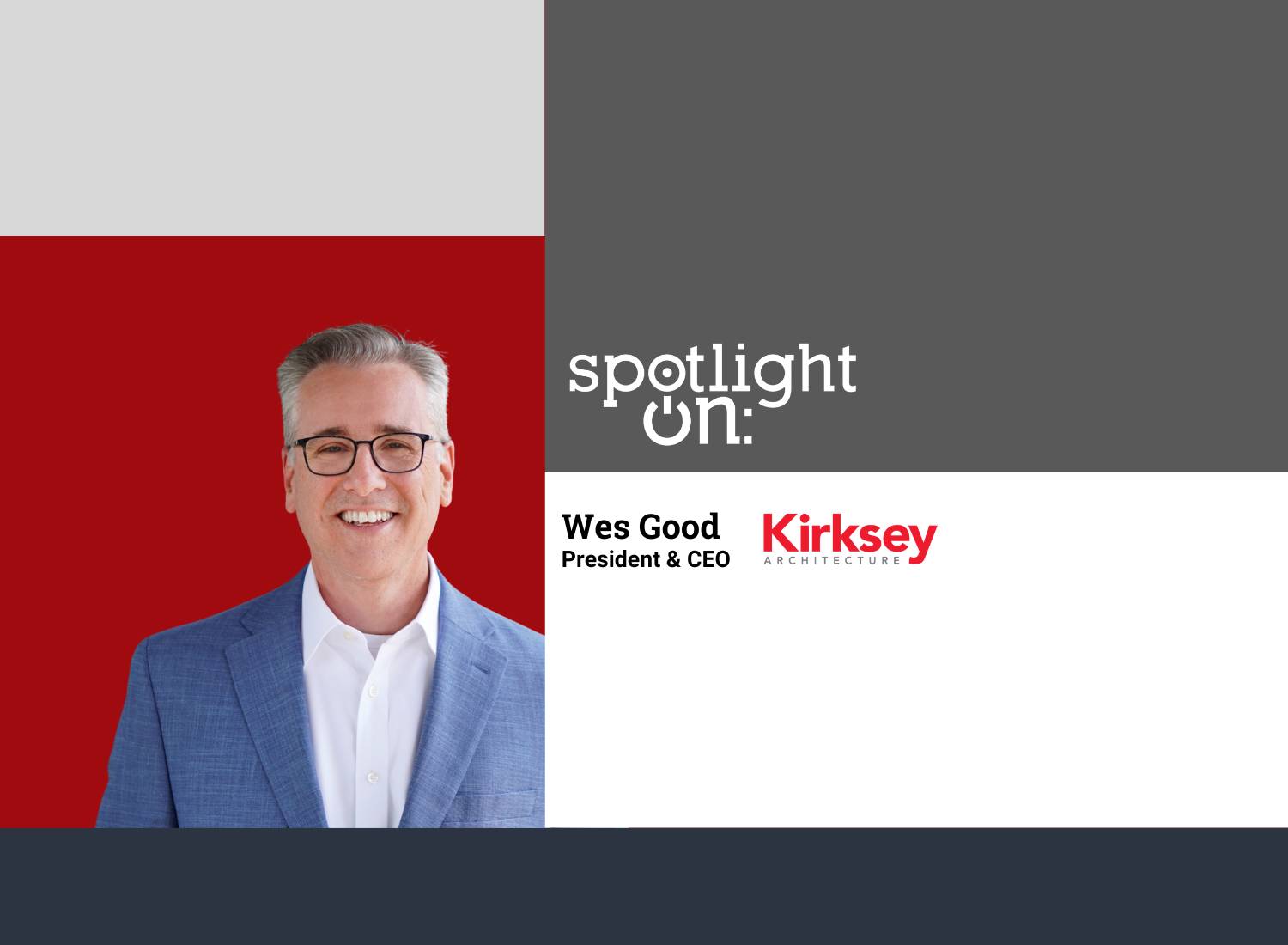 March 2026 — Invest: spoke with Wes Good, president and CEO of Kirksey Architecture, about how Houston’s built environment is evolving as the city adapts existing assets, rethinks workplace design, and balances growth with long-term sustainability. “We have a lot of infrastructure and a lot of great buildings that we’re just not going to tear down,” Good said.
What recent changes in the Houston market or economy have had the biggest impact on your firm’s work and your clients’ priorities?
What we have seen is a pullback in large corporate office buildings and major corporate relocations, alongside a clear increase in repurposing and repositioning existing properties. During earlier growth cycles, Houston added a significant volume of office product, and many end-users moved into newer facilities. That left several buildings partially occupied or vacant.
As a result, owners are looking at what those assets can become. We’ve taken office buildings and added worship space when a church purchased the property. We’re seeing hotels converted into mid- to lower-cost housing and early examples of office-to-residential conversions. We’ve also modernized older office buildings with full facelift programs so they can compete again.
We have a lot of infrastructure and a lot of great buildings that we’re just not going to tear down, so the work becomes reimagining them and putting them in a new position for today’s users. That shift toward adaptive reuse has already impacted our pipeline and will continue to shape the market.
Are you seeing demand shift toward certain project types that weren’t as prominent a few years ago?
Yes. Houston is still growing, and while the city is densifying in places, development keeps pushing outward. In those suburban growth corridors, we’re increasingly seeing mixed-use projects that used to be concentrated in more urban environments.
People are still flocking to experiences. Convenience retail will always exist, but more clients are pursuing walkable environments that combine dining, shopping, living, and office uses in closer proximity. At the same time, we’re seeing more civic and community-focused work: museums, community centers, churches, and other projects that serve the public in experiential ways.
Education remains a major need as well. With continued population growth, school districts and higher education institutions are working through bonds and planning processes to keep pace with demand.
You’ve said that office culture is shaped by both design and leadership. How are clients balancing those factors as they bring people back to the office?
There’s still a search for what makes someone leave the comfort of home and choose an office. Part of that is human interaction, but part of it is the workplace itself: the ability to support focus work, collaboration, and the day-to-day experience in a way that feels worth the commute.
The trend is not fun amenities. It’s more casual collaboration, intentional interactive spaces, and comfort and convenience that help people do their work better together. Many organizations are also realizing that fully remote work is not ideal for everyone, particularly in collaborative fields. Hybrid policies give employers flexibility, but the physical environment still matters if you want people to return consistently.
With construction costs remaining high, how are clients approaching timelines, budgets, and long-term investments?
We generally counsel clients that prices rarely move downward in a meaningful way unless the economy hits a downturn. So the conversation becomes: how do we get the most value from the dollars available?
Often, that means building more efficiently rather than simply building more. In workplaces, you don’t necessarily need a dedicated desk for every person. In education, you can plan shared spaces more effectively. The long-term challenge is not building so small that you can’t accommodate growth.
Where possible, we plan expansion into the concept, especially on greenfield sites. In leased office space, growth planning often becomes a lease strategy: options on adjacent space, right-of-first-refusal language, and operational approaches like adjusting hybrid schedules to manage headcount in the office.
What tells you that a project will be successful beyond aesthetics and initial delivery?
Success is strongest when a project addresses more than a single function. It’s not only about housing people or meeting a program requirement. It’s also about what happens at the ground level, pedestrian interaction, and whether the project enhances the neighborhood around it.
We look for impact beyond the borders of the site. Does it bring services and convenience closer to residents? Does it improve connectivity or the experience of a district in tangible and intangible ways? When the benefits bleed into the surrounding community, you tend to see lasting value.
How are energy performance and carbon targets influencing design decisions this year?
Not every client comes in with specific targets, and many are still figuring out what those targets should be. Carbon neutrality is ambitious, and even when it isn’t mandated, our role is to educate and show options.
We have in-house energy modeling, so we can demonstrate performance throughout design and connect those decisions to operational outcomes. From our perspective, sustainability is increasingly embedded in how we approach projects, even when clients simply start with the need for space and rely on us to be responsible stewards of the environment.
Mass timber is gaining attention in Houston. What’s driving that interest?
We delivered our first mass timber building roughly four years ago, and at the time, it was the largest academic collegiate mass timber building in the country. Early interest was driven by technology and speed of construction, which can materially affect schedule and cost.
As understanding has grown, the sustainability case has strengthened as well. With managed forests and regional supply improving in the South, mass timber can compete more effectively. And it’s a beautiful material when it’s used well and left exposed, creating warmth without a lot of added finishes.
Where are you seeing real value from AI tools in the design process?
Right now, the most practical gains are on the front end: generating options, improving visualization, and producing renderings and animations faster. We’re testing broader uses, including parts of documentation, but those applications depend on high-quality, well-organized information.
AI is only as good as what it can pull from, so we’re focused on strengthening internal data and standards so it can assemble reliable outputs. The pace is accelerating, and I expect capabilities to expand quickly.
What makes Houston the right place for Kirksey’s continued growth?
I’m a Houston homer. I’ve lived here since 1972, so I’m biased, but it’s a great business city. We don’t have the same tourism draw as some markets, yet we have economic diversity and depth: the medical center, research activity, emerging data center growth, industrial distribution, sports, and performing arts.
Houston also remains attractive from an affordability and opportunity standpoint. There are jobs across sectors, and the city continues to draw people and investment. Improving mobility and transit will be important as congestion grows, but the fundamentals that make Houston a place where people want to build careers are still strong.
How do nonprofit and community-focused projects fit into your overall strategy?
They’re a major part of our identity. We encourage our team to be involved in community activity and organizations, not to promote the firm, but to contribute.
Those relationships often lead to projects with outsized impact. Being part of organizations like the Houston Food Bank or Kids’ Meals, and seeing them scale the way they have, is rewarding at a different level. We’re invited into those opportunities because we’re visible and rooted in the community.
Looking ahead, what are your biggest goals for the firm?
We want more balance across our market sectors. Some areas will pull back, and we want to be positioned to backfill with work in other industries. We’re active in almost every market, and we’d like to see a consistent level throughout our portfolio.
We also want to continue to grow our Austin and Dallas offices, applying our experience and cross-sector capabilities to support those locations. And we want to keep building Houston thoughtfully.
Sustainability stays central, not only in how buildings perform, but in the stewardship of client resources. Doing the most for the least amount of money, while designing places that can endure, adapt, and improve over time, remains a core goal.
Want more? Read the Invest: Houston report.