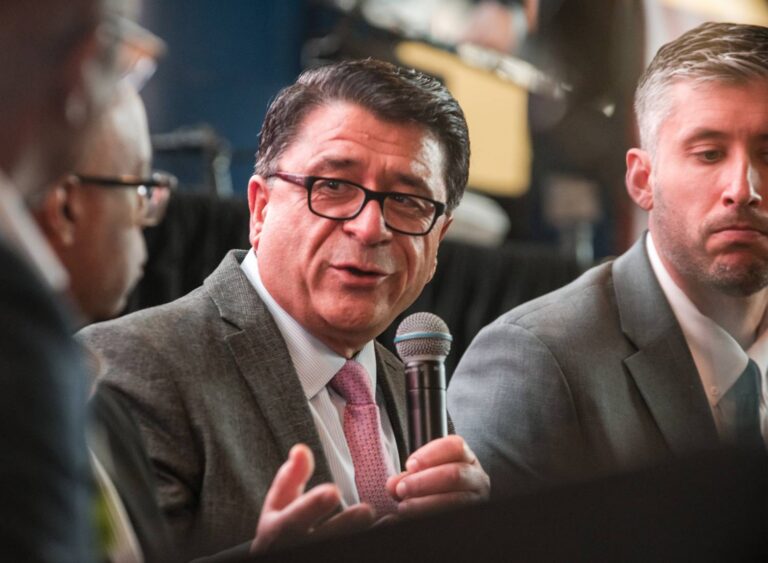







Steve Smith, Executive Vice President, Carolinas Division, McKenney’s, Inc.
In an interview with Invest:, Steve Smith, executive vice president of the Carolinas Division at McKenney’s, Inc., highlighted the dynamic growth in healthcare and data centers, alongside the steady rise in industrial construction, despite challenges in the commercial sector. Smith also shared a discerning perspective on the application of emerging technologies like AI in industries such as construction. “The key lesson from past technological shifts is not to take a polarized stance but to find a balanced approach. The construction industry, like many others, will benefit from finding ways to incorporate AI effectively, even if the optimal methods are still a few years away,” he said.
From your perspective, which industries are most active right now?
There is no question that healthcare is definitely active. We’re also starting to see a strong resurgence in data centers and high-tech construction, driven by AI and the digitized world. While there hasn’t been much data center construction in the local market recently, it’s picking up around Charlotte. We’re in discussions with clients about expanding their presence or locating new facilities.
Industrial construction, particularly manufacturing and pharmaceuticals, has been steady, with substantial growth in the last 12 to 24 months in South Carolina and parts of North Carolina. Commercial space is still down, with shuffling of tenant occupancy and interior movements, but major new construction remains constrained.
Public-private partnerships, including projects from county and municipal governments, are also seeing investment. This likely stems from remaining COVID funding being allocated to infrastructure and amenities like libraries and schools.
Are developers cautious about the near term or are there still good project opportunities?
In commercial construction, there will likely be more renovations, with tenants moving within existing spaces and buildings upgrading amenities to attract or retain tenants. For new developments, there is an appetite among developers who are not in the business of sitting on land or cash — they want to build.
However, with interest rates remaining higher than in the recent past and uncertainty in space utilization and vacancy rates, particularly in Charlotte, there’s a mix of realism and caution. Some developers are waiting because their cash investments are currently yielding good returns, and land isn’t losing value.
Despite this, I believe someone will eventually take the initiative, perhaps offering unique amenities and incentives to fill vacancies. Developers thrive on development which involves taking risks, and when the financials make sense, they will move forward with new projects.
Have you seen meaningful applications of AI in the industry, or is it still in the early stages?
AI’s application in construction is still in its infancy. There’s a clear potential, but we’re just beginning to explore how to leverage it effectively. Many companies, including ours, are experimenting with AI for backend analysis and predictive modeling. However, we’re still uncovering new possibilities.
The journey of technology adoption in construction mirrors other industries — from the rise of email in the 1990s to the transition to smartphones, and then cloud computing. Early adopters often pave the way, while latecomers can struggle to catch up. With AI, opinions vary widely, from viewing it as revolutionary to being wary of its implications.
The key lesson from past technological shifts is not to take a polarized stance but to find a balanced approach. As AI continues to develop, companies will need to integrate it alongside their existing technologies. The construction industry, like many others, will benefit from finding ways to incorporate AI effectively, even if the optimal methods are still a few years away.
How do you see economic challenges affecting the business environment in Charlotte?
There are significant headwinds related to interest rates, inflation, and overregulation. The government’s generous distribution of taxpayer money exacerbates these issues, leading to predictable and unpredictable outcomes. Historically, we’ve seen similar economic patterns, some of which correct very quickly with subtle changes to things like interest rates.
Currently, companies must pay higher wages due to rising costs. If they don’t, they risk negative media attention or losing employees to competitors. However, these wage increases and other costs are generally passed on to consumers, which just makes costs rise and keeps profit margins high and stock values stable or growing. Some companies are also using off-balance-sheet strategies such as subcontracting, outsourcing, renting versus owning to maintain their financial appearances.
Two optional follow-up questions as mentioned during the interview:
- Given the complex regulatory landscape in construction and infrastructure, how does the company strategize to ensure compliance while fostering innovation and growth across its operations in the Carolinas?
- Balancing between leveraging technology and human capital are important. To build things we have to use people matched up with appropriately technology, ranging from the technology of basic machines and tools that have been around for decades to the intricacies of software and specialized tools that are cutting edge deployments. While many facets of construction may one day be replaced or significantly augmented with technology such as 3D printing, AI generative design, etc, the criticality of personnel safety still requires the oversight and ultimate “approval” of the human hand or a person’s sign-off to satisfy many requirements. As the newer technologies continue to be tested and verified there will likely be countless new ways to leverage technology to supplement, augment or drive efficiency into the built environment.
- In light of the economic recovery trends you’ve observed, what are the key opportunities you see emerging for public-private partnerships in infrastructure projects across the Carolinas?
- The concept of public-private partnerships is not new. It’s been around for many years whether it was called P-P-P or not. The idea of an individual or firm providing substantial funding for projects inclusive of “in-kind” services for their specific scope of expertise is at its core a Public-Private partnership. When economic conditions are such that companies (developers, construction firms, etc) can do better financially in an open (competitive) market they have an obligation to their share holders and stake holders to do so. When market conditions dictate that helping to fund projects paired with government participation(funding) creates more economic opportunities for those same shareholders and stake holders, the market conditions lean more in that direction. My opinion is that the idea of public-private partnerships is a winning strategy for everybody, regardless of the market conditions. If government entities could recognize the efficiency gains, heightened quality, and overall collaborative construction environment that the private sector typically enjoys the tax payers and communities would benefit tremendously. But it requires trust in the partnerships, good benchmarking for cost validation, a shared fate outcome of the development/construction and putting the mindset of “low bid is always the right bid” in the past. It also requires that the private side of the transaction needs to see and recognize a fair return expectation that includes more than just the financial outcome and includes the social and communal value of their effort. All of these are real and tangible value propositions, it’s just that the economic conditions of a lot of public money, a lot of public building plans, constrained public construction management resources and the inverse on the private side are currently creating an environment likely more ripe for this. However the success and benefit could be realized in every market condition if there was regulatory and compliance common sense.