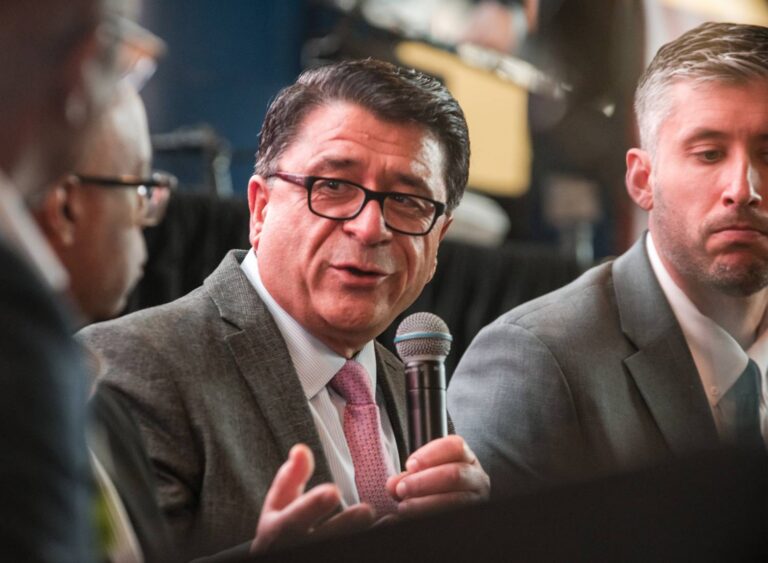







T.J. Bogdewic, President & CEO, Bridgeway Capital
 Access to capital remains crucial for people and businesses to move their missions forward. Creative solutions are key to meeting funding gaps in the face of economic headwinds, noted Bridgeway Capital President and CEO TJ Bogdewic. In an interview with Invest:, Bogdewic also highlighted efforts to help nonprofits and major trends impacting business in today’s economic landscape. “We need to invest in people, and in the businesses and resources that matter most to people,” Bogdewic added.
What major changes in the past year have most impacted your operations?
2025 marked Bridgeway Capital’s 35th anniversary and the conclusion of a five-year strategic plan. We also just launched a three-year strategic plan, so we’ve been giving a lot of thought to how we would like to evolve in the next three years. The groundwork for that evolution was put in place over this past year. Our previous five-year plan was a tremendous success. We easily exceeded our goal to lend $100 million into targeted investment communities across our region. Internally, we’ve also made strategic operational changes, including implementing new data analysis and IT enhancements to accomplish enhanced security and begin leveraging emerging technologies, such as AI. This will help us stay better informed and to become more efficient and productive and more responsive to our customers.
All of this has translated into a strong year for us despite ongoing high interest rates, which are increasingly difficult for the lending world. We find that when those things happen, the type of patient and flexible capital that Bridgeway offers as an alternative to traditional financial institutions is more in demand than it is in other periods. We are able to fill the gaps in the traditional financial markets to help keep growth in our region moving ahead.
What demand signals spurred the launch of investment services targeted toward nonprofits?
Our Nonprofit Rainy Day Loan was one recent product that was prompted by experience. Bridgeway Capital has been a lender to nonprofits for decades. Because of that, we noticed unexpected facility maintenance can be a persistent challenge. They buy a building, renovate it, they think they are in their forever home — and the elevator breaks, for example.
Nonprofit funding presents a challenge for this type of situation. For them, capital expenditures, like renovating or purchasing a building, tend to be unrelated to ongoing revenue from programs and grants. Usually, it requires a multiyear capital campaign to secure enough funds to invest in their own building, and it can be challenging to fundraise just to cover an emergency repair. With the Rainy Day Loan, we help them bridge this funding gap. When the roof springs a leak, instead of a cash crunch, they have access to emergency capital to cover the repairs.
This is where patient capital comes into play. Thanks to philanthropic support, we can offer nonprofits a solution with zero percent financing that exists explicitly for these types of situations. Instead of trying to figure out what they are going to cut, they have a backstop; it enables them to preserve liquidity. They have time to repay the loans and can avoid the stress caused by an immediate need. Instead, the nonprofits can focus on providing their essential services. It benefits the region. It is good for them, and it helps us fulfill our mission, too.
What changes in trends locally or nationally are you watching closely?
One factor we are monitoring is the increased cost of borrowing. Persistently high interest rates affect consumers and businesses alike. When the federal fund rates were close to zero, qualified borrowers could get mortgages under 3%. When that changed, it was a shock to the system; we had not seen interest rates spike since the Great Recession.
People were trying to make sense of how this change would affect their costs; it was as if they forgot that rates could rise. It took time for them to adapt, but I think they have now accepted the high-rate environment. The current rates have made borrowing from traditional financial institutions different than before. Our financing solutions help fill gaps that might exist in capital stacks for larger scale projects. For us, we transformed a challenge into an opportunity.
Another factor that may be hurting small business is the uncertainty around supply chain and costs of goods. The costs of imports are increasing and remain in a state of flux. Dealing with uncertainty is always a challenge for small businesses. Overall, we are optimistic. We are strong believers in the adaptability of business leaders and other professionals with whom we work to make it through uncertain times. To support their growth paths for the future, we’ve adapted too by launching new programs designed to help our clients navigate change.
What does attracting and retaining talent in today’s economic landscape entail?
Bridgeway is a social impact lender that provides financing and programmatic support to grow businesses and revitalize places. Because we are a mission-driven organization, that can be a real asset when attracting talent. Our work requires us to maintain strong relationships with the communities we serve — and when we hire from within those communities, it’s a win-win.
Because attracting and retaining talent is one of the biggest challenges for any business, we are focused on creating an environment that helps our human resources succeed. When we find talented people, many of whom come from the financial industry, we want to make sure they have the tools they need to adapt to a nonprofit institution. Our type of lending creates opportunities to have a real impact, not just in the communities we serve, but within the organization itself.
So, on the lending side, while it helps to find talent that understands how real estate finance works, how small-business lending works, and how complex capital structures for those real estate deals come together, it’s also critical that we create internal pathways for growth. Being a smaller institution than traditional banks, that journey will look different. Yet, if we can give our team the tools and training they need, paired with opportunity for them to realize how their unique skills truly benefit the people we serve, then both Bridgeway and our clients will thrive.
For us, this is the best path for attracting talent. It is a tough market. Unemployment is still low. By investing in talented, mission-driven people and by creating an attractive, functional teamwork environment, we can avoid turnover costs and transform jobs into meaningful careers.
What types of partnerships are most essential to drive your mission forward?
Partnerships are the essence of what we do. They are central to our ability to identify opportunities for investment and to attract the necessary capital in order to invest. Without partnerships — and the trust that those partnerships lead to — we can’t do our work.
Since our lending is geared toward areas that are underserved by traditional finance, it’s imperative that we have strong partnerships in the communities where we lend so that we can meet their needs. We have built an enormous network by building partnerships across our region of western Pennsylvania, eastern Ohio, and northern West Viriginia.
It’s a special space that we operate in. You see it in practice at our annual networking events. Our small business clients and creatives from our business accelerator cohorts are in conversation with our banking allies, nonprofit leaders, and grantmaking funders. Each of those partnerships is essential to how we build our reputation and do our work. Bridgeway Capital is a community connector.
What are your top priorities for the near term?
Our focus is clear: we are investing in our people and our systems. After our recent successes, it might seem like we should continue on the same path, but thanks to an incredible staff and leadership from our board, we have the support we need to pursue the next level of development.
We will continue to focus on lending and investments that strengthen communities over the long haul and that helps business grow. Bridgeway has set a ten-year horizon goal for our financing to mobilize $1 billion in total investment from additional public and private capital to support the people and places we serve.
By staying focused on our people — community partners and our internal talent — and by refining our systems, we can improve the quality of life for our communities. Our investments are in people and in the businesses and resources that matter most to them.