







Key points:
- • Infrastructure and development are aligning to support Atlanta’s growth ahead of global events like the World Cup.
- • Housing affordability and access near job centers are emerging as critical challenges.
- • Downtown is shifting toward mixed-use density, with mobility seen as a key constraint on future growth.
 April 2026 — Infrastructure and large-scale development are converging to reshape how Atlanta grows, both in preparation for global events and in defining the long-term future of its urban core. As investment accelerates across the region, public and private leaders are increasingly aligned around how to support growth while ensuring it remains accessible and economically sustainable.
Join us at caa’s upcoming leadership summits! These premier events bring together hundreds of public and private sector leaders to discuss the challenges and opportunities for businesses and investors. Find the next summit in a city near you!
“Atlanta is not a rookie city when it comes to hosting events,” said Michael Russel, CEO of H.J. Russell & Companies, during the Focus: Atlanta Leadership Summit in March. “From an infrastructure point of view, not just physical assets but public safety, technology, and transit, we are working to make sure the city is ready.”
That preparation is already influencing development decisions across the metro. With the FIFA World Cup approaching, infrastructure investments are being treated as long-term assets that will determine how residents and businesses move through the city.
At the airport, the region’s primary entry point, the focus has shifted toward filling specific gaps in how workers get around. Gerald McDowell, executive director of the ATL Airport Community Improvement Districts, pointed to microtransit as one example with the launch of Shift On Demand last year.
“Instead of waiting 30 to 40 minutes for a bus, you can request a ride through an app and get to your destination much faster,” McDowell said. “That is a life-changing solution.”
Since its launch, the pilot has already exceeded expectations, signaling that demand for flexible transit exists and that leaders must rethink how mobility systems support major employment centers.
The connection between transportation and access is also pushing housing conversations in a new direction. As job centers expand and workers travel farther to reach them, where people live relative to where they work is carrying more weight in development decisions across the metro.
“The average first-time homebuyer in Atlanta is now 40 years old,” said Booker Washington, founder and CEO of Techie Homes. “That changes how we think about affordability, access, and the path to building wealth through housing.”
For many developers and housing providers, those challenges are compounded by rising costs and regulatory constraints.
“There is a shortage of roughly 100,000 affordable units across the region,” said Larry Padilla, CEO of Decatur Housing. “At the same time, development costs continue to rise, making it harder to deliver housing that working families can actually afford.”
A broader mix of housing types, from micro homes to condos to single-family, is needed near employment hubs like the airport, where much of the workforce still rents and has few paths to building equity.
From global readiness to downtown transformation
These same pressures are redefining Atlanta’s urban core. What might look like preparation for global events are also decisions that will define the region for years to come, rethinking how downtown gets built, activated, and tied to the neighborhoods around it.
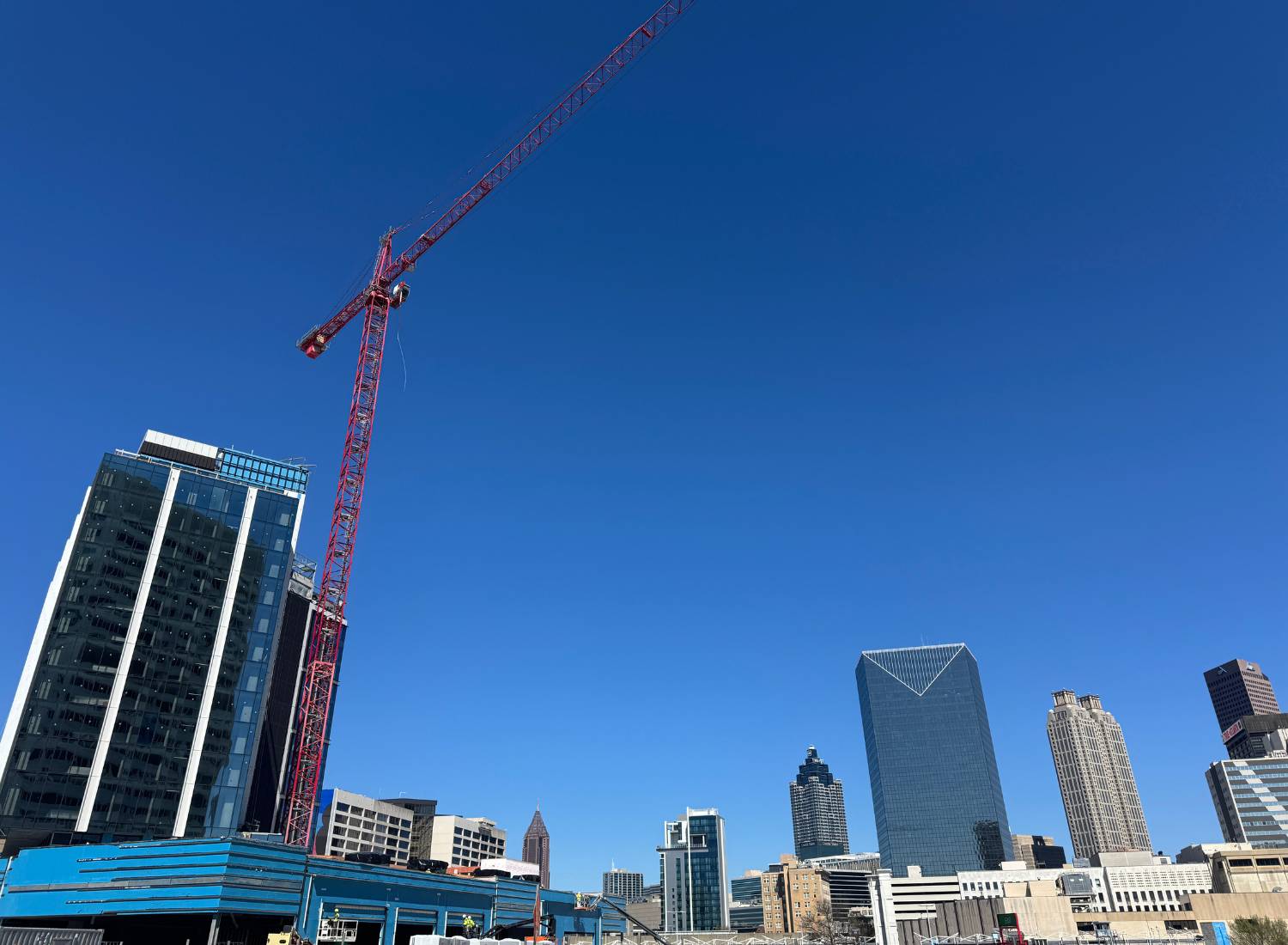
“You’re seeing construction cranes in downtown Atlanta again. That hadn’t happened in decades,” said Brian McGowan, CEO of Centennial Yards. “We’re moving from a place that was largely inactive outside of major events to one that is being built as a true mixed-use district.”
That shift is being driven in part by Centennial Yards, a $5 billion redevelopment transforming a long-underutilized stretch of downtown into a dense, mixed-use district. Early phases are already taking form. The Mitchell, a 300-plus-unit residential tower that opened in 2025, brought new density to an area previously dominated by surface parking, while ground-floor retail and restaurant space are beginning to activate the street level.
Across the street, Hotel Phoenix has opened close to Mercedes-Benz Stadium and State Farm Arena, adding nearly 300 rooms and a bar-driven hospitality concept to the district. The hotel, which hosted the Focus: Atlanta Leadership Summit, reflects a wider push to create destinations that draw people downtown outside of major events.
It’s part of a longer transition, as downtown Atlanta moves from an event-driven environment toward something closer to a functioning neighborhood.
That push toward activation is also visible at the street level, particularly in projects like Underground Atlanta. Shaneel Lalani, CEO of Lalani Ventures, said one of the biggest gaps in downtown has been the lack of a consistent residential base.
“What’s missing is people living downtown,” Lalani said. “Historically, people have come for events and then left.”
Lalani noted that Underground Atlanta alone has already drawn more than 2 million visitors over the past year, a signal of growing interest in the area. The next phase, he said, is converting that activity into a more permanent presence, supported by housing, retail, and everyday amenities.
Running parallel to it is continued investment along the Atlanta Beltline, which has become one of the city’s biggest economic drivers. Roughly $900 million in public investment has helped generate more than $9 billion in private development, according to Clyde Higgs, president and CEO of Atlanta Beltline.
“When you look at the return on public investment, it is significant,” Higgs said, pointing to the project’s role in driving job creation and new development.
Leaders were clear, though, that growth at this scale must be paired with deliberate thinking about who benefits. “It is not about balancing growth and affordability,” Higgs said. “If you approach affordability proactively, it actually fuels growth rather than constraining it.”
That view is gaining ground among both public agencies and private developers, especially across downtown and surrounding districts where several major projects are moving at once. Invest Atlanta is guiding more than $3 billion in potential development, spanning projects like the conversion of 2 Peachtree Street into residential units and the revitalization of Underground Atlanta, alongside the continued buildout of Centennial Yards. Together, they are expected to add thousands of residential units and hotel rooms to the urban core, much of it timed around the 2026 World Cup but designed to outlast it.
“What we see today is not going to be the downtown of the future,” said Eloisa Klementich, president and CEO of Invest Atlanta.
Pointing to a pipeline of projects already funded or underway, she emphasized that the scale of investment will change Atlanta over the coming years, bringing new housing, retail, and public space into areas that have historically lacked consistent activity.
“These are not projects sitting on a shelf,” Klementich said. “They are already moving forward and will change how downtown functions.”
Mobility as a lever for growth
As Atlanta looks toward 2030 and beyond, mobility stands as a potential constraint on regional growth. With Metro Atlanta expected to add close to 2 million residents over the next two decades, transportation systems will need to expand in both capacity and reach to keep pace.
“You cannot grow your economy if you cannot move people, goods, and information,” said McGowan. “Mobility is going to be a natural growth restrictor if we don’t address it.”
That challenge is already visible in how people move in and out of downtown, where much of the existing infrastructure was designed long before the scale of development now underway.
“The freeway system that connects downtown was built in the ’60s and ’70s,” McGowan said. “It wasn’t designed for the level of activity we’re adding today.”
No single fix will be enough. Higgs pointed to trails, transit, and regional coordination as pieces of a larger puzzle, arguing that connectivity between districts and access to alternative modes of transportation are just as important as expanding roads or adding capacity.
“The ability to move through the city is going to require more than one solution,” Higgs said.
Interested in reading the Focus: Atlanta report? Sign up today!
For complete conference panel discussions, tune in to our YouTube Channel.


 April 2026 — In an interview with Invest:, Heiko Dobrikow, executive vice president & general manager of


 April 2026 — Invest: spoke with David Barksdale, president and CEO of
 April 2026 — In an interview with Invest:, Allan Rasmussen, president and CEO of
 April 2026 — Invest:


 April 2026 — Invest: spoke with Ashley Loute, executive director of the