Spotlight On: David Barksdale, President & CEO, Piedmont Federal Bank
Key points:
- • Community banks compete through local relationships and reinvestment in their markets.
- • Housing affordability and rates continue to limit mortgage activity.
- • AI, fraud risk, and consolidation are shaping the industry’s future.
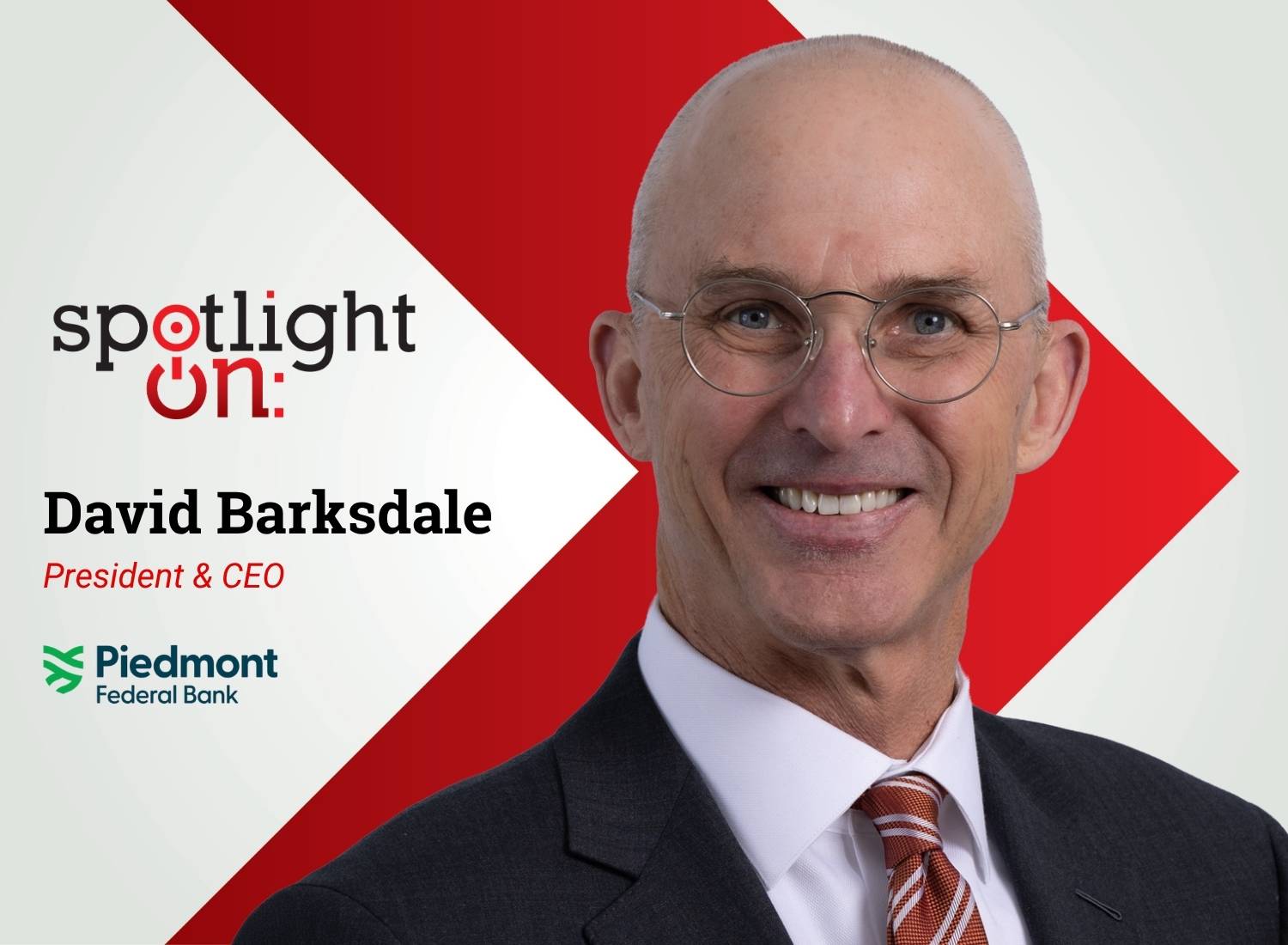 April 2026 — Invest: spoke with David Barksdale, president and CEO of Piedmont Federal Bank, about the outlook for community banking, the pressures shaping housing affordability, and the balance between innovation and relationship-driven service. “We gather deposits and provide financial solutions for small businesses, mid-sized businesses, and consumers. And then we turn around and lend that money back out into the community,” Barksdale said.
How would you describe the current economic environment for community banks, and what trends are shaping lending and investment activity in your market?
The opportunity for community banking is strong right now. Credit quality across the industry remains solid, and we have not yet seen major cracks emerge, even though cycles tell us that some kind of credit event will eventually come. In the meantime, community banks are well- positioned because many clients choose us for very specific reasons. They want to work with local decision-makers, and they want their bank to reinvest in the same communities where they live and do business.
That is especially true for us as a mutual bank. We are owned by our depositors, not by outside shareholders, so we are not sending dividends off to distant investors. We are using our resources to hire bankers, support local businesses, and serve our communities. That structure keeps us focused on the long term.
The regulatory environment is also becoming more favorable for banking, particularly for community banks. We know regulation is necessary, but there has to be common sense in how it is applied. A $1.3 billion bank should not be regulated the same way as a $1.3 trillion bank. When regulation is better tailored, it allows us to devote more resources to what we do best.
What do community banks do best in this environment?
At our core, community banks are deposit gatherers and lenders. We do not have large investment banking operations or major fee-income engines. Our job is straightforward but important. We gather deposits and provide financial solutions for small businesses, mid-sized businesses, and consumers. Then we turn around and lend that money back out into the community.
That mission still resonates. Business owners and families want a banker who understands their market and can make decisions with local knowledge. That is why I remain bullish on community banking.
One area we are watching closely is stablecoin. It has real potential as a payment tool, but if it becomes a stored-value instrument that pays interest, it could pull deposits away from community banks. That would matter because community banks depend on deposits to fund lending in the local economy.
What changes are you seeing in how businesses approach borrowing, expansion, and capital planning in today’s climate?
Small and mid-sized businesses are trying to combine two things that both matter today: speed and personal service. They want the convenience of technology, including automated payments and faster money movement, but they also want a trusted banker when something becomes more complex.
That is why relationship banking still matters. Technology is excellent when everything is working as designed, but businesses still want a real person when there is a problem, when fraud is suspected, or when a transaction is not straightforward. In our experience, most business owners want that banker to come to them, understand the business, and help solve the issue.
We are also seeing heightened concern around fraud. Faster payments create efficiency, but too much frictionless movement can create openings for fraudsters. A little friction can be a good thing when it helps protect the client.
Mortgage lending has long been one of your core services. What trends are you observing in housing demand and mortgage activity across the communities you serve?
Housing activity is still suppressed across much of North Carolina, including the Triangle, Charlotte, and the Triad. The first reason is supply. We simply do not have enough housing, especially at the entry level. What used to be a starter home at $150,000 or $200,000 is now often priced around $400,000 in markets like Winston-Salem. That is a hard number for first-time buyers to reach.
The second factor is changing consumer behavior. Younger generations are not always following the same path of graduating, getting married, buying a house, and settling into one place. Many are more mobile and more comfortable delaying homeownership.
Then there is the rate environment. Mortgage rates in the 6% range are historically reasonable to many of us who have been in the market for decades, but for younger buyers who became familiar with 3% rates, 6% feels dramatically different. That shift has kept many people on the sidelines. At the same time, many existing homeowners are holding onto low mortgage rates and do not want to move.
How are banks and local stakeholders working to address housing affordability and expand access to homeownership?
Affordable housing is a huge issue with a lot of moving parts, and there is no single solution. Banks are trying to identify the lanes where we can be most effective. For us, that includes supporting organizations such as Habitat for Humanity. It also includes participating in housing trust fund efforts that can provide bridge or gap financing for projects serving low- to moderate-income households.
Many banks also offer first-time homebuyer programs with lower down payment requirements and more flexible structures that can help people enter the market sooner. Credit counseling and down payment assistance are also critical. There are many would-be buyers who may have had setbacks in their credit history, and partnerships with cities, counties, and agencies can help them become mortgage-ready.
It is a multifaceted challenge, and community banks are working to determine where they can bring the most value.
Technology is changing the way community banks operate. How are you balancing innovation with strong customer relationships?
That is one of the biggest questions in banking today. Community banking has always innovated, but the challenge now is deciding how to invest in technology without losing the personal touch that defines the sector.
Branches still matter, even though they are being used differently. People are not coming in as often to make routine transactions, because most of that now happens on a phone. But they still come in for meaningful decisions, such as buying a first home, financing equipment, or deciding whether to lease or purchase a building. Those moments still require conversation and trust.
For smaller banks, the challenge is scale. Large banks can spend enormous sums on research and development and build their own tools. Community banks often rely more on core operating systems and partnerships with fintech firms. That can work well, but it requires careful judgment about timing, investment, and client needs.
How do partnerships with local organizations and community groups help strengthen economic opportunity and financial inclusion?
Partnerships are essential. Financial inclusion does not happen in isolation. If you use affordable housing as an example, real progress depends on banks, local governments, community groups, and other institutions all working together. Homeownership remains one of the main ways families build wealth and pass it to the next generation, so improving access has a direct connection to long-term economic mobility.
We also work through programs aimed at the unbanked and underbanked. One example is BankOn, which offers simple, lower-cost checking products designed for people who may not be comfortable with traditional banking. These products can help people avoid costly alternatives such as payday lenders and provide a more predictable pathway into the financial system.
Across the industry, banks often work collaboratively on these issues. It is not really about competition. It is about creating solutions that expand access and help more people participate in the economy in a healthy way.
Looking ahead, what trends do you believe will most shape the banking industry and local economies over the next several years?
Technology will continue to be the biggest force, and AI is going to be a game changer. It will not replace good employees, but employees who know how to use AI effectively will have a significant advantage over those who do not. Used properly, it can improve productivity and accuracy, which matters in every industry, including banking.
At the same time, banks have to be cautious. We handle sensitive client data, and any use of AI has to be done securely and responsibly. The other major trend will be continued consolidation. The number of banks has declined over time, and the pressure of technology costs and compliance costs will keep driving mergers and acquisitions.
Even so, I hope we maintain a banking system with room for large banks, mid-sized banks, and smaller community institutions. That mix is healthy for the economy and healthy for customers.
How do you see Piedmont Federal continuing to support economic growth and financial stability in the communities it serves?
Our entry into Raleigh-Durham through the partnership with Wake Forest Federal was a major step for us. It gave us a presence in one of the strongest markets in the Southeast, and it brought together a talented team of bankers with deep expertise in small-business banking and homebuilder finance.
That matters because housing and small business are major drivers of economic growth. In Raleigh-Durham, we are particularly well positioned to support homebuilders and to offer deposit and treasury solutions that help local businesses operate more effectively. We are not trying to be everything to everyone. We want to be good at the areas where community banking can make the greatest impact.
It is a great market, and we are fortunate to be part of it. Our responsibility now is to build on that opportunity by doing what we do best as a mutual community bank and continuing to invest in the people and businesses that make the region strong.
Want more? Read the Invest: Raleigh-Durham report.