Spotlight On: Robert Hoyt, Vice President, York Properties Inc.
Key points:
- York Properties is leveraging deep local roots and a full-service platform to navigate Wake County’s rapid growth and shifting office and retail demand.
- Amenity-driven, mixed-use environments are outperforming traditional office as tenants downsize footprints but pay premiums for walkable, experience-rich locations.
- Technology, data analytics, and disciplined cost management are becoming essential as construction costs rise and capital markets tighten.
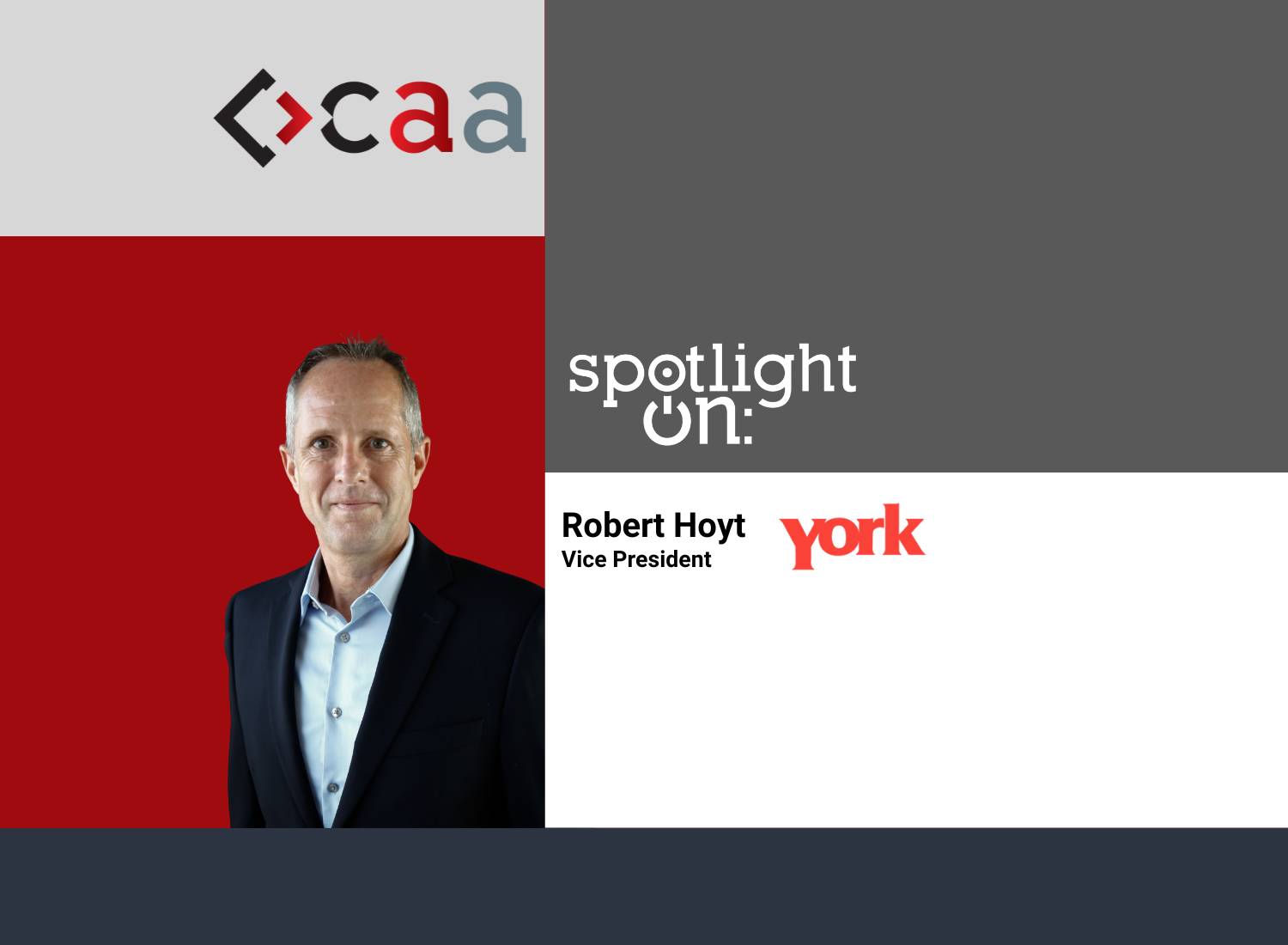 February 2026 — Invest: spoke with Robert Hoyt, vice president of York Properties Inc., about how one of Raleigh’s oldest full-service commercial real estate firms is navigating rapid market growth, shifting market dynamics, and rising demand for amenity-driven environments. He discussed the firm’s legacy, the evolution of office and retail, and the growing influence of technology. “With about 60 people per day moving into Wake County, we’re in one of the highest growth areas in the country. That brings opportunity as well as growing pains, but local leaders are managing the expansion thoughtfully. They are doing an excellent job of making this a place you want to be 10, 20, or even 100 years from now,” he shared.
Join us at caa’s upcoming leadership summits! These premier events bring together hundreds of public and private sector leaders to discuss the challenges and opportunities for businesses and investors. Find the next summit in a city near you!
From your perspective, what distinguishes York Properties from other commercial real estate firms in the market?
York Properties is a boutique, full-service commercial real estate company, and we’re probably the oldest one in Raleigh. The firm was established in 1910, so we have roughly 115 years of experience in this market. That long history gives us deep local knowledge and long-standing relationships that are difficult to replicate.
We’re also truly full-service. Beyond brokerage, we handle property management, association management, security, maintenance, construction, and landscaping. That level of integration lets us assist clients through the entire lifecycle of an asset. While many firms emphasize integrity, we make local knowledge, integrity, and a strong client-first mindset central to everything we do.
How do you balance innovation with tradition across a 115-year-old organization?
Most of my work focuses on brokerage, while the York family selectively acquires and develops properties. Our longevity brings a strong sense of tradition, but we pair it with the need to stay current. Today, that includes actively integrating emerging tools, including AI, into our processes.
We use AI to support client service, analyze data, and improve internal workflows. More broadly, we regularly reassess how we operate. Even with a long history behind us, we work to ensure we’re not relying solely on past success and are instead adapting to how the industry continues to evolve.
What recent trends in commercial real estate have had the greatest influence on your decision-making?
The most significant trend is the high volume of office vacancies. I used to specialize in tenant representation in the office market, and the shift toward hybrid and remote work has reshaped demand. As leases renew, many tenants are reducing their footprints by 50% or more. That shift has major implications for landlords, developers, and the brokerage community.
We’re also seeing a move from what used to be “flight to quality” toward “flight to amenities.” Projects like Fenton in Cary, American Tobacco in Durham, Ironworks and North Hills in Raleigh offer environments where people can work, grab lunch, meet clients, and enjoy a range of amenities in a compact walkable area. Tenants are willing to pay a premium for that. Suburban full-service office rents might be in the mid-to-upper $30s per square foot, while these amenitized projects can approach $50 per square foot.
Meanwhile, Wake County continues to grow rapidly, with about 60 people per day moving into the area. That population growth, combined with limited new retail projects being delivered due to the high interest rate environment, has made the retail market extremely tight. For retail tenants, securing space has become significantly more challenging, and much of that demand is directly tied to population growth and tenants competing for limited space.
What are some of the most important challenges facing the regional commercial real estate industry, and how is York Properties addressing them?
Construction costs are one of the biggest challenges. Whether you’re a landlord or a tenant, construction costs play a major role in whether a deal pencils out, and inflation and tariff pressures have pushed those costs higher. That makes it more difficult to align project budgets with what tenants can afford.
We work closely with general contractors to ensure they are bidding out to as many subcontractors as possible. Creating competitive pressure helps keep costs in check while still allowing contractors to earn a fair profit.
Another major challenge is the capital markets. Interest rates have risen substantially, making it difficult to secure financing for new development. Over the past several years, Raleigh rezoned multiple properties for 40-story development, yet many of those are on hold because capital isn’t available at acceptable terms.
Beyond brokerage, which parts of the business are experiencing the most growth, and how does your full-service platform support stability?
Brokerage is more cyclical and moves with the economy, but our other divisions — property management, association management, security, maintenance, construction, and landscaping — are more stable and offer recurring revenue. That diversification is a major advantage during economic fluctuations.
Recently, our property management division has seen tremendous growth. They’ve secured a substantial amount of new business, and that benefits both the company and the clients we serve. Strong property management also supports our acquisition and leasing efforts. When you can bring in a proven management team, it boosts tenant satisfaction, retention, and overall confidence in a building’s operations.
Mixed-use developments are becoming increasingly prominent. How do you view their future, and how is York Properties positioned in that space?
York Properties played an early role in shaping mixed-use development in our market. Our office is located in the Village District — formerly Cameron Village — which was developed in the late 1950s as an open-air shopping center with some office space integrated into it. Over time, multifamily and, most recently, a hospitality component were added. Today, it represents the kind of compact, highly amenitized environment that many mixed-use projects strive for.
York developed the project many years ago and later sold it, and it has changed ownership multiple times. While we’re not currently leading large mixed-use developments ourselves, we remain engaged with the major mixed-use environments defining the region, such as Fenton, Ironworks, North Hills, and American Tobacco. We track their lease-ups, absorption, and tenant activity closely and work with clients interested in being part of those ecosystems.
Are there any upcoming projects you’re excited about, and what impact could they have on the community?
The York family is working on several confidential initiatives, including land leases and other potential mixed-use developments that we can’t discuss publicly yet. When those projects move forward, they create opportunities not only in development but across our full-service platform — property management, security, landscaping, construction, and maintenance. A single project can generate activity across multiple business lines and contribute to the broader commercial ecosystem.
Separately, I’m working on several tenant representation assignments where clients are entering new spaces. These are tied more to my brokerage practice than to York Properties as a whole, but they reflect the ongoing growth and diversification happening across the region.
How do you balance profitability with creating and managing spaces that support community, culture, and creativity?
There’s a limit to how far you can go with amenities before costs rise to a point where a project is no longer competitive. Tenants ultimately have to support those expenses through their operating budgets.
For us, it comes down to understanding exactly what clients want and what they can reasonably absorb. From there, it’s about designing the right mix of amenities for each project — enough to create an attractive and functional environment, but not so many that costs push it out of the market. Every project requires its own balance.
Is York Properties pursuing any partnerships with local governments or organizations?
Several of our leaders are engaged in public-private partnerships by serving on local boards and advisory committees, and we remain closely connected to local leaders. Our chairman, Smedes York, is a former mayor of Raleigh, and the company has a strong history of civic involvement. Smedes also serves on numerous boards and advisory committees. If I listed his extensive civic engagement, past and present, it would take a whole page. Our CEO, George York, is also actively engaged in numerous community-based organizations. York has a long history of charitable contributions in this market, and we quietly support organizations that help those in need in our community.
We track local elections and pay attention to which leaders share our vision for planned and sustainable growth. We like to stay aligned with municipal priorities and support efforts that contribute to responsible, long-term development. Personally, I represent York Properties as a board member of the West Raleigh Alliance, where I also serve on the Executive Committee, and I’m a co-chair of the Economic Development Committee. The West Raleigh Alliance’s mission is to coordinate thoughtful public and private investment that adds value to the existing stakeholders and community.
What role will technology and data analytics play in the future of property management and development?
Data analytics is becoming essential across the industry. On the development side, understanding construction costs, cost of capital, and the internal costs associated with navigating municipal processes is critical. Without that data, projects can run into overruns and become infeasible.
Once a project is built, data remains important. We’re exploring technologies that use AI and drones to collect and organize building information. One example is a service that uses drones to photograph and catalog HVAC units on retail properties. The data integrates directly with lease terms, making it easy to determine responsibilities and respond quickly when issues arise. Much of that process can occur with minimal human effort.
We’re pursuing these tools to make decision-making more accurate, operations more efficient, and outcomes more favorable for our clients.
Looking ahead, how would you describe the long-term outlook for Wake County and the region you serve?
With about 60 people per day moving into Wake County, we’re in a high-growth area. That brings opportunity as well as growing pains, but local leaders are managing the expansion thoughtfully. They are doing an excellent job of making this a place you want to be 10, 20, or even 100 years from now.
Want more? Read the Invest: Raleigh-Durham report.