
New Jersey business news today signals trade shift
Key points:
- • Port of NY/NJ container volumes fell 1.9% year to date through May 2026.
- • Monthly TEU swings ranged from +6.9% to -15.7%, an unusually volatile pattern.
- • On-dock rail lifts held essentially flat, signaling steadier inland demand.
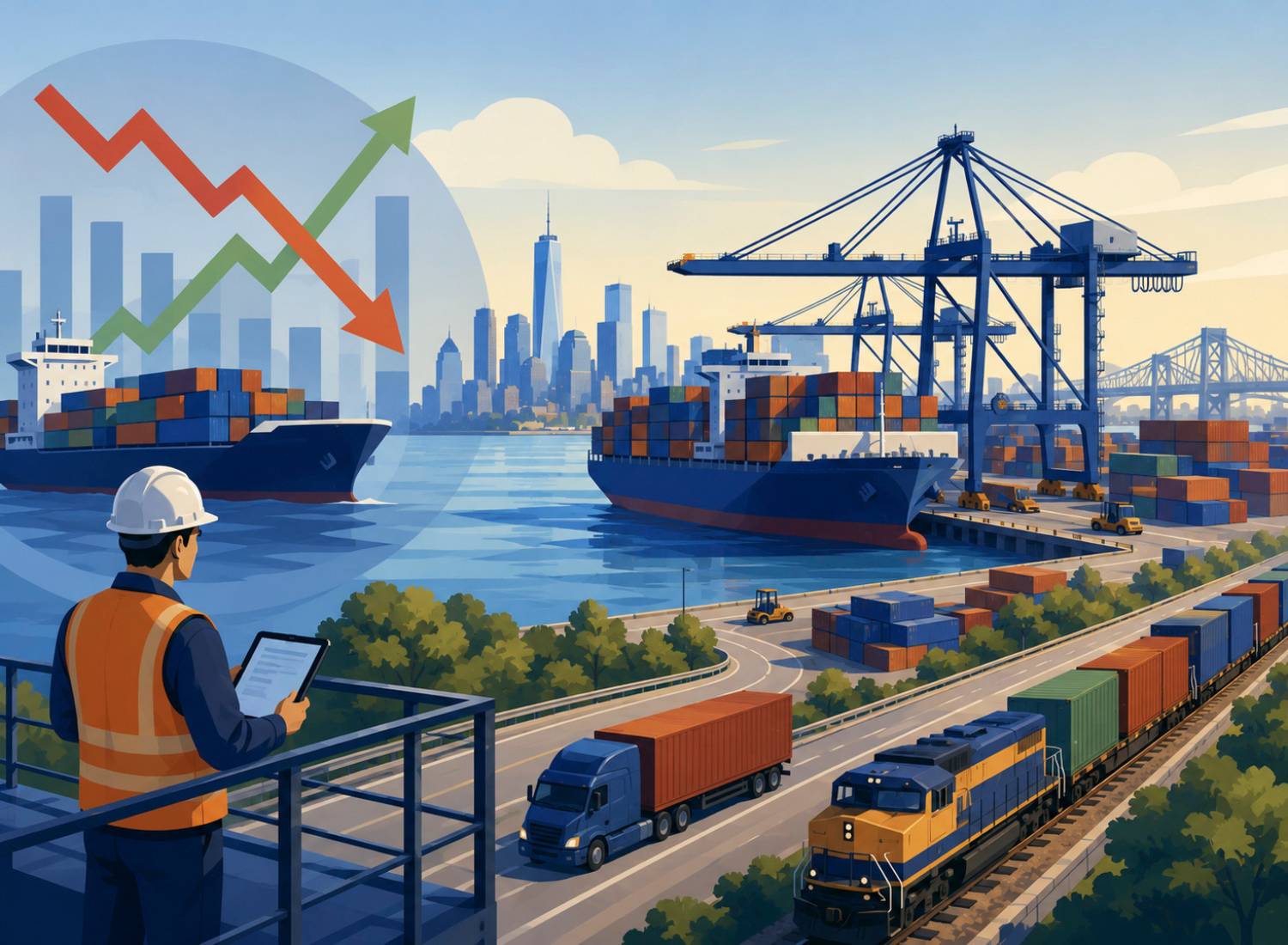 July 2026 — Container volumes moving through the Port of New York and New Jersey slipped in the first five months of 2026, topping New Jersey business news today as it snapped a nearly two-year run of growth.
Join us at caa’s upcoming leadership summits! These premier events bring together hundreds of public and private sector leaders to discuss the challenges and opportunities for businesses and investors. Find the next summit in a city near you!
The Port Authority of New York and New Jersey’s own monthly cargo report shows 3,657,737 loaded and empty TEUs crossed the docks at all of the port’s marine terminals between January and May, down 1.9% from the 3,729,611 TEUs handled over the same five months of 2025. For the busiest container complex on the East Coast, even a modest pullback carries outsized weight for the region’s warehouse, trucking, and rail networks, and it is quickly becoming the story defining New Jersey business news today for logistics executives across the state.
A choppy first half
The year-to-date decline masks a far more volatile month-to-month pattern, and that volatility is arguably the more important story for anyone tracking New Jersey business news today. According to the same Port Authority of New York and New Jersey monthly cargo data, monthly container volumes swung from a 4.0% gain in January to a 15.7% drop in February, then rebounded 6.9% in March before falling again 8.4% in April and edging back up 2.2% in May. That kind of whiplash is not typical for a port this size, which historically moves in gentler, more predictable seasonal waves tied to retail restocking and manufacturing cycles.
The details inside the topline number point to where the softness is concentrated. Loaded import TEUs fell 2.4% year to date, to 1,840,605, while loaded export TEUs actually rose 0.8%, to 597,353. Empty export containers, however, dropped 2.6%, to 1,211,364 — a sign that fewer containers are being repositioned overseas for reloading, consistent with importers pulling back on new orders rather than exporters losing customers. Read together, the numbers describe a port absorbing a demand-side shock on the inbound side of the ledger, even as outbound freight holds closer to steady.
That pattern lines up with the broader national picture this year, as shippers have spent 2026 recalibrating order timing around shifting tariff schedules and renegotiated trade terms rather than underlying consumer demand. Ports up and down the East and Gulf coasts have reported similar front-loading-then-pullback cycles, but the scale of New Jersey’s swings stands out because of how much of the region’s industrial economy — from the New Jersey Turnpike’s warehouse corridor to Class I rail yards in Kearny and South Jersey — is built around predictable, high-volume ocean flows. When the port sneezes, the logistics economy downstream feels it within weeks, not months.
Rail lifts hold firm
One figure in the same Port Authority report tempers the headline: on-dock rail lifts, the volume of containers moved directly onto trains rather than trucks, were essentially flat year to date at 284,184, down from 284,296 a year earlier — effectively unchanged. That stability, even as ocean TEU volumes fell nearly 2%, suggests the port’s inland intermodal network and the industrial real estate built around it have so far absorbed the swings better than the waterside terminals themselves. Rail throughput tends to track more closely with warehouse leasing activity and inland distribution demand than raw container counts do.
For New Jersey’s logistics sector, which has built its identity on the port’s decade-long expansion, the current numbers are a signal that the market has entered a more unsettled phase. Warehouse operators, trucking fleets, and rail yards across Newark, Elizabeth, Jersey City, and the Turnpike corridor have grown accustomed to planning around steady increases in cargo. A year where volumes rise 4% one month and fall nearly 16% the next demands a different kind of operational planning, with more flexible labor scheduling, tighter inventory-to-demand matching and closer coordination between ocean carriers and inland rail partners.
Looking ahead, the second half of 2026 will be the real test of whether this volatility settles into a new, lower-growth normal or reverts toward the port’s prior trajectory. Executives and investors watching the market should track the Port Authority’s monthly releases closely for the June and July figures, which will show whether the swings of the first five months were a temporary reaction to tariff timing or the start of a longer repositioning of trade flows away from the port. Warehouse landlords should also watch whether rail-lift stability continues even if ocean volumes soften further, since that split has become the clearest early indicator of where the region’s logistics real estate demand is actually headed.
Want more? Read the Invest: New Jersey report.