Pittsburgh business news: AI companies choose AI Avenue
Key points:
- • Jacobian and Mine Vision Systems are opening headquarters along Pittsburgh’s AI Avenue corridor.
- • Mine Vision Systems is relocating its headquarters to Larimer.
- • AI Avenue runs along Penn Avenue between Bakery Square and East Liberty.
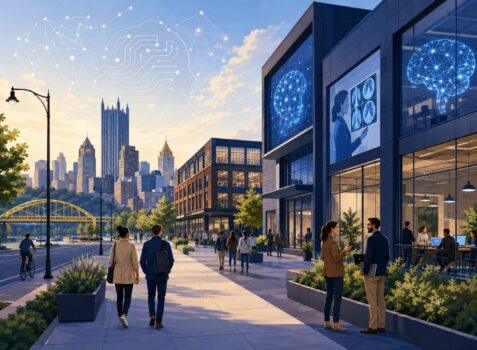 September 2026 — Two blocks of Penn Avenue in Pittsburgh‘s Larimer neighborhood are quietly becoming ground zero for the region’s next economic chapter. Today’s Pittsburgh business news centers on AI Avenue, the roughly half-mile corridor stretching between Bakery Square and East Liberty and already anchored by Google and Duolingo, where two more companies have just signed on to open headquarters.
Join us at caa’s upcoming leadership summits! These premier events bring together hundreds of public and private sector leaders to discuss the challenges and opportunities for businesses and investors. Find the next summit in a city near you!
Jacobian, an AI-powered imaging platform built for radiologists, and Mine Vision Systems, an AI company founded out of Carnegie Mellon University’s National Robotics Engineering Center, are the newest additions to a corridor that local boosters are positioning as the city’s answer to Silicon Valley’s innovation districts — except built on top of a steel-and-rail economy rather than a tech one.
The two arrivals illustrate different sides of the same pitch, according to Axios Pittsburgh.
Jacobian’s decision to headquarter in Pittsburgh leans on the city’s medical infrastructure: CEO Michael Finke pointed to “Pittsburgh’s world-class technical talent and strong intersection between healthcare, life sciences and tech” as the deciding factor, a nod to the region’s hospital systems and university medical programs alongside Carnegie Mellon’s computer science strength.
Mine Vision Systems’ CEO Mike Smocer cited “Pittsburgh’s unique combination of robotics expertise, engineering talent” drawn largely from Carnegie Mellon’s decades-old robotics program.
The move by the two firms also suggests confidence in the region’s talent pipeline.
Appeal based on proximity
AI Strike Team CEO Joanna Doven, whose organization created the AI Avenue branding to concentrate artificial intelligence companies for collaborative growth, framed the corridor’s appeal around proximity rather than incentives. “On AI Avenue, companies transforming health care, defense, energy, and manufacturing aren’t just co-existing — they are collaborating,” Doven said, describing a model where firms working on disparate applications of the same underlying technology benefit from being a short walk apart. That framing matters because it distinguishes Pittsburgh’s approach from cities that have tried to attract tech investment purely through tax abatements: the pitch here is concentrated talent and cross-pollination, assets that are harder for competing metros to replicate quickly.
The timing fits a broader pattern playing out across the country. As AI investment has surged nationally, the biggest coastal hubs — the Bay Area, Boston, New York — have absorbed much of the venture capital, but they have also become expensive and talent-constrained, pushing companies to look at secondary markets with strong technical universities and lower costs.
Pittsburgh has spent the better part of a decade positioning itself for exactly this moment, rebuilding its economy around robotics and machine learning research that traces back to Carnegie Mellon’s founding of one of the country’s first robotics institutes. Google’s and Duolingo’s presence on the same corridor gave AI Avenue credibility before this latest round of arrivals, and each additional headquarters makes the pitch to the next company easier, a flywheel effect regional economic development officials are counting on to compound over time.
What’s next?
What happens next will test whether that flywheel is real or aspirational. Jacobian and Mine Vision Systems now have to prove out their Pittsburgh operations, hiring locally rather than importing talent wholesale, a distinction that will determine whether the city’s universities see a real return in graduate retention. Local officials will also be watching whether other AI companies, particularly ones in adjacent fields like defense technology and energy, follow Mine Vision Systems’ example and treat Pittsburgh as a legitimate alternative to a coastal headquarters.
For a city whose economic identity was built and then hollowed out by a single industry, the emergence of a genuine cluster of artificial intelligence employers — rather than a handful of scattered offices — would mark a meaningful step toward diversifying its business base for decades to come.
Whether AI Avenue’s next chapter includes more headquarters relocations, additional venture investment, or simply steady hiring growth from its current tenants will be the clearest indicator of how durable Pittsburgh’s AI ambitions really are.
Want more? Read the Invest: Pittsburgh report.